
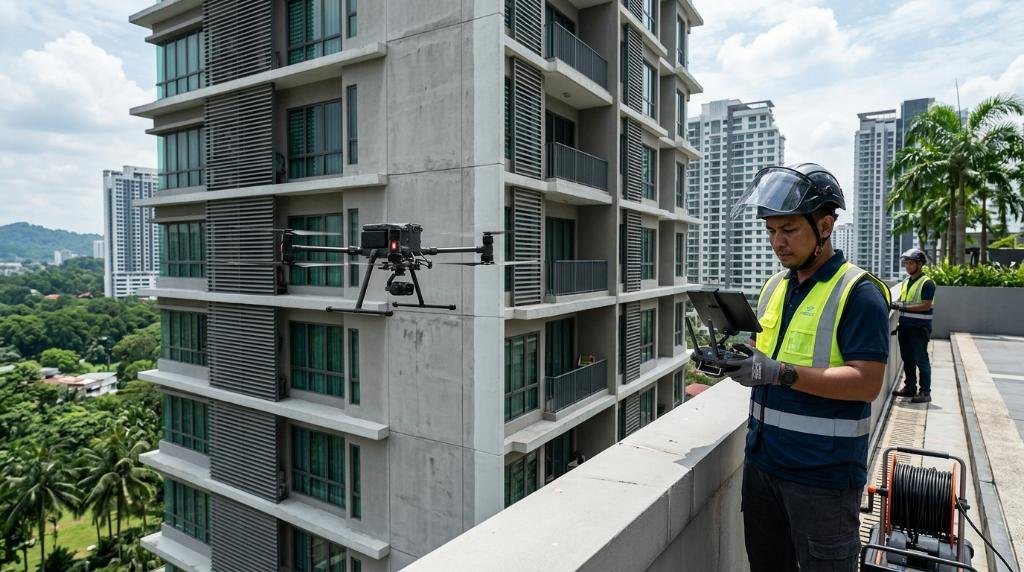
KUALA LUMPUR, July 7, 2026 — By Ir Vimal, Professional Engineer
Managing a high-rise building in Malaysia’s tropical climate is a relentless battle against intense UV radiation, thermal shock, and torrential monsoon rains. When building defects appear—be it delaminating façade tiles or dampness on the top-floor ceiling—Joint Management Bodies (JMBs) and Management Corporations (MCs) face a harsh financial dilemma. The traditional route of erecting scaffolding for a simple visual check drains resources and delays vital remedial work.
As a practicing engineer in Malaysia, I have witnessed first-hand how inefficient building diagnostics can deplete a property’s financial reserves. This is where modern non-destructive testing (NDT), specifically a professional drone roof inspection, completely changes the paradigm. By integrating aerospace technology with structural engineering protocols, we can now assess towering structures faster, safer, and far more economically.
The Hidden Costs of Conventional Building Inspections
Historically, conducting a building condition assessment on a 30-storey condominium or commercial tower required scaffolding, mechanized gondolas (BMU), or industrial rope access (IRATA). While these methods are valid, they come with astronomical setup costs and stringent logistical hurdles.
Working at height in Malaysia requires strict adherence to the Department of Occupational Safety and Health (DOSH) and the Construction Industry Development Board (CIDB) regulations [1]. Securing permits, ensuring structural load capacities for gondola counterweights, and mitigating risks to pedestrians below can delay an inspection by weeks. Furthermore, the daily rental rates for access equipment consume budget that should ideally be spent on actual repairs.

How Drones Revolutionize Sinking Fund Management
In light of recent reviews by the Housing and Local Government Ministry (KPKT) to amend the Strata Management Act 2013 (Act 757) [1], there is an increasing mandate for JMBs and MCs to adopt digitally based, responsive systems to prevent the depletion of building maintenance funds. Effective sinking fund management is no longer just about collecting dues; it is about predictive, cost-efficient expenditure.
By opting for a drone roof inspection, strata committees can drastically reduce preliminary assessment expenses. The drone inspection cost is typically 40% to 60% lower than traditional access methods. A drone can map an entire high-rise façade and roof in a matter of hours, providing high-resolution data and 3D photogrammetry. This allows property managers navigating strata management Malaysia regulations to allocate their sinking funds exclusively toward targeted repairs, such as PU injection or localized waterproofing, rather than wasting capital on access equipment.
Diagnosing a Commercial Roof Leak with Precision
A commercial roof leak in a reinforced concrete (RC) flat roof is rarely straightforward. By the time water stains appear on the ceiling of a penthouse or a top-floor office, the water ingress has likely already compromised the waterproofing membrane, saturated the screed, and initiated rebar corrosion within the slab.
In Malaysian engineering practice, we often encounter structural degradation—such as concrete spalling—caused by delayed leak detection. Visual inspections alone are insufficient. We utilize advanced drone payloads featuring FLIR (Forward Looking Infrared) thermography. Following principles aligned with BS EN 13187 (Thermal performance of buildings), our drones detect minute temperature differentials on the roof’s surface during the evening cooling cycle.
Trapped moisture retains heat longer than dry concrete. The thermal drone captures these anomalies, allowing us to help locate the likely origin of the commercial roof leak beneath the membrane. This targeted diagnosis means contractors don’t have to rip and replace the entire roof, saving tens of thousands of Ringgit.

Compliance: CIDB, Strata Management Malaysia, and MS EN Standards
A common misconception is that a drone inspection is merely “taking aerial photos.” At Pro Inspect Solution, our approach is deeply rooted in forensic engineering. The data acquired during a drone façade and roof inspection is analyzed by qualified engineers to ensure compliance with Malaysian Standards (MS) and international codes (BS EN).
Recent high-profile building safety incidents in the Klang Valley serve as a harsh reminder that building maintenance quality is a matter of life and safety. By conducting regular, drone-assisted building condition assessments, property owners fulfill their statutory duty of care under Act 757 [1]. We provide comprehensive, court-ready engineering reports detailing defect severity, root cause analysis, and localized rectification methodologies (e.g., specifying the correct MS EN 1504 compliant repair mortars for spalled concrete).
Future-Proof Your High-Rise Today
Embracing drone technology for building diagnostics is the smartest financial decision a Malaysian property owner or strata committee can make today. It cuts down the drone inspection cost overhead, provides unparalleled diagnostic accuracy for issues like a hidden commercial roof leak, and ultimately protects your long-term sinking fund management strategies.
Don’t wait for minor hairline cracks to become major structural failures. Trust the engineering experts to give you a clear, data-driven picture of your building’s health.
Ready to Save on High-Rise Maintenance?
Contact Pro Inspect Solution for a professional, engineer-led Drone Façade & Roof Inspection.
Frequently Asked Questions
How much does a drone inspection cost in Malaysia?
A drone inspection cost in Malaysia varies based on the building’s size and the payloads used (e.g., thermal vs. visual). However, it generally costs 40% to 60% less than conventional methods since it completely eliminates the need for expensive scaffolding, gondola rentals, and prolonged DOSH/CIDB permitting processes.
Can a drone roof inspection detect a hidden commercial roof leak?
Absolutely. By utilizing thermal imaging payloads (compliant with BS EN 13187), drones can detect temperature differentials beneath the waterproofing membrane. This helps structural engineers identify likely areas of trapped moisture and resolve a commercial roof leak before it causes severe concrete spalling.
How does this benefit sinking fund management and strata management in Malaysia?
Under the Strata Management Act 2013, JMBs and MCs have a fiduciary duty to maintain the building safely. Drone inspections provide highly accurate, actionable engineering data at a fraction of the time and cost, optimizing sinking fund management and ensuring compliance with strata management Malaysia guidelines.
