
By Ir Vimal | July 14, 2026
Unmasking Contractor Negligence: Beyond Visual Inspections
When roofing failures occur, contractors frequently hide behind the excuse of “unprecedented weather” or claim that the waterproofing membrane passed its initial visual inspection. However, compliance with local and international standards, such as the Malaysian Standards (MS) for waterproofing and British Standards (BS EN 13707) for reinforced bitumen sheets, is regularly compromised on site to save costs.
Common forms of negligence we uncover include:
- Insufficient overlapping of waterproofing membranes.
- Improper detailing at parapet walls, upstands, and plinths.
- Failure to conduct proper ponding tests before laying the screed.
- Substandard concrete compaction leading to early-stage honeycombing.
Traditional manual inspections are flawed. Human inspectors cannot see trapped moisture beneath a concrete slab, nor can they safely access every fragile corner of a high-rise commercial roof. If you rely on a contractor’s own visual sign-off, you are accepting a massive financial risk, a sentiment frequently echoed in tribunal cases covered by The Star regarding strata management disputes.
How a Commercial Roof Inspection Drone Changes the Game
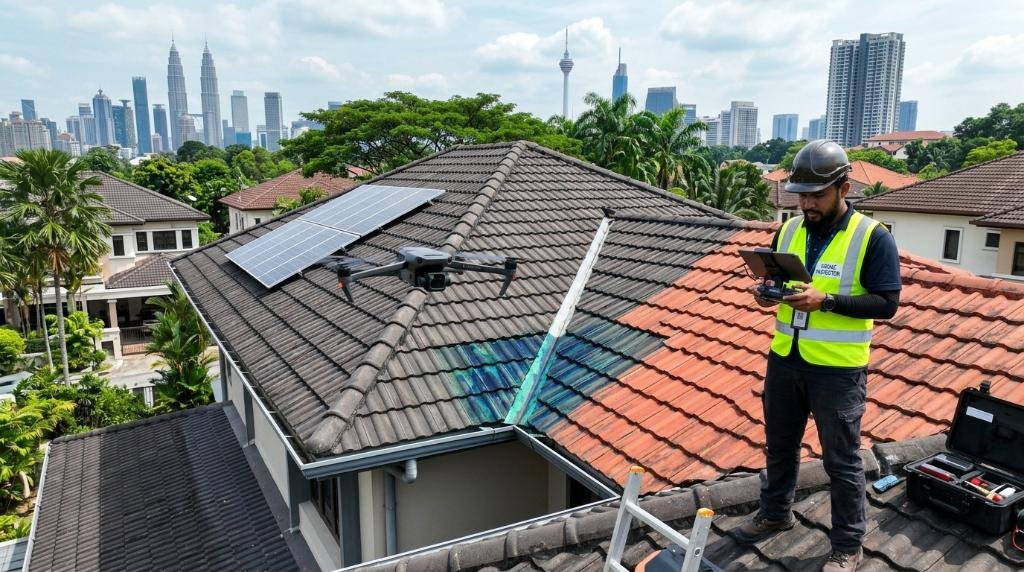
To definitively prove poor workmanship, you need irrefutable, empirical data. This is where deploying a commercial roof inspection drone transforms the landscape of facilities management and defect resolution.

A drone inspection is not just about taking aerial photographs. Modern Unmanned Aerial Vehicles (UAVs) equipped with RTK (Real-Time Kinematic) positioning and multi-spectral sensors provide a millimeter-accurate digital twin of your roof. By conducting a façade and roof inspection via drone, engineers can bypass the physical limitations and blind spots of manual surveys.
We leverage drones to comprehensively map out concrete spalling, membrane blistering, and flashing failures. This approach provides a mathematically precise overview of the roof’s condition, giving property owners the hard evidence required by the Construction Industry Development Board (CIDB) when filing complaints about QLASSIC standard violations.
The Science: Thermal Imaging Roof Leaks
The true “insider secret” to exposing hidden negligence lies in thermography. Identifying thermal imaging roof leaks is an advanced non-destructive testing (NDT) method that operates on the principle of thermal capacitance.
Here is how it works under the Malaysian sun:
- Solar Loading: Throughout the day, the roof absorbs intense solar radiation.
- Heat Retention: Water trapped beneath a failed waterproofing membrane has a higher thermal mass than dry concrete or insulation. It absorbs heat and holds onto it much longer.
- Evening Scanning: As the sun sets and the ambient temperature drops, the dry areas of the roof cool rapidly. The areas with trapped moisture, however, radiate the retained heat.
- Detection: Our drone’s FLIR (Forward Looking Infrared) camera captures this temperature differential (Delta T). The trapped water appears as a glowing hotspot on the thermal spectrum.
This allows us to pinpoint the exact point of water entry and the entire sub-surface spread of the moisture, long before a drop of water breaches the interior ceiling. Contractors can no longer deny the presence of a defect when faced with undeniable radiometric data.
Securing Your Rights with a Building Defect Audit
For Joint Management Bodies (JMBs), Management Corporations (MCs), and commercial building owners, conducting a comprehensive building defect audit before the expiration of the DLP is critical.

A professional audit combines drone thermography with boots-on-the-ground engineering analysis. If you are adjacent to a new construction site and suspect their piling or excavation is causing your roof to crack and leak, you should also consider a pre-construction dilapidation survey to establish a baseline condition of your property.
With an engineering report stamped by a Professional Engineer, building owners possess the legal leverage needed to force negligent developers or contractors to rectify the faults at their own expense, preventing millions of ringgit in future repair liabilities.
Future Property Development Trends in Malaysia
Looking at property development trends in 2026, the Malaysian real estate market is shifting heavily towards smart building management and predictive maintenance. ESG (Environmental, Social, and Governance) compliance is pushing developers to ensure buildings are sustainable and resilient.
Top-tier developers in Kuala Lumpur and Johor Bahru are now integrating drone-based thermal inspections into their handover protocols. Rather than waiting for buyers to complain, forward-thinking developers use these audits to assure quality control, thereby enhancing their brand reputation in a highly competitive market.
Don’t Wait for the Monsoon: Take Action
Contractor negligence doesn’t have to be a permanent financial drain on your property. By utilizing a commercial roof inspection drone, you can expose hidden defects, hold responsible parties accountable, and protect your investment with pinpoint accuracy.
At Pro Inspect Solution, we provide the authoritative, data-backed engineering reports you need to win your case.
Suspect a hidden roof leak or approaching your DLP deadline?
Chat with our Engineers on WhatsApp: +6016-8064902
Learn more about our Façade & Roof Inspection (Drone) Services.
Frequently Asked Questions (FAQ)
What is a commercial roof inspection drone?
A commercial roof inspection drone is a high-grade Unmanned Aerial Vehicle (UAV) equipped with specialized sensors, including high-resolution RGB cameras and thermal imaging (FLIR) payloads. These drones are piloted by certified professionals to safely and accurately map building defects, moisture entrapment, and structural failures on commercial rooftops without requiring scaffolding or high-risk manual labor.
How does thermal imaging detect roof leaks?
Thermal imaging cameras do not “see” water; they detect temperature differences. During the day, water trapped under a roofing membrane absorbs solar heat. In the evening, as the dry roof cools down, the trapped water retains its heat longer. The thermal drone captures these warmer areas as visible “hotspots,” pinpointing the exact location and spread of the hidden leak.
How do I prove contractor negligence in Malaysia?
Proving contractor negligence requires objective, empirical data that highlights non-compliance with Malaysian Standards (MS) or CIDB regulations. By conducting an independent building defect audit using drone technology and thermal imaging, property owners receive an authoritative engineering report. This report serves as irrefutable evidence for negotiations, the Strata Management Tribunal, or formal legal claims.
