Table of Contents
- Introduction
- What Are Inspection Services?
- The Renovation Journey: Where Disputes Usually Arise
- What Is the Defects Liability Period (DLP)?
- How Inspection Services Lower Dispute Risks
- a. Quality Documentation & Benchmarking
- b. Early Defect Detection
- c. Standardized Reporting
- d. Clear Expectations & Communication
- e. Evidence for Claims During DLP
- Common Disputes Prevented by Inspections
- Step‑by‑Step Inspection Workflow for Renovations
- Best Practices for Homeowners & Contractors
- Tools & Technology Used by Inspectors
- Case Studies: Real Examples of Prevented Disputes
- Choosing the Right Inspection Service Provider
- Frequently Asked Questions (FAQs)
- Conclusion
1. Introduction
Renovations are exciting — they promise refreshed spaces, improved functionality, and increased property value. However, without professional oversight, they can also become the source of costly disputes between homeowners, contractors, and suppliers. Disagreements often stem from misunderstandings about quality, incomplete work, hidden defects, or unmet expectations. The good news? Inspection services act as an objective safeguard throughout the renovation lifecycle and particularly during the DLP (Defects Liability Period).
This blog examines how inspection services prevent disputes, protect investments, and strengthen contractor‑client relationships by ensuring transparency, accountability, and accuracy.
2. What Are Inspection Services?
Inspection services involve qualified professionals assessing construction work — structural, mechanical, electrical, and architectural — at various stages of a renovation project. Inspectors document quality, adherence to standards, compliance with plans, and detect defects that may lead to disagreements if overlooked.
Key functions of inspection services:
- Condition assessments before renovation
- Milestone inspections during construction
- Final completion evaluation
- DLP inspections before the warranty expires
These unbiased assessments create a factual foundation for decision‑making and contractual compliance.
3. The Renovation Journey: Where Disputes Usually Arise
Renovation projects typically progress through several phases:
| Phase | Common Issues | Dispute Triggers |
|---|---|---|
| Pre‑construction | Incomplete surveys | Scope mismatches |
| Early construction | Design interpretation | Rework & delays |
| Mid‑project | Material quality | Substitutions without notice |
| Final‑stage | Defects | Missed snags |
| Post‑completion | Warranty claims | Unresolved defects |
Disputes often involve:
- Miscommunication
- Poor documentation
- Unverified work quality
- Delayed defect reporting
Inspection services help eliminate ambiguity by providing consistent, standardized documentation at each phase.
4. What Is the Defects Liability Period (DLP)?
The Defects Liability Period (DLP) is a contractual timeframe — typically 6–24 months after project completion — during which the contractor is responsible for repairing defects at no additional cost to the client. The DLP is intended to protect owners from latent or workmanship defects that become apparent only after use.
Without inspection checkpoints, owners may unknowingly accept work and miss the opportunity to claim warranty repairs, leading to out‑of‑pocket expenses and disputes.
5. How Inspection Services Lower Dispute Risks
Professional inspections prevent disputes by establishing credibility, transparency, and objective evidence. Here’s how:
a. Quality Documentation & Benchmarking
One of the most powerful tools for preventing disagreements is accurate documentation. Inspectors use checklists and photographic records to log:
- As‑built conditions
- Material used vs materials specified
- Deviations from plan
A baseline comparison reduces interpretation gaps and protects both parties.
Example: If tiles installed differ from specified brand and warranty, documented evidence helps address it before completion.
b. Early Defect Detection
Detecting problems early reduces dispute escalation and cost. Inspections at critical milestones — foundation, waterproofing, framing, electrical — catch issues before they’re concealed.
This early detection serves as proof of notice, often required in contracts to make claims enforceable.
c. Standardized Reporting
Quality reports follow published standards (e.g., ISO 19011 for audits) and include:
- Clear defect classification
- Severity levels
- Risk impact
- Recommended corrective action
Standardized reporting avoids subjective language like “looks fine”, replacing it with measurable criteria.
d. Clear Expectations & Communication
Inspection reports provide third‑party verification — a neutral voice that:
- Clarifies what was done
- Highlights what remains
- Documents if corrections were made
This shared reference reduces emotional conflicts that derail projects.
e. Evidence for Claims During DLP
Inspectors often conduct a pre‑handover DLP inspection — typically 30–60 days before the liability period ends. This ensures defects are raised within the warranty window.
Without it, homeowners may:
- Miss minor but costly defects
- Lose the opportunity for contractor remediation
- Face expensive repairs later
Inspection evidence ensures contractual rights can be enforced.
6. Common Disputes Prevented by Inspections
Here are typical disagreements inspection services help avoid:
| Dispute Type | Inspection Prevention |
|---|---|
| Poor workmanship | Early defect identification |
| Material substitution | Verification of specified materials |
| Missed defects after completion | Structured final and DLP inspections |
| Payment disagreements | Documentation linked to milestones |
| Warranty refusal claims | Objective evidence for warranty coverage |
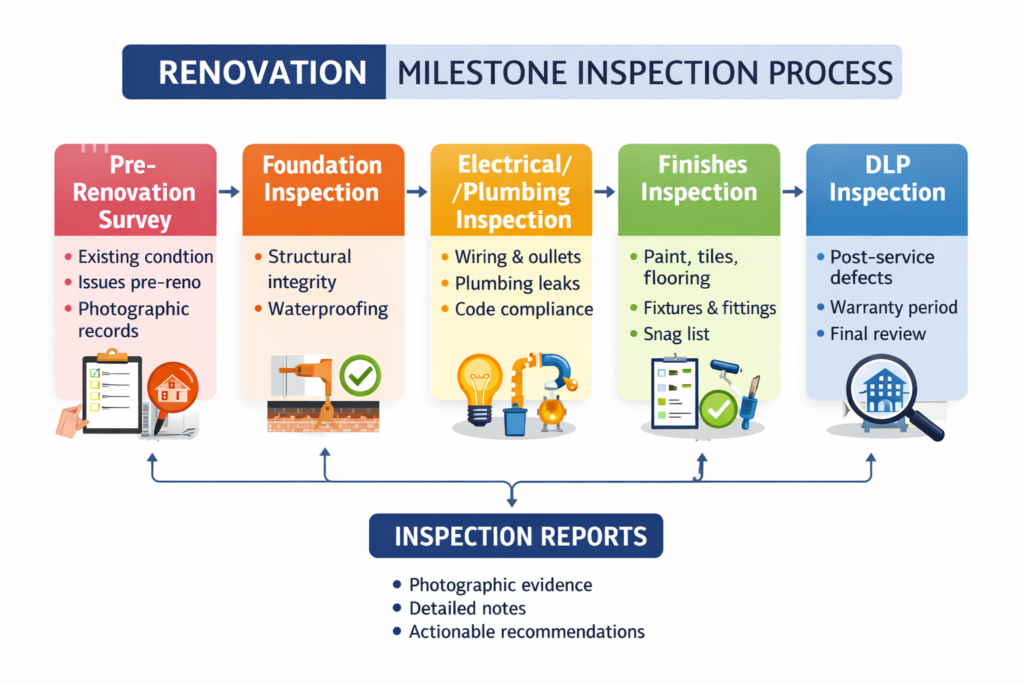
7. Step‑by‑Step Inspection Workflow for Renovations
Here’s a recommended inspection workflow that prevents disputes:
Step 1: Pre‑Renovation Survey
A comprehensive walkthrough documenting:
- Existing conditions
- Hidden issues (mold, rot, structural cracks)
- Baseline measurements & photographs
This protects against contractor claims that defects were present before work began.
Step 2: Design & Scope Review
Before work starts, review:
- Drawings
- Specifications
- Contract terms
- Special conditions
This ensures all stakeholders share the same expectations.
Pro Tip: Use checklists aligned with your contract scope for clarity.
Step 3: Milestone Inspections
Schedule inspections at:
- Foundation
- Waterproofing
- Electrical rough‑in
- Plumbing
- Finishes
Each inspection finds issues before they’re covered up.
Step 4: Final Completion Inspection
This is a snag list walkthrough involving:
- Homeowner
- Contractor
- Inspector
Identifies cosmetic and functional defects before handover.
Step 5: DLP / Warranty Inspection
Conduct a thorough assessment before the defect liability expires to catch:
- Settlement cracks
- Water leaks
- Mechanical failures
This protects your warranty rights.
8. Best Practices for Homeowners & Contractors
Best Practices for Homeowners
✔ Get inspections written into the contract
✔ Understand key milestones
✔ Attend walkthroughs with contractors
✔ Keep records (emails, reports, photos)
Best Practices for Contractors
✔ Cooperate with inspectors
✔ Address defects within agreed time
✔ Provide documentation proactively
✔ Clarify specification differences early
Proactive collaboration reduces adversarial disputes and improves trust.
9. Tools & Technology Used by Inspectors
Inspection professionals use technology to increase precision and defend against disputes:
| Tool | Purpose |
|---|---|
| Digital checklists | Standardize reporting |
| Drones | Access hard‑to‑reach areas |
| Thermal cameras | Detect moisture, heat loss |
| Laser distance meters | Accurate measurements |
| Mobile apps | Timestamped photo & GPS records |
These tools add verifiable, timestamped evidence to inspection reports.

10. Choosing the Right Inspection Service Provider
Selecting a qualified inspection service provider is a crucial step in ensuring renovation success and minimizing post-project disputes. Whether you’re a homeowner, contractor, or developer, it’s important to work with professionals who combine technical expertise with local experience.
✅ Why Choose Pro Inspect Solution?
Pro Inspect Solution is a trusted property and building inspection company based in Malaysia, known for its comprehensive renovation inspection services, structural assessments, and DLP evaluations. With a team of certified inspectors and engineers, they bring industry-grade tools and detailed reporting to every project — ensuring that you receive not only observations, but also actionable recommendations.
Services include:
- Pre-renovation condition assessments
- Mid-project milestone inspections
- Final handover inspections
- DLP inspections before warranty expiration
- Structural and defect diagnosis reports
By engaging Pro Inspect Solution early in the renovation process, you gain peace of mind, transparency, and a well-documented project journey that helps you avoid unexpected costs and legal disputes down the road.
✔ Key Qualities to Look For
When choosing any inspection provider, ensure they offer:
- Certifications & Licensing (CIDB, professional engineers, etc.)
- Local knowledge of construction standards in Malaysia
- Detailed inspection reports with photos, ratings, and recommendations
- Timely communication and availability for scheduled walkthroughs
- Independent operation with no conflict of interest
11. Frequently Asked Questions (FAQs)
Q1: Are inspection services legally required for renovations?
In Malaysia, simple home renovations don’t legally require inspections, but including them contractually provides legal evidence and reduces risk.
Q2: How often should inspections be scheduled?
Key points are:
- Pre‑renovation
- Milestone stages
- Final completion
- Before the DLP ends
Q3: Can inspection reports be used in court?
Yes. Detailed, timestamped reports with photographic evidence and checklists are admissible as objective documentation.
Q4: Do contractors resist inspections?
Reputable contractors generally welcome inspections because it clarifies expectations and reduces conflicts.
Q5: What if defects are found after DLP?
Once DLP expires, contractual rights may lapse. Pre‑DLP inspections help ensure defects are captured in time.
12. Conclusion
Inspection services are critical to preventing costly disputes during renovation projects and the Defects Liability Period (DLP). Through professional documentation, early defect detection, standardized reporting, clear expectations, and objective evidence, inspections safeguard both homeowners and contractors.
Whether you are renovating your home or supervising a large project, incorporating inspection services into your contract protects your investment, ensures accountability, and reduces disagreements — ultimately resulting in a smoother, more predictable renovation experience.