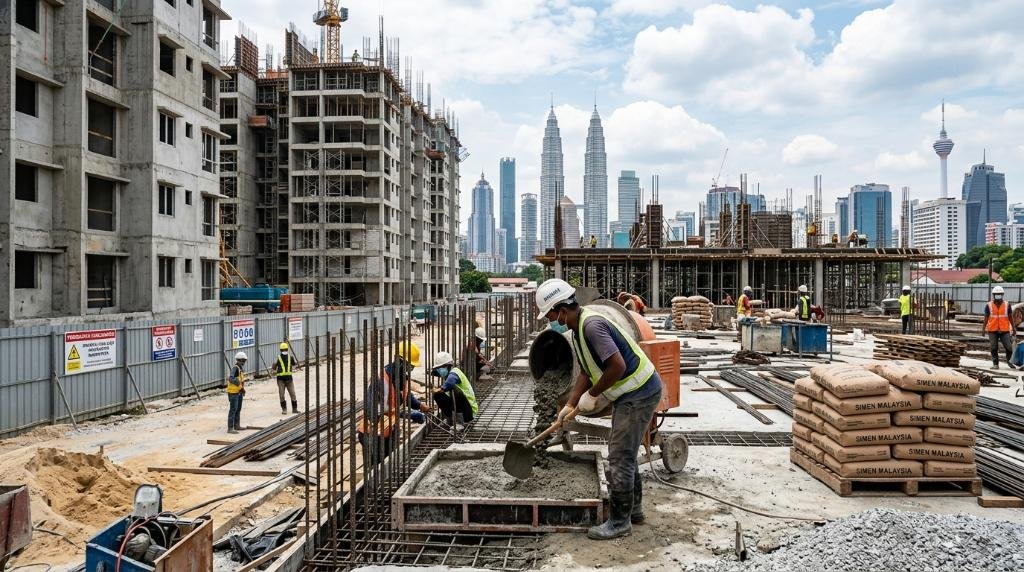
As the Malaysian property market continues to navigate post-pandemic recovery and shifting global economics, one pressing issue remains a massive roadblock for prospective homeowners: housing development delays. The government’s recent expansion of the Rahmah Cement Malaysia initiative in late May 2026 has been heralded by many as a lifeline for struggling developers. But as an engineer who regularly inspects stalled sites and conducts forensic structural investigations across the nation, I must ask a deeper question: is cheaper cement the ultimate cure for our industry’s chronic ailments?
In this comprehensive analysis, we will break down the latest 2026 updates to the Simen Rahmah scheme, examine the root causes of abandoned properties from an engineering standpoint, and provide an insider’s look into how building material prices genuinely dictate construction quality and compliance on the ground.
The 2026 Expansion of the Rahmah Cement Scheme
On May 20, 2026, the Ministry of Housing and Local Government (KPKT) announced the continuation and massive expansion of the Simen Rahmah Scheme. A staggering 1.6 million metric tonnes of subsidised cement have been officially allocated to support the 13th Malaysia Plan (13MP) target of constructing 500,000 affordable housing units.
The updated initiative broadly covers affordable housing projects under the Federal Government, state governments, and the private sector, explicitly targeting homes priced at RM300,000 and below. For contractors struggling with fluctuating Malaysia construction costs, the scheme’s numbers represent substantial and much-needed financial relief:
- Bulk Cement: Capped at RM290 per metric tonne, delivering a massive 31.8% saving compared to the prevailing market price of RM425.
- Bagged Cement (50kg): Fixed at RM17.50 per bag, offering a 29.7% discount off the standard market rate of RM24.90.
However, this intervention comes with strict oversight via the Housing Integrated Management System (HIMS) to prevent leakages. To deter opportunists, KPKT Minister Nga Kor Ming issued a stern warning that housing developers and their directors face a severe, lifetime industry ban—including the revocation of their Advertising Permit and Developer’s Licence (APDL)—if they are caught reselling the highly subsidised cement for non-eligible, high-end projects.

An Insider’s Engineering Perspective: Where Projects Truly Fail
Many laypersons and industry observers assume that housing development delays are purely administrative or financial—a developer simply runs out of funds, and the cranes stop moving. However, as an engineering consultant deeply entrenched in CIDB (Construction Industry Development Board) compliance and Malaysian Standards, I see a much more technical sequence of failure.
When building material prices—particularly cement, steel reinforcement, and essential aggregates—spike unexpectedly, contractors who secured affordable housing projects on razor-thin margins face a terrifying dilemma. To preserve profitability and avoid insolvency, some resort to “optimizing” their structural concrete mix designs to the absolute minimum viable limits. They reduce the cementitious content, hoping it still barely squeaks past structural testing.
The High Cost of Hacking and Rework
This is where the real, catastrophic delays happen on the ground. Under MS EN 206 (Concrete Specification) and MS EN 12390 (Testing Hardened Concrete), structural elements must undergo strict compressive strength assessments, usually via standard concrete cube testing at 7 and 28 days. When a contractor thins out the cement to save money, the concrete inevitably fails these crucial load-bearing tests.
When a cast column, slab, or shear wall fails to meet its specified design grade (e.g., Grade 30 or Grade 40), the consulting engineer has no choice but to issue a Non-Conformance Report (NCR). The contractor is then legally and technically obligated to halt upper-level construction, mobilise breakers to hack down the defective concrete elements, clean the reinforcement steel, and re-cast everything from scratch.
This endless cycle of failed material tests, structural hacking, and extensive re-work destroys project timelines far more aggressively than temporary supply chain hiccups. By capping the bulk price of Rahmah Cement Malaysia at RM290 per tonne, the government is fundamentally removing the financial incentive for contractors to tamper with structural mix designs. This initiative is a monumental win not just for project economics, but for overall engineering integrity.
Broader Construction Industry Trends and Cash Flow Realities
While standardizing Malaysia construction costs through bulk cement subsidies is a highly commendable move, we cannot view the construction ecosystem in a vacuum. On May 24, 2026, the Pertubuhan Akitek Malaysia (PAM) officially voiced its support for the expanded scheme but accurately noted that the broader building industry is currently navigating extraordinary external headwinds, severe geopolitical uncertainties, and ongoing supply chain crises.
PAM also highlighted a critical bottleneck that subsidized raw materials simply cannot fix: liquidity and cash flow. Professional fees for architects and consulting engineers, alongside critical progress payments to contractors, are increasingly being delayed. In a highly volatile construction industry trends landscape, smooth, predictable cash flow is the actual lifeblood of project completion. If a main contractor is not paid promptly for work completed, site operations will unavoidably grind to a halt—regardless of how cheap the raw cement might be.

Will Cheaper Cement Actually Stop Housing Development Delays?
The short answer is: No, not completely, but it acts as a massive, critical buffer.
To accurately understand the trajectory of “sick” or abandoned housing projects, we must recognize that cement is only one piece of a complex engineering puzzle. Steel reinforcement bars, mechanical and electrical (M&E) components, imported ceramic tiles, and chronic skilled labour shortages all play significant roles in dictating a project’s critical path.
While the Rahmah Cement initiative acts as an excellent early intervention mechanism to mitigate the risk of sick properties, achieving true zero-delay developments requires comprehensive project management, strict adherence to engineering standards, and reliable financial liquidity. For developers and property owners, the focus must remain on holistic quality assurance from day one.
For deeper technical insights into engineering consultancy and ensuring quality across your developments, you can explore more resources at our homepage.
Frequently Asked Questions (FAQ)
What is the Rahmah Cement initiative in Malaysia?
The Rahmah Cement initiative (Simen Rahmah) is a government program led by KPKT and the Cement and Concrete Association of Malaysia to provide subsidised cement for affordable housing projects. As of the May 2026 expansion, bulk cement is capped at RM290 per metric tonne.
Who is eligible for the Simen Rahmah scheme?
Developers and main contractors working on affordable housing projects priced at RM300,000 and below per unit. This includes developments under the People’s Residency Programme (PRR), SPNB, PR1MA, and various state-level housing schemes.
Will the Rahmah Cement Initiative completely stop housing development delays?
While subsidised cement significantly mitigates construction costs and reduces the risk of structural re-work due to poor mix designs, it will not completely eradicate housing delays. Other dominant factors like cash flow issues, skilled labour shortages, and fluctuations in steel prices still heavily influence project timelines.
Let’s Talk About Your Next Project
Have a question about structural integrity, material compliance, or how these shifting industry trends might affect your upcoming developments? Let’s discuss it directly. Connect with our engineering advisory team today via WhatsApp at 60168064902.