
By Ir Vimal | June 8, 2026
The Malaysian Leak Epidemic: Why Traditional Methods Fail
In a tropical climate subjected to relentless monsoon downpours and intense UV radiation, water ingress is an inevitable nemesis of structural integrity. Dealing with condo inter-floor leakage Malaysia has historically been a nightmare for Joint Management Bodies (JMBs), Management Corporations (MCs), and residents alike. Conventional leak detection has largely relied on archaic moisture meters and destructive hacking—often leading to frustrated tenants and ballooning repair costs without ever finding the root cause.
From an engineering perspective, water rarely travels in a straight line. Guided by capillary action and lateral migration along reinforcing steel and concrete capillaries, a water stain on a ceiling may originate from a micro-crack 10 meters away on the external façade or roof. This lateral movement makes visual-only inspections nearly obsolete in any comprehensive property investigation. According to guidelines set out by the Construction Industry Development Board (CIDB) and Malaysian Standards (MS) for waterproofing, pinpointing the true source of moisture intrusion requires scientific precision, not guesswork.
The Legal Minefield: Form 28 Strata Management Act
The disputes surrounding any Malaysia strata property leak are not just structural; they are deeply legal. When a resident discovers water dripping onto their expensive parquet flooring, the immediate question is: Who pays for the damage?
Under the Strata Management Act 2013 (Act 757), the presumption of liability generally falls on the unit above, unless proven otherwise. This is where the notorious Form 28 Strata Management Act (Certificate of Inspection for Inter-Floor Leakage) comes into play. Issuing a Form 28 requires definitive proof of the leak’s origin to attribute responsibility fairly—whether it’s the upper unit owner’s failed bathroom waterproofing, or a common property defect managed by the JMB.
To avoid lengthy battles in the Strata Management Tribunal (SMT), building managers are increasingly moving away from subjective visual assessments. Instead, they are turning to advanced, empirical evidence. By integrating a formal Building Condition Assessment utilizing thermography, inspectors can provide irrefutable, timestamped data that stands up under legal scrutiny.

The Engineering Solution: Thermal Drone Roof Leak Detection
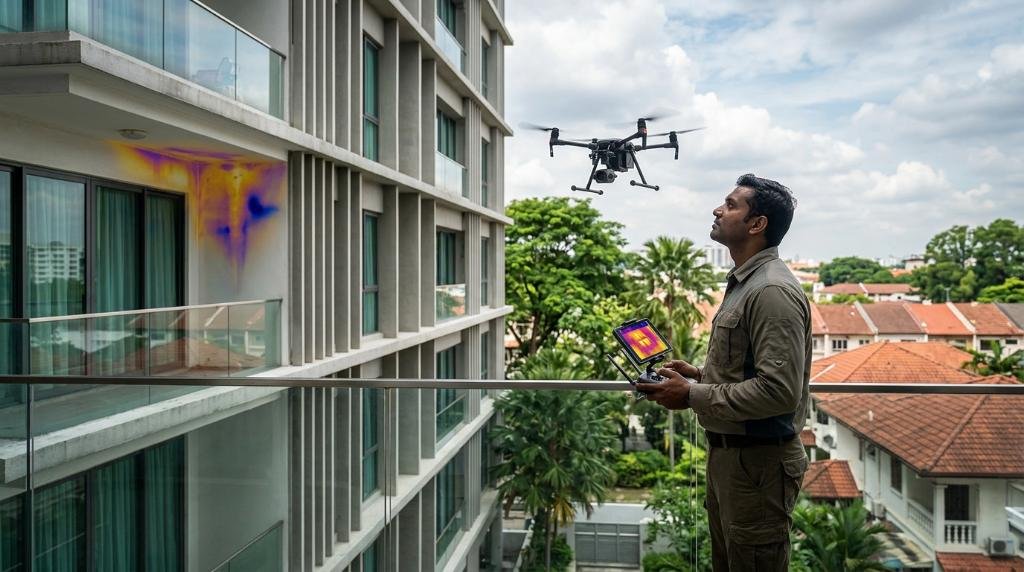
The deployment of Unmanned Aerial Vehicles (UAVs) equipped with radiometric radiometric infrared cameras has revolutionized the engineering approach to diagnostics. Thermal drone roof leak detection relies on the principle of thermal capacitance. Water possesses a high specific heat capacity compared to common building materials like concrete, brick, and elastomeric roof coatings.
During the diurnal temperature cycle—particularly right after sunset in Malaysia—the building envelope begins to cool. Dry concrete cools rapidly, while areas of entrapped moisture retain solar heat for much longer. The thermal drone captures this subtle temperature differential (Delta-T) as a distinct heat signature.
This thermal imaging leak detection process allows structural engineers to map exact moisture migration pathways beneath the surface. For professionals at Pro Inspect Solution, this means we can identify failing waterproof membranes, debonded tiles, and compromised expansion joints with pinpoint accuracy, delivering actionable data without ever lifting a hacking tool.
Tackling High Rise Roof Leaks Without Scaffolding
Historically, investigating high rise roof leaks or towering external façades required the expensive and dangerous erection of scaffolding or the deployment of rope access (gondola/abseiling) teams. Not only does this method carry significant Occupational Safety and Health (DOSH) risks, but it is also slow, severely disrupting the daily lives of condo residents.
By opting for a specialized Façade & Roof Inspection via Drone, JMBs and property developers can achieve 100% coverage of inaccessible areas in a fraction of the time. The drone captures high-resolution 4K visual data simultaneously with radiometric thermal data. When assessing Malaysian buildings—often characterized by complex architectural ledges and hidden RC gutters that trap heavy tropical rain—this dual-payload capability is crucial for identifying latent defects before they cascade into catastrophic structural spalling.
Leading authorities on local property maintenance frequently note the necessity of proactive maintenance over reactive firefighting. As detailed in numerous reports by The Star regarding urban strata disputes, modern diagnostic tools are the only sustainable path forward for aging high-rises.

Why Trust Pro Inspect Solution?
Procuring a drone is easy; interpreting the radiometric data requires profound engineering expertise. Misinterpreting thermal reflections (emissivity issues) as moisture can lead to thousands of Ringgit in unnecessary repairs. It requires a deep understanding of Malaysian construction methodologies, CIDB QLASSIC standards, and BS EN testing protocols.
When you commission a Building Condition Assessment with us, you are guaranteed an analysis that considers the holistic structural health of your property. We translate complex thermal matrices into comprehensive, easy-to-understand reports that empower JMBs to decisively execute a Form 28 and resolve condo inter-floor leakage Malaysia disputes permanently.
Ready to Resolve Your High-Rise Leaks?
Stop guessing and start solving. Leverage our state-of-the-art thermal drone roof leak detection services to protect your strata property investment.
Contact Ir Vimal and the team via WhatsApp at +6016 806 4902 for a specialized consultation today.
Frequently Asked Questions (FAQ)
What causes condo inter-floor leakage in Malaysia?
Most inter-floor leaks in Malaysia strata properties are caused by the degradation of Polyurethane (PU) or cementitious waterproofing membranes in wet areas (bathrooms/balconies), compromised plumbing pipe joints, or deteriorating roof façades exacerbated by heavy monsoons and high thermal expansion cycles.
How does thermal drone roof leak detection work?
Thermal drones use highly calibrated infrared sensors to detect temperature variations (Delta-T) on the surface of a building envelope. Because trapped moisture retains thermal energy differently than dry concrete, our engineers can pinpoint the exact origin of a leak non-destructively.
What is Form 28 under the Strata Management Act?
Form 28 is the official “Certificate of Inspection for Inter-Floor Leakage” under Malaysia’s Strata Management Act 2013 (Act 757). It is issued by the building management or their appointed technical inspector to document the cause of a leak and legally declare which party is responsible for the repair costs.
Is thermal imaging leak detection accepted by the Strata Management Tribunal?
Yes. Empirical data gathered through professional thermal imaging and certified building condition assessments provides objective, irrefutable evidence. This scientific approach is highly respected in tribunal proceedings compared to subjective visual guesswork.
