
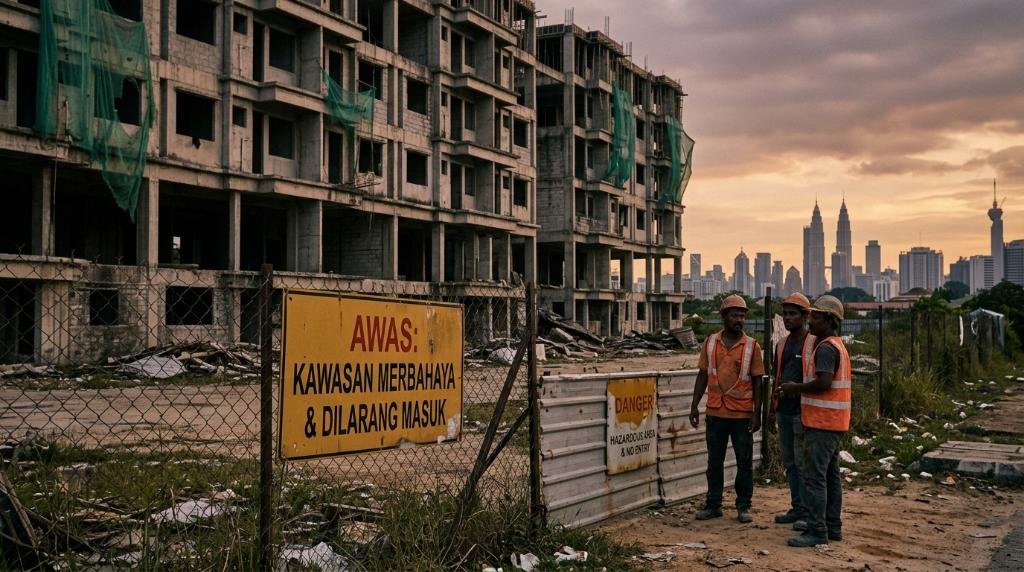
Kuala Lumpur, Malaysia — June 8, 2026
The skyline of Kuala Lumpur is an evolving tapestry of architectural triumph, but interspersed within this dynamic metropolis lie the sobering silhouettes of abandoned construction sites Malaysia. Beyond the obvious aesthetic blight, these stalled mega-projects and residential developments represent a ticking time bomb of engineering complexities. From an insider’s vantage point, looking past the hoarding reveals severe, compounding hazards that transcend basic regulatory non-compliance.
For property owners, developers, and local contractors, inheriting or managing an abandoned site is not merely an administrative hurdle—it is an exercise in complex forensic engineering and stringent risk management.

The Engineering Reality: Why Standard Codes Fail Stalled Projects
To understand the peril of an abandoned site, one must look at how structures are fundamentally designed. In Malaysia, civil and structural engineering practices adhere closely to Malaysian Standards (MS) and the British Standard European Norms (BS EN). For instance, MS EN 1992 (Eurocode 2) dictates concrete design based on specific durability classes and cover requirements. However, these calculations inherently assume a continuous construction timeline where the bare skeleton is swiftly enveloped by waterproofing, cladding, and a protective roof.
When a project is abandoned, the Ultimate Limit State (ULS) and Serviceability Limit State (SLS) assumptions are compromised. Structural elements meant for an interior, protected environment are suddenly subjected to Malaysia’s aggressive tropical climate—relentless UV radiation, torrential monsoons, and high humidity. Without the intended protective finishes, rapid material degradation begins almost immediately.
DBKL Structural Decay & The Hidden Weakness of Exposed Concrete
The phenomenon of DBKL structural decay on monitored sites within the city center highlights a severe gap in temporary preservation. While Kuala Lumpur City Hall (DBKL) mandates periodic safety checks under the Street, Drainage and Building Act 1974 (Act 133), the chemical reality of exposed concrete waits for no inspector.
Two primary mechanisms threaten these structures:
- Carbonation-Induced Corrosion: Atmospheric carbon dioxide penetrates the porous concrete, lowering its high alkaline pH. Once the pH drops at the depth of the reinforcing steel, the protective passive layer on the rebar breaks down, initiating rust. The volumetric expansion of rusting steel forces the concrete to crack and spall, significantly reducing load-bearing capacity.
- Stalled Substructure Integrity: Deep excavations and temporary earth-retaining systems (like sheet piles or contiguous bored pile walls) are engineered with the assumption that permanent basement slabs will eventually act as lateral props. Prolonged abandonment leaves these temporary retaining structures vulnerable to long-term creep, ground water pressure fluctuations, and catastrophic failure.

Environmental Perils: Flash Floods Building Sites and Urban Siltation
Beyond the structural frame, the ground level presents an immediate public hazard. We frequently hear of flash floods building sites exacerbating the city’s urban drainage woes. The root cause lies in the failure of the Erosion and Sediment Control Plan (ESCP).
Temporary silt traps, perimeter earth drains, and wash-through facilities are designed for active maintenance. When a site goes dormant, these systems quickly fill with sediment and overflow. During heavy monsoonal downpours, untreated runoff laden with high volumes of silt bypasses these failed traps and discharges directly into municipal drains. This rampant siltation chokes public waterways, directly triggering localised flash floods in adjoining commercial and residential zones.
According to regulations set by the Department of Environment (DOE) and DBKL, the failure to maintain zero-silt discharge is a serious offense, but the enforcement heavily relies on active project owners.
Mitigating Property Safety Risks: CIDB and Legal Perspectives
The cascading property safety risks extend beyond the boundary hoardings. Unfinished lift cores, submerged basement excavations (often breeding grounds for Aedes mosquitoes, driving up local dengue cases), and uncertified, decaying tower cranes pose mortal threats to the public.
From an industry standpoint, the Construction Industry Development Board (CIDB) via Act 520 holds stringent powers. Under this act, contractors and developers are legally obligated to ensure structural safety, even in suspension. Reviving an abandoned site requires an exhaustive, independent structural appraisal—often involving core sampling, ultrasonic pulse velocity (UPV) testing, and ground-penetrating radar (GPR) to assess the true extent of the hidden decay.
For industry professionals seeking comprehensive baseline methodologies for site assessments, referencing broader building inspection frameworks provides the necessary blueprint to satisfy both CIDB requirements and local authority approvals before any remediation works can safely commence.
Moving Forward: Evaluating the Remains
Addressing the crisis of abandoned construction sites Malaysia requires a pivot from seeing them as mere “stalled investments” to recognizing them as active engineering liabilities. The tropical weathering process does not pause for legal disputes or financial restructuring.
For developers looking to acquire or revive such sites, proceeding without a ruthless, empirical structural assessment is a gamble against physics. Only through rigorous testing, understanding the nuances of DBKL structural decay, and managing the aggressive environmental runoff can these concrete ghosts be safely resurrected or responsibly demolished.
Need expert insight on a distressed or stalled structural project?
Ensure your project complies with CIDB and MS EN standards before taking on the liability.
Contact Ir Vimal via WhatsApp at +60168064902 for specialized structural consultation and risk mitigation strategies.
Frequently Asked Questions
What happens to the structural integrity of abandoned construction sites in Malaysia?
Because structural designs (like MS EN 1992) assume swift weatherproofing, prolonged exposure to Malaysia’s tropical climate drastically accelerates decay. Exposed incomplete structures suffer from carbonation, rapid reinforcement corrosion, and concrete spalling, significantly reducing their load-bearing capacity over time.
How do abandoned projects contribute to urban flash floods?
Abandoned sites are notorious for failed Erosion and Sediment Control Plans (ESCP). Temporary silt traps and drainage systems degrade quickly without maintenance. Heavy monsoons wash untreated silt into municipal drains, choking them and directly causing flash floods around building sites.
Who is responsible for the property safety risks of stalled projects?
Under the Street, Drainage and Building Act 1974 (Act 133) and CIDB Act 520, the registered property owners and developers remain legally liable for securing the site, maintaining hoardings, preventing mosquito breeding, and mitigating structural public safety hazards, overseen by local authorities like DBKL.
