
By Ir Vimal, Professional Engineer | June 22, 2026
An exclusive engineering and regulatory perspective on navigating Malaysia’s distressed property market.
Understanding “Projek Sakit”: The Anatomy of Sick Housing Projects in Malaysia
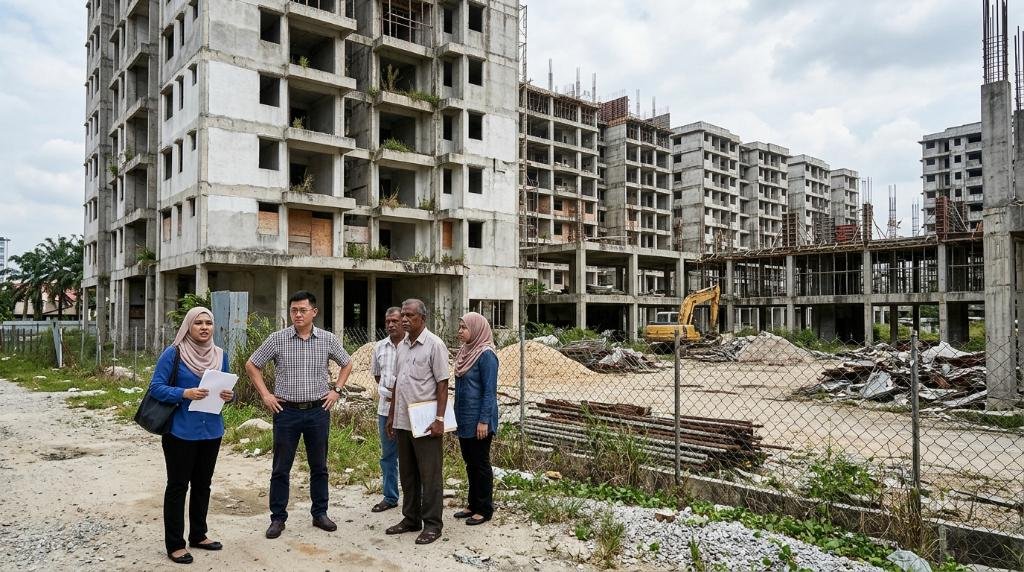
For decades, the Malaysian real estate market has been a cornerstone of local wealth generation. However, beneath the gleaming skylines of Kuala Lumpur and Johor Bahru lies a persistent systemic issue: sick housing projects in Malaysia. Known locally as projek sakit, these developments represent financial and emotional sinkholes for thousands of homebuyers every year.
By definition from the Ministry of Local Government Development (KPKT), a housing project is officially classified as “sick” when its physical construction is delayed by more than 30% compared to its scheduled progress, or when the Sale and Purchase Agreement (SPA) delivery deadline has lapsed without the issuance of a Certificate of Completion and Compliance (CCC).

While the financial implications are widely discussed, the engineering realities of these stalled projects are rarely brought to light. When a project begins to stall, the cascading effects on material integrity and construction quality are immediate and severe.
The Hidden Danger: Structural Defects in Distressed Developments
As a professional engineer examining local failures, I can attest that the most insidious risk of a sick project is not just the delay—it is the catastrophic drop in build quality. When a development hemorrhages capital, contractors inevitably resort to value engineering of the worst kind.
Compromised Concrete and Rebar Compliance
In a financially healthy project, concrete works strictly follow MS EN 1992 (Eurocode 2) standards. In distressed projects, we frequently observe deviations. To maintain cash flow, sub-contractors might substitute specified G30/G40 grade concrete with inferior mixes. Furthermore, the critical curing process—which requires adequate time and moisture control—is often rushed to fabricate “progress” for interim claims.
This rush results in severe plastic shrinkage cracks and honeycombing. Worse still, when projects are temporarily halted and exposed to Malaysia’s tropical monsoon climate, exposed starter bars and reinforcement steel (which should adhere to BS EN 10080) undergo accelerated corrosion. When construction resumes months later, contractors rarely treat or replace this rusted rebar, embedding compromised tensile strength deep into the building’s skeleton, leading to inevitable structural defects.
CIDB and QLASSIC Evasions
Malaysia’s Construction Industry Development Board (CIDB) utilizes the QLASSIC (Quality Assessment System in Construction) metric to gauge workmanship. In healthy developments, QLASSIC scores routinely exceed 75%. In sick housing projects, compliance becomes an afterthought. Waterproofing membranes are installed over poorly prepped screed, leading to pervasive inter-floor leakages the moment the building is handed over. The systemic failure to adhere to these Malaysian Standards transforms a delayed dream home into a perpetual maintenance nightmare.
The Domino Effect: Property Overhang and Developer Controversies
Sick housing projects do not exist in a vacuum; they are heavily intertwined with the ongoing property overhang crisis. Developers often over-leverage themselves to launch high-density projects in areas with saturated demand. When sales fail to meet targets, the cash flow required to pay main contractors dries up.
This financial tightrope often leads to highly publicized developer controversies. We have seen numerous cases highlighted by local media outlets like The Star where developers divert funds from one phase of a project to another, effectively cannibalizing their own developments. When the music stops, buyers are left holding the bag in a landscape littered with abandoned projects KPKT has to subsequently monitor.

Navigating the Nightmare: Buyer Rights and Legal Recourse
If you find yourself trapped in a sick or abandoned project, understanding your buyer rights under the Housing Development (Control and Licensing) Act 1966 (HDA) is paramount.
Liquidated Ascertained Damages (LAD)
Under Schedule G (landed) and Schedule H (strata) of the HDA, developers are bound to deliver vacant possession within 24 or 36 months, respectively. If they fail, buyers are entitled to LAD, calculated at 10% per annum of the purchase price on a daily basis. However, extracting LAD from a financially distressed developer often requires filing a claim with the Tribunal for Homebuyer Claims.
The Right to Terminate
Many Malaysians are unaware of Section 8A of the HDA. This provision allows buyers to terminate their SPA if continuous construction has been delayed for six months or more. You must obtain written consent from your end-financier and ensure the project is officially certified as abandoned by the Housing Controller at KPKT.
The Role of Independent Engineering Evaluations
Whether a developer has managed to pull a sick project across the finish line, or a white-knight developer has taken over an abandoned site, buyers must exercise extreme caution at the point of Vacant Possession (VP). Do not blindly accept the keys.
Given the high probability of hidden structural anomalies, commissioning a rigorous defect liability assessment by certified professionals is not a luxury; it is a necessity. Independent engineering evaluations ensure that all deviations from the approved Building Plan (BP) and Malaysian building codes are documented legally, forcing the developer to rectify issues before the Defect Liability Period (DLP) expires. For broader insights on construction quality and independent advocacy in Malaysia, resources from organizations like Pro Inspect Solution advocate for enforcing stringent local standards.
Frequently Asked Questions (FAQ)
What qualifies as a sick housing project in Malaysia?
Under KPKT guidelines, a project is classified as “sick” when its construction progress is delayed by more than 30% against the scheduled timeline, or if the Sale and Purchase Agreement (SPA) delivery date has completely lapsed without vacant possession being delivered.
Can I terminate my SPA if the project becomes an abandoned project under KPKT?
Yes. Under Section 8A of the Housing Development (Control and Licensing) Act (HDA) 1966, buyers have the right to terminate the SPA if continuous construction has been stalled for at least six months, provided they obtain written consent from their end-financier.
Why do sick housing projects suffer from severe structural defects?
Financial distress leads to systemic corner-cutting. Contractors may substitute specified materials with sub-standard alternatives, rush concrete curing times, or ignore Malaysian Standards (MS) and CIDB’s QLASSIC requirements, resulting in compromised structural integrity.
Are you dealing with suspected structural defects in a delayed development? Protect your rights and your investment before your Defect Liability Period (DLP) ends.
For expert engineering consultation and assistance, WhatsApp us at 60168064902 today to speak directly with an industry professional.
