
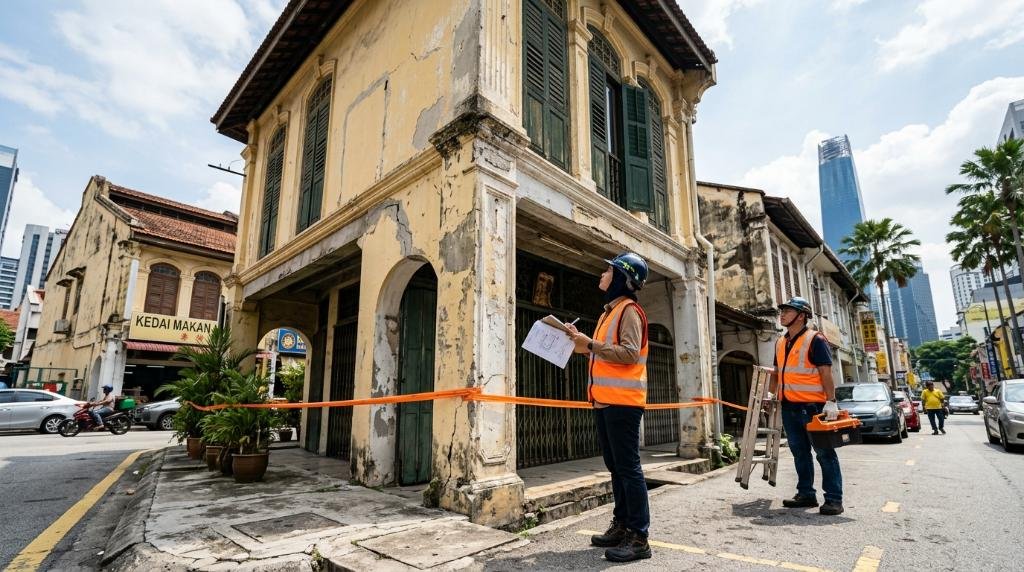
By Ir Vimal, Professional Engineer | May 24, 2026
Malaysia experienced a massive construction boom in the late 1980s and 1990s. Today, many of these iconic commercial structures in the Klang Valley, Penang, and Johor are crossing the 30-year mark. In our aggressive tropical climate—characterized by high humidity, torrential monsoons, and extreme thermal cycling—reinforced concrete deteriorates far faster than textbook models predict. For property owners and developers, conducting a rigorous building health check Malaysia is no longer just a best practice; it is a critical legal and financial necessity.
As a Professional Engineer, I frequently encounter surface-level “inspections” that entirely miss systemic structural decay. Generic checklists do not secure Malaysia infrastructure. This step-by-step guide is designed to walk property owners, facility managers, and developers through a professional, standard-compliant approach to safeguarding aging structures.
The Malaysian Context: Beyond Surface-Level Cracks
When discussing a commercial building inspection, we must talk about carbonation and chloride ingress. In Malaysia, constant exposure to atmospheric carbon dioxide combined with high humidity lowers the pH of concrete over decades. Once the concrete’s natural alkalinity drops, the embedded steel reinforcement begins to rust, expand, and cause spalling.
We’ve seen recent localized failures—from collapsed awnings to severe structural degradation in commercial hubs. A “knock-and-tap” inspection is wholly inadequate for buildings built under outdated codes (such as the older BS 8110 before Malaysia’s transition to MS EN 1992 Eurocodes). You need engineering expertise to understand how structural stability is compromised in our specific environment.

The Legal Framework: Act 133 and Your Liability
Ignorance is not a defense in Malaysian engineering law. Under Section 85A of the Street, Drainage and Building Act 1974 (Act 133), enforced by the Ministry of Local Government Development (KPKT), buildings exceeding five storeys must undergo a mandatory periodic structural inspection every 10 years.
Failure to comply or acting on an unqualified report can result in severe penalties, voided commercial property insurance, and worst-case scenarios involving human casualties. Relying on an accredited engineer ensures your building health check Malaysia meets CIDB (Construction Industry Development Board) guidelines and protects you from liability.
Step-by-Step Guide to a Proper Building Health Check
Securing long-term structural stability requires a methodical, engineering-led approach. Here is how a proper inspection should be executed:
Step 1: Historical Data Review & Desk Study
Before any on-site boots hit the ground, engineers must review the building’s “medical history.” This includes analyzing the original As-Built structural drawings, previous renovation permits, and past maintenance logs. Identifying load-bearing walls that may have been illegally removed by previous tenants is a critical priority for older commercial spaces in Malaysia.
Step 2: Drone-Assisted Façade & Roof Inspection
In the past, inspecting a 30-storey building in Kuala Lumpur meant expensive scaffolding and gondolas. Today, we utilize high-resolution, thermal-equipped drones to capture millimeter-accurate data of building envelopes. To fully understand external defects like water seepage, delaminated tiles, or roofing failures, a specialized façade & roof inspection using drones is highly recommended. Thermal imaging can pinpoint trapped moisture behind concrete before it causes internal reinforcement corrosion.

Step 3: Non-Destructive Testing (NDT) & Intrusive Testing
Visual inspections alone are insufficient. To gauge true structural stability, engineers must perform NDT, including:
- Rebound Hammer Tests: To estimate the surface compressive strength of the concrete.
- Ultrasonic Pulse Velocity (UPV): To detect internal voids, honeycombing, or deep cracking.
- Cover Meter Surveys: To locate rebars and measure concrete cover.
- Carbonation Depth Testing: Spraying a phenolphthalein indicator on a freshly exposed concrete surface to check if carbonation has reached the reinforcement zone.
Step 4: The Building Condition Assessment Report
The culmination of these tests is the building condition assessment report. This is not just a list of defects; it is a legally binding engineering document. It categorizes structural risks, aligns findings with Malaysian Standards (MS), and provides a prioritized, actionable rectification plan with estimated repair methodologies (such as resin injection or carbon fiber reinforced polymer strengthening).
Common Pitfalls in Commercial Building Inspections
Many property owners make the mistake of hiring general contractors or facility managers for structural assessments. While contractors are vital for execution, they do not possess the diagnostic engineering background required to certify structural integrity under Act 133. Another common pitfall is ignoring waterproofing failure. In Malaysia’s climate, a leaking roof is not merely an architectural nuisance; it is the primary catalyst for structural concrete degradation.
Frequently Asked Questions (FAQ)
Is a building health check mandatory in Malaysia?
Yes, under Section 85A of the Street, Drainage and Building Act 1974 (Act 133), commercial and residential buildings exceeding five storeys must undergo a mandatory structural inspection by a registered structural engineer every 10 years.
What does a commercial building inspection entail?
It involves a comprehensive review of structural stability, involving visual inspections, Non-Destructive Testing (NDT), drone façade evaluations, and a review of as-built drawings to identify spalling, foundation settlement, and material degradation.
How does the Malaysian climate affect structural stability?
Malaysia’s high humidity and rainfall accelerate the carbonation of concrete and the corrosion of steel rebars. Without periodic maintenance and proper waterproofing, water ingress drastically reduces the lifespan of reinforced concrete structures.
Protect Your Investment and Ensure Compliance Today
The safety of your tenants and the longevity of your asset rely on proactive, engineering-backed intelligence. Don’t wait for visible cracks to become structural emergencies. Trust Pro Inspect Solution to deliver unparalleled engineering insight.
Ready to secure your property’s future? Schedule a comprehensive building condition assessment with our expert engineering team today.
