
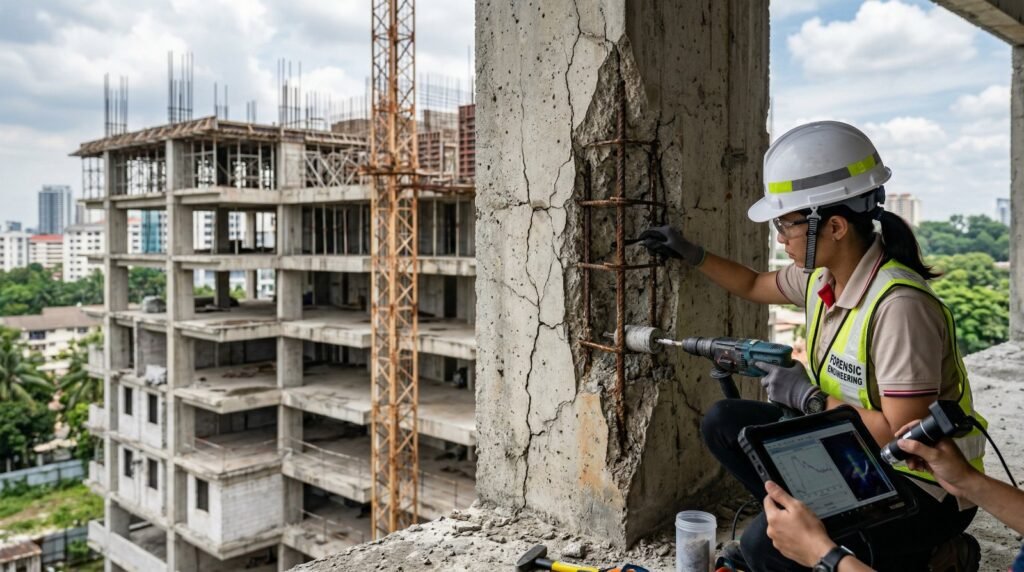
Malaysia’s rapid urbanization and real estate boom have led to the construction of magnificent skylines and modern infrastructures. However, this aggressive growth brings its own set of challenges, most notably the rising number of “sick projects” (projek sakit). When a construction project is delayed or abandoned due to structural failures, material discrepancies, or legal disputes, the financial and reputational damages can be catastrophic for property owners, developers, and contractors. This is where concrete forensics Malaysia steps in as the ultimate diagnostic tool to rescue and rehabilitate struggling developments.
By leveraging advanced scientific methodologies, professional engineers can identify the root cause of material failures and propose actionable remedies. In this comprehensive guide, we will explore how concrete forensics and diagnostic engineering are effectively resolving Malaysia’s sick projects.
What is Concrete Forensics?
Concrete forensics is the application of engineering science to investigate the materials, structural components, and environmental factors that contribute to the failure, deterioration, or underperformance of a concrete structure. Similar to medical forensics determining the cause of health issues, concrete forensics determines the “why” and “how” behind building defects.
In Malaysia’s highly humid and tropical climate, concrete structures are susceptible to unique stresses, including carbonation, chloride-induced corrosion, and thermal cracking. Through rigorous concrete NDT testing (Non-Destructive Testing) and laboratory analysis, structural forensic engineers can accurately map out the health of a building without causing further damage to the existing structure.

Understanding Sick Projects in Malaysia
The term “sick projects” is a recognized classification by the Ministry of Local Government Development (KPKT) in Malaysia. A project is generally deemed “sick” when its construction progress is delayed by more than 30% compared to its scheduled timeline, or when the completion date has lapsed. As of recent statistics, hundreds of developments across the nation fall into this category.
While financial mismanagement and labor shortages are common culprits, an often-overlooked factor is structural and material failure. Poor initial concrete mix design optimization, sub-par curing practices, or unexpected ground settlements can halt construction entirely. When regulatory bodies issue stop-work orders due to safety concerns, the project instantly becomes a liability. Resolving sick projects Malaysia requires an undeniable, data-backed assessment of the current structural integrity to assure authorities and investors that the building can be safely completed.
Structural Defects Evaluation: Identifying the Root Cause
To rehabilitate an abandoned or delayed site, developers must first understand what went wrong. A thorough structural defects evaluation involves systematically examining the building’s current state. Common concrete defects that stall projects include:
- Honeycombing and Voids: Caused by improper compaction during the concrete pouring phase, severely reducing load-bearing capacity.
- Severe Cracking: Often a result of thermal stress, drying shrinkage, or structural overloading.
- Spalling and Delamination: Usually triggered by the corrosion of embedded steel reinforcement due to moisture ingress.
- Low Compressive Strength: When the poured concrete fails to meet the required design strength, risking potential structural collapse.
To accurately document these issues, developers often rely on a comprehensive Building Condition Assessment. For residential developments nearing completion but plagued by buyer complaints, a detailed Property Defect Inspection (DLP) helps segregate structural failures from minor architectural flaws.
How Forensics Provide Projek Sakit Solutions
Once a project is declared sick, stakeholders need immediate, viable projek sakit solutions. Concrete forensics paves the way for rehabilitation through several key methodologies:
1. Advanced Concrete NDT Testing
Traditional testing methods often require coring, which damages the structure. Non-Destructive Testing (NDT) utilizes advanced equipment like Rebound Hammers, Ultrasonic Pulse Velocity (UPV), and Ground Penetrating Radar (GPR) to assess the internal integrity of concrete elements. This allows engineers to detect hidden voids, measure concrete uniformity, and locate rebar positioning safely and swiftly.
2. Concrete Mix Design Optimization
If forensic analysis reveals that the concrete utilized is fundamentally weak, experts will step in to provide concrete mix design optimization. By adjusting the water-cement ratio, introducing specific admixtures, or altering aggregate sizes, consultants can formulate custom remediation mixes for structural patching or for completing the remaining phases of the project safely.
3. Customized Structural Rehabilitation
Forensic reports do not just point out flaws; they provide the blueprint for recovery. Based on the findings, engineers can design tailored retrofitting strategies. This seamless transition from diagnosis to cure is best handled through specialized Structural Repair Consultancy, ensuring that the repaired sections integrate perfectly with the existing framework.

Integrating Forensics with Holistic Engineering Services
Solving the puzzle of a sick project rarely relies on a single discipline. True recovery demands a multi-disciplinary approach. For instance, in high-rise sick projects where scaffolding has been dismantled or is unsafe, experts utilize Façade & Roof Inspection (Drone) technologies to safely capture high-resolution data on concrete deterioration at inaccessible heights.
Furthermore, sick projects that have been abandoned for years often suffer from missing or outdated architectural drawings. In these scenarios, conducting an As-Built Survey & Drawing Service is crucial. This ensures that the new contractors and structural engineers have accurate, up-to-date documentation that reflects the exact physical state of the building before any remediation work begins.
Navigating Legal Disputes with Forensic Evidence
Sick projects are breeding grounds for litigation. Property owners blame developers, developers blame main contractors, and contractors point fingers at material suppliers. In such contentious environments, objective data is the only way to resolve conflicts.
A certified structural forensic report serves as an irrefutable piece of evidence in arbitration or court proceedings. By pinpointing exactly why a structural failure occurred—whether it was poor workmanship, substandard materials, or flawed design—stakeholders can definitively assign liability. Engaging a consultant for Expert Witness & Dispute Resolution services ensures that the highly technical findings of the concrete forensics report are translated into clear, compelling testimonies that hold up under legal scrutiny.
Why Choose Inspect Solution for Concrete Forensics in Malaysia?
When millions of Ringgit are on the line, there is no room for guesswork. As a leading engineering consultancy firm, Inspect Solution is dedicated to providing independent, authoritative, and deeply scientific evaluations of distressed structures.
Through our dedicated Concrete Technology Consultancy, we bring decades of specialized experience to the table. Our team of certified engineers utilizes state-of-the-art NDT equipment and globally recognized testing standards to deliver precise diagnostics. Whether you are a developer looking to restart an abandoned project, or a property owner caught in a dispute over structural defects, we provide the clarity and engineered solutions you need to move forward with confidence.
Frequently Asked Questions (FAQ)
What is concrete forensics?
Concrete forensics is the scientific investigation of a concrete structure to determine the root causes of its failure, deterioration, or defects. It involves physical inspections, Non-Destructive Testing (NDT), and laboratory analysis to assess structural integrity.
How does concrete NDT testing help sick projects in Malaysia?
Concrete NDT (Non-Destructive Testing) allows engineers to evaluate the internal health of a concrete structure without causing damage. It helps identify hidden defects like voids, poor compaction, and rebar corrosion, providing vital data to design safe rehabilitation plans for abandoned or delayed “sick projects”.
What are common “projek sakit” solutions?
Solutions for “projek sakit” (sick projects) include conducting comprehensive structural defects evaluations, optimizing the concrete mix design for ongoing works, performing targeted structural repairs, and legally resolving contractor disputes using objective forensic engineering reports.
When do I need a structural defects evaluation?
You need a structural defects evaluation when you notice severe cracking, concrete spalling, foundation settlement, or when taking over an abandoned construction project. It is essential to ensure the building meets safety standards before continuing construction or occupation.
Don’t Let Structural Failures Derail Your Project
Get expert diagnostic engineering and concrete forensic solutions to revive your sick project today.
