
By Ir Vimal, Professional Engineer | June 22, 2026
As Malaysian property developers continue to build skyward, maintaining the structural integrity and watertightness of building envelopes has never been more challenging. Between the aggressive thermal cycling of the equatorial sun and the punishing wind-driven rain of our annual monsoons, high-rise exteriors are subjected to immense environmental stress. Over time, these forces exploit weaknesses in architectural finishes, causing insidious water ingress that damages interiors and compromises structural lifespans.
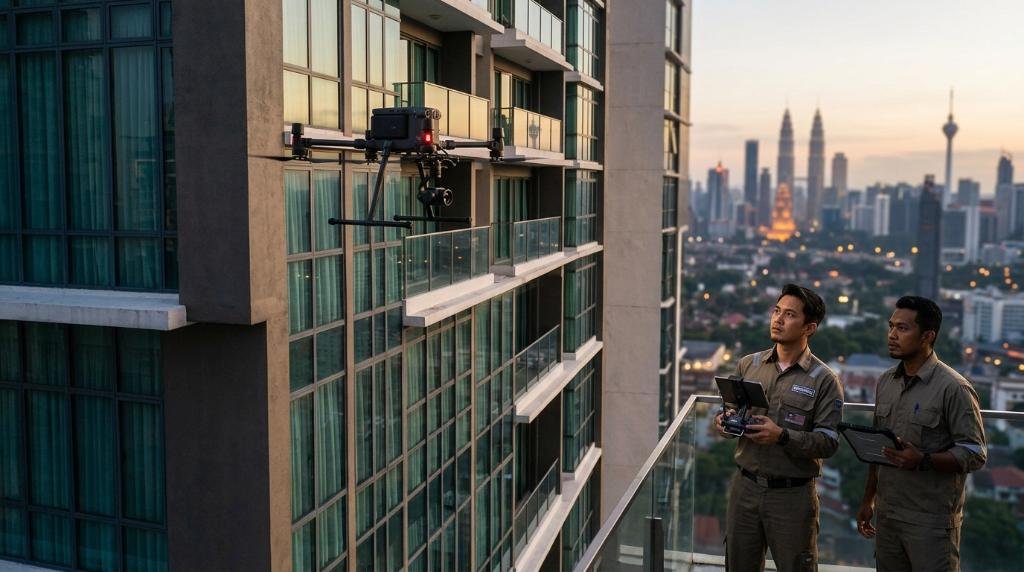
Finding the exact source of a moisture breach on a 40-storey tower using traditional methods is notoriously difficult and highly subjective. This is precisely why modern high-rise facade inspection is aggressively shifting away from risky rope access and gondolas, moving toward advanced, data-driven drone thermography.

The Reality of Condo Facade Failures in Malaysia
As an engineer deeply involved in forensics and defect resolution across Malaysia, I frequently witness the aftermath of compromised building envelopes. High-rise buildings here do not just sit statically; they breathe, expand, and contract. The thermal shock experienced when a 35°C sun-baked facade is suddenly hit by a 24°C tropical thunderstorm causes immense stress on elastomeric sealants, window frames, and exterior plastering.
These micro-movements eventually lead to hairline cracks in concrete shear walls or sealant failures along Aluminum Composite Panels (ACP). Once a breach occurs, positive wind pressure during a storm physically drives rainwater deep into the building envelope. Without comprehensive high-rise facade inspection protocols, these micro-fissures go entirely unnoticed until residents complain of peeling paint, black mold, or actively dripping ceilings.
Why Visual Inspections & QLASSIC Fall Short
Many property buyers are comforted when developers boast about high scores under the CIDB Malaysia Quality Assessment System in Construction (QLASSIC, as per CIS 7:2021) [1]. While QLASSIC has undoubtedly raised the baseline for architectural finishing in Malaysia, it is crucial to understand its limitations. QLASSIC is predominantly a visual sampling assessment conducted at the point of project completion [1]. It cannot predict long-term structural watertightness against hydrostatic pressure.
When a leak inevitably occurs, traditional defect checking relies on rope access (Spiderman) or gondolas. These methods are inherently flawed for three reasons:
- Subjectivity: A technician hanging from a rope can only inspect what is immediately in front of them, easily missing the true source of water tracking which may originate several floors above.
- Safety & Compliance: Deploying gondolas is highly restricted by weather and governed by strict DOSH guidelines.
- Time & Cost: Inspecting an entire high-rise facade manually can take weeks and drain strata maintenance funds.
The Science of Drone Water Leak Detection
This is where modern building maintenance technology changes the game completely. At Pro Inspect Solution, we bypass the limitations of human visual checking by utilizing advanced radiometric thermal imaging combined with unmanned aerial vehicles.
How Infrared (IR) Thermography Spots Hidden Moisture
Water has a significantly higher specific heat capacity than construction materials like concrete, brick, or aluminum. During the day, the building facade absorbs solar radiation. As the sun sets, the dry areas of the facade cool down rapidly. However, areas where moisture has penetrated and become trapped behind the rendering or ACP cladding will cool down at a much slower rate (or display evaporative cooling anomalies during the day).
Through drone water leak detection, we pilot high-resolution thermal cameras across the building envelope during optimal thermal crossover periods. The thermal sensors pick up these minute temperature differentials (Delta-T), rendering invisible trapped moisture as clear thermal anomalies on our monitors. This allows us to pinpoint the precise entry point of the water, not just the exit point where the damage is visible.

Navigating Property Developer QA and Defect Claims
The transition phase from developer management to a Joint Management Body (JMB) or Management Corporation (MC) is a critical period in Malaysian strata living. Under the Housing Development Act (HDA) Schedule H and the Strata Management Act 2013, there is a limited Defect Liability Period (DLP)—typically 24 months—during which the developer is legally bound to rectify structural flaws.
Without empirical evidence, JMBs often struggle to prove that facade leaks are systemic developer defects rather than normal wear and tear. Developers may apply superficial “patch-and-paint” fixes that merely mask the problem until the DLP expires. Once the DLP lapses, the financial burden of costly facade repairs falls entirely onto the parcel owners’ sinking fund.
To ensure robust property developer QA accountability, JMBs must secure forensic, irrefutable data before the DLP ends. A comprehensive drone thermography report provides timestamped, geolocated, and undeniable thermal evidence of systemic ingress. Should the developer refuse to undertake permanent rectification, these engineering reports serve as crucial evidence. In such scenarios, our specialized Expert Witness & Dispute Resolution services provide the authoritative testimony needed for tribunal success.
Our Methodology for Malaysia Condo Defect Checking
Conducting accurate Malaysia condo defect checking requires more than just knowing how to fly a drone. It requires deep structural engineering expertise to interpret the thermal data accurately. At Pro Inspect Solution, our methodology is meticulous:
- Environmental Assessment: We calculate optimal thermal crossover times based on local Malaysian weather patterns, solar loading, and building orientation.
- Automated Drone Flight: We execute pre-programmed, uniform flight paths to capture overlapping radiometric thermal and 4K visual data of the entire high-rise facade.
- Engineering Analysis: Our certified engineers analyze the thermal orthomosaics to identify false positives (e.g., reflections) and isolate genuine moisture anomalies.
- Actionable Reporting: We deliver a court-admissible, comprehensive report detailing the exact coordinates of every facade breach, prioritizing areas for immediate structural rectification.
To learn more about deploying this technology for your building, explore our dedicated Façade & Roof Inspection (Drone) service.
Conclusion: Protect Your Asset with Precision
A high-rise building is a multi-million ringgit asset that demands proactive, precise maintenance. Relying on outdated visual inspections leaves JMBs, MCs, and property owners financially vulnerable to hidden structural decay. By embracing drone thermography for high-rise facade inspection, you replace guesswork with irrefutable engineering data.
Stop Guessing Where the Leak is Coming From
If your condominium is facing persistent water ingress or your Defect Liability Period is coming to an end, don’t wait for the next monsoon season to reveal the damage.
Contact Pro Inspect Solution today:
WhatsApp Us Now at +60 16-806 4902
Frequently Asked Questions (FAQ)
How does drone water leak detection work for high-rise condos?
Drones equipped with high-resolution radiometric thermal cameras scan the building envelope. By measuring temperature differentials on the facade surface, the drone detects cold spots caused by trapped moisture or water ingress behind cladding, rendering, or ACP panels.
Why is QLASSIC certification not enough to prevent facade leaks?
CIDB’s QLASSIC (CIS 7:2021) is primarily a visual assessment of workmanship quality at the completion stage. It does not evaluate structural integrity over time or hidden moisture ingress, making specialized thermal drone inspections essential during the Defect Liability Period (DLP).
Are drone inspection reports valid for strata management disputes in Malaysia?
Yes. When prepared by certified engineers, thermal drone inspection reports provide irrefutable, timestamped data. These reports are heavily utilized by Joint Management Bodies (JMBs) and Management Corporations (MCs) for tribunal claims and expert witness testimonies under the Strata Management Act 2013.
