
By Ir Vimal | July 14, 2026
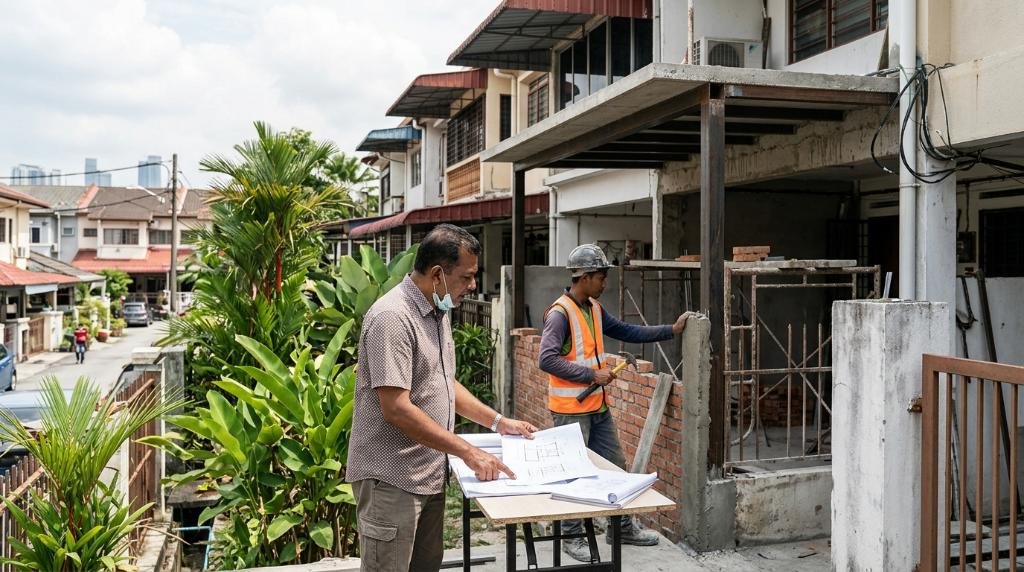
As a practicing Professional Engineer in Malaysia, I am frequently called upon to mediate or investigate structural failures that stem from a surprisingly common root cause: unapproved property modifications. What starts as a seemingly harmless desire for extra living space often spirals into a bitter neighbour renovation dispute Malaysia is unfortunately becoming famous for.
Whether you are dealing with a rogue contractor in a high-rise strata property or an aggressive terrace house expansion, the risks are identical. An illegal condo extension KL does not just violate local council guidelines—it introduces severe structural safety concerns that can compromise the integrity of the entire building block. At Pro Inspect Solution, we emphasize that protecting your asset requires proactive engineering oversight, not just reactive legal threats.
In this insider’s guide, we will break down the engineering realities of illegal extensions, how Malaysian laws like Act 133 and Act 757 come into play, and why booking a dilapidation survey before renovation is the ultimate shield for property owners.
Table of Contents
The Engineering Reality of an Illegal Condo Extension KL
Many homeowners view renovation purely through an aesthetic or spatial lens. However, from a structural engineering perspective, buildings in Malaysia are designed strictly according to established codes, specifically the Malaysian Standards (MS) and British Standards/Eurocodes (BS EN 1990 for Basis of Structural Design and MS EN 1992-1-1 for Concrete Structures).
When an illegal condo extension KL occurs—such as converting a cantilevered balcony into a heavy wet kitchen—the original load assumptions are completely violated. Balconies are typically designed for specific live loads (e.g., 1.5 to 2.0 kN/m²). Adding brick walls, heavy cabinetry, and concrete screed drastically increases the dead load. This leads to excessive shear stress at the structural supports.

The result? Deflection, concrete spalling, and severe diagonal tension cracks that inevitably propagate into the adjacent unit. This is exactly where severe structural safety concerns transition from a private mistake to a public hazard. Under Section 70 of the Street, Drainage and Building Act 1974 (Act 133), erecting a building or making structural alterations without the prior written permission of the local authority (such as DBKL or MBPJ) is a punishable offense.
Anatomy of a Neighbour Renovation Dispute in Malaysia
A neighbour renovation dispute Malaysia rarely starts in the courtroom; it starts with a hairline crack on a shared party wall or sudden water seepage through a ceiling slab. In strata-titled properties, such as condominiums in Mont Kiara or Cheras, the Strata Management Act 2013 (Act 757) clearly governs the management of common properties and the responsibilities of parcel owners.
Unfortunately, when damage occurs, the offending neighbour will almost always claim that the cracks were “already there.” Without empirical baseline data, it becomes a chaotic case of “he said, she said,” leading to expensive and prolonged litigation.
As property inspection specialists, we see homeowners lose thousands of Ringgit simply because they lacked the proper engineering documentation to prove causation. The burden of proof lies with the victim, making proactive measures essential.
Why a Dilapidation Survey Before Renovation is Your Ultimate Shield
If your neighbour announces an upcoming major renovation, a polite nod is not enough. Your immediate reaction should be to secure a dilapidation survey before renovation. This is not a generic home inspection; it is a specialized, legally binding engineering record of your property’s exact condition prior to any adjacent construction works.
At Pro Inspect Solution, our professional dilapidation survey strictly adheres to Construction Industry Development Board (CIDB) best practices. Here is why it is non-negotiable:
- Irrefutable Baseline Data: We map out existing pre-renovation anomalies (or lack thereof) with high-resolution photographic evidence and precise structural mapping.
- Deters Reckless Contractors: When the neighbouring contractor knows an independent Professional Engineer has documented your unit, they are forced to adhere to safe working protocols, reducing impact vibrations and structural risks.
- Streamlines Claims: If an illegal condo extension KL causes your party wall to crack, our post-renovation survey will conclusively link the damage to their works, empowering you for swift tribunal or legal victory.

Addressing Structural Safety Concerns: The Repair Phase
If the damage has already been done, superficial patching with putty is a dangerous mistake. Structural cracks signify internal stress failures that can compromise the stability of your home. The next crucial step is securing a structural repair consultancy to assess the severity of the load-bearing failure.
Professional structural repair involves evaluating the root cause (e.g., differential settlement or structural overloading) and specifying approved rectification methods, such as epoxy resin injection for structural cracks, carbon fiber reinforced polymer (CFRP) wrapping, or underpinning, all conforming to local engineering standards.
Step-By-Step Guide: How to Stay Secure
To summarize, if you are a homeowner facing potential risks from a neighbour’s construction, follow these insider steps to protect yourself against a neighbour renovation dispute Malaysia:
- Verify the Approvals: Ask your Joint Management Body (JMB) or Management Corporation (MC) if the renovation has received local council (DBKL/MBPJ) and strata management approvals.
- Commission a Dilapidation Survey: Do not wait for the hacking to start. Book a dilapidation survey before renovation commences.
- Monitor Vibrations and Debris: Keep a log of severe vibrations or water leakages during their hacking phase.
- Report Illegal Works: If you suspect an illegal condo extension KL (like tampering with structural columns or extending balconies), report it immediately to the local authority under Act 133.
- Engage Experts for Damage: If cracks appear, immediately halt the neighbour’s work via the JMB and contact a structural engineer to perform a structural integrity assessment.
Don’t Let a Neighbour’s Mistake Cost You Thousands
Protect your property with Malaysia’s leading engineering inspection experts. Secure your legally binding dilapidation report today.
Frequently Asked Questions (FAQ)
What should I do if my neighbour in Malaysia is renovating without a permit?
If you suspect an illegal condo extension KL or unauthorized renovation, you should immediately lodge a report with your local council (e.g., DBKL or MBPJ) under the Street, Drainage and Building Act 1974. Additionally, engage a professional engineer to conduct a property inspection to ensure your structural integrity is not compromised.
How does a dilapidation survey prevent a neighbour renovation dispute in Malaysia?
A dilapidation survey before renovation establishes a legally binding, photographic, and structural baseline of your property’s existing condition. If their renovation subsequently causes structural cracks or water leaks, you have irrefutable engineering proof to claim damages in a tribunal or civil court.
Are structural cracks from a neighbour’s extension dangerous?
Yes. Unapproved extensions often ignore Malaysian Standards (MS EN 1990) for structural loads. If your property exhibits new diagonal or shear cracks during a neighbour’s construction, it signifies serious structural safety concerns requiring immediate structural repair consultancy.
