
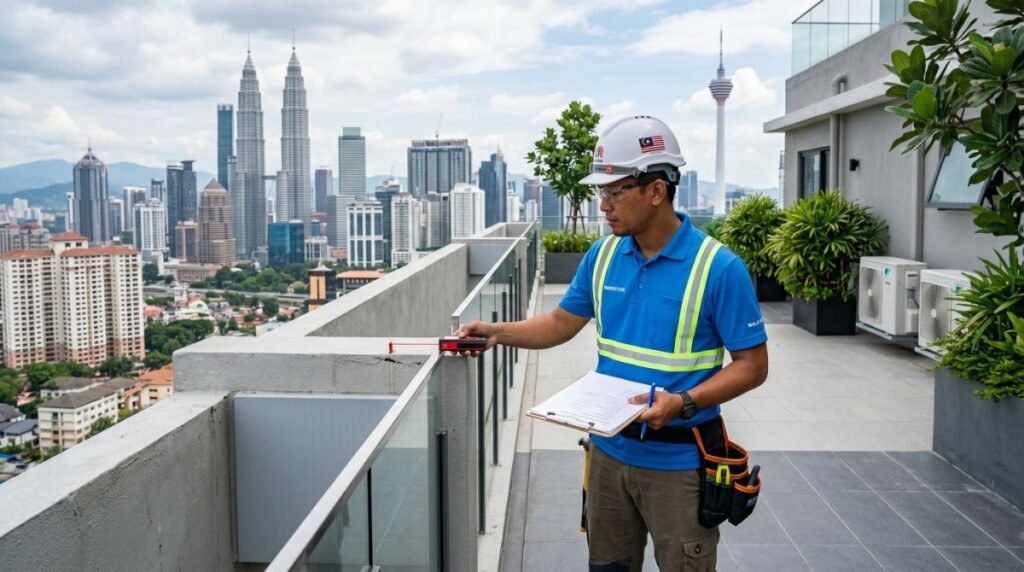
By Ir Vimal, Professional Engineer | Published on October 5, 2026
Acquiring residential property in Malaysia represents one of the most consequential financial milestones a homeowner or property investor will ever undertake. Whether taking delivery of Vacant Possession (VP) for a stratified high-rise condominium in Mont Kiara or purchasing a mature sub-sale bungalow in Petaling Jaya, an independent, engineering-backed physical condition assessment protects capital, mitigates financial exposure, and safeguards structural safety. Thorough technical scrutiny identifies latent defects, non-compliant building practices, and structural distress before warranty periods lapse or purchase deeds become legally binding.
Need an engineer on site? Pro Inspect Solution provides house defect inspection in Malaysia across KL, Selangor and Malaysia. This article is a general guide.
Table of Contents
- Legal Framework: VP, DLP, and Sub-Sale Caveat Emptor
- Selecting a Certified Building Inspector in Malaysia
- Engineering Inspection Protocols: Architectural, Structural & M&E
- Common Building Defects in the Malaysian Tropical Climate
- Technical Defect Reports, QLASSIC Scoring, and Statutory Forms
- Enforcing Developer Rectification and Negotiating Sub-Sale Escrow
- Frequently Asked Questions (FAQ)
Legal Framework: VP, DLP, and Sub-Sale Caveat Emptor
Executing an effective property inspection in Malaysia requires a clear understanding of the statutory distinctions between newly handed-over properties and second-hand sub-sale properties. For new residential developments regulated under the Housing Development (Control and Licensing) Act 1966 (Act 118), standard contracts fall under Schedule G (landed title properties) and Schedule H (strata-titled developments). Homebuyers enjoy a statutory 24-month Defects Liability Period (DLP) that commences immediately upon the official notice of Vacant Possession.
Engaging a specialized property defect inspection (DLP) team during this critical window ensures that latent construction defects, architectural finishes non-conformances, and installation faults are formally cataloged. Developers are legally mandated to rectify verified defects at their sole expense pursuant to housing legislation monitored by the Ministry of Housing and Local Government (KPKT).
For stratified units, purchasers must also navigate the Strata Management Act 2013 (Act 757). Under Section 84 of Act 757, statutory presumption governs inter-floor leakage: when dampness or active water infiltration penetrates a ceiling slab, the upstairs parcel owner or developer is legally presumed liable until conclusive diagnostic evidence proves otherwise. Conversely, sub-sale residential transactions are governed by the strict legal doctrine of caveat emptor (let the buyer beware). Without pre-purchase technical due diligence or explicit contractual warranties incorporated into the Sales and Purchase Agreement (SPA), the financial burden of all structural movement, plumbing corrosion, or slab seepage shifts unreservedly to the purchaser upon title transfer.

Selecting a Certified Building Inspector in Malaysia
The Malaysian property assessment landscape spans from informal snagging handymen to fully licensed engineering consultancies. When inspection findings must withstand legal arbitration, tribunal challenges, or contractual negotiations, homeowners must verify that inspection firms satisfy recognized statutory credentials and testing standards:
- Statutory Registration: Ensure your building inspection and structural audits are overseen by certified engineers registered with the Board of Engineers Malaysia (BEM) in compliance with the Registration of Engineers Act 1967.
- Standardized Workmanship Benchmarks: Top-tier inspection agencies grade architectural elements according to the Construction Industry Standard (CIS 7:2021) Quality Assessment System in Construction (QLASSIC), an objective framework established by the Construction Industry Development Board (CIDB) Malaysia.
- Calibrated NDT Instrumentation: Authoritative inspectors deploy specialized Non-Destructive Testing (NDT) tools, including thermal imaging cameras, pinless electromagnetic moisture meters, ultrasonic pulse velocity (UPV) testers, digital RCD trip-time analyzers, and rotary laser levels rather than superficial visual estimations.
- Baseline Context & Adjacent Risks: If major civil excavation, underground utility tunneling, or road widening borders your property, establish pre-construction baseline records through a formal dilapidation survey to protect against adjacent ground movement claims.
Engineering Inspection Protocols: Architectural, Structural & M&E
A professional home inspection adheres to the statutory mandates of the Uniform Building By-Laws 1984 (UBBL 1984) and the Street, Drainage and Building Act 1974 (Act 133). Comprehensive diagnostic engineering evaluations systematically cover five core building categories:
1. Structural Integrity & Concrete Framing
Engineers evaluate structural framing, including reinforced concrete (RC) columns, transfer beams, load-bearing shear walls, and floor slabs. Critical focus is placed on differential foundation settlement, spalling concrete caused by carbonation, exposed corroded rebar, and active shear fractures (cracks exceeding 0.3mm in width). In cases involving deep structural cracking or design overloading, a professional structural repair consultancy should be engaged to specify structural carbon-fiber reinforced polymer (CFRP) wrapping or structural underpinning solutions.
2. Roof Systems & Building Envelopes
Malaysia's tropical downpours and thermal cycles inflict intense expansion stress on roof trusses, valleys, and parapet walls. Complete roof assessments require an advanced façade and roof inspection using drone technology to safely survey inaccessible pitch profiles, slipped clay tiles, deteriorating underlay membrane barriers, and debris-blocked internal box gutters.
3. Wet Areas, Plumbing & Slab Waterproofing
Bathrooms, balconies, and utility wash yards are subjected to 24-hour flood retention testing to verify the physical integrity of liquid-applied acrylic membranes or torch-on bituminous membranes. Drainage gradients, cleanout access points, and water supply pressures are audited to eliminate trap seal evaporation and foul sewer gas backflow.
4. Mechanical & Electrical (M&E) Systems
Audits of electrical sub-circuits verify compliance with Suruhanjaya Tenaga (Energy Commission) and MS IEC 60364 installation codes. Technicians inspect earth loop impedance, verify phase polarity across all 13A socket outlets, confirm dedicated 10mA RCD protection for wet-area circuits, and run infrared thermal profiling on distribution boards (DB) to detect loose terminals and high-resistance arcing.
5. Architectural Craftsmanship & Finishes
Wall plaster verticality, hollow tile debonding (using specialized acoustic tapping rods against CIS 7 tolerances), aluminum frame perimeter mastic sealing, and powder-coated window weatherstripping are inspected to prevent interior water ingress during high-wind monsoonal squalls.

Common Building Defects in the Malaysian Tropical Climate
The combination of high ambient humidity, heavy monsoonal precipitation, and intense solar radiation makes residential properties in Malaysia particularly susceptible to distinct defect types:
- Efflorescence and Slab Delamination: Water pooling on inadequately sloped balconies or unsealed wet-area pipe collars leaches free calcium hydroxide from the concrete matrix, forming white salt stalactites on lower floor ceilings.
- Debonded & Buckling Ceramic Tiles: Inadequate adhesive contact area (dot-dabbing instead of full notched-trowel coverage), insufficient perimeter expansion gaps, and thermal cycling cause floor tiles to "pop" under stress.
- Fungal Growth & Interstitial Dampness: Missing or bridged damp-proof courses (DPC) in brick footings combined with leaking internal plumbing generate capillary moisture rise, fostering toxic black mold (Stachybotrys chartarum) colonies on drywall linings and skim coats.
- Hidden Plumbing Joint Failures: Inadequately solvent-welded PVC soil pipes or defective heat-fused PPR water supply joints inside concealed wall chases cause steady internal water seepage that rots built-in timber cabinetry.
- Subterranean Termite Infestations: In landed developments, aggressive subterranean termite species (Coptotermes gestroi) exploit micro-fissures in foundation ground slabs to hollow out timber architraves, parquet flooring, and roof battens.
Technical Defect Reports, QLASSIC Scoring, and Statutory Forms
Following an on-site engineering audit, homeowners receive a technical defect report containing high-resolution photographic evidence, localized floor plan markups, root-cause analyses, severity categorizations, and references to CIS 7 quality criteria. For purchasers within their statutory DLP, these entries are transferred onto the developer's formal handover defect submission register.
Defect entries are prioritized into three operational tiers: Critical Safety Hazards (such as lack of circuit earthing or structural shear fractures), Functional Failures (such as active pipe leaks, ponding slabs, and misaligned safety doors), and Cosmetic Imperfections (such as uneven paint coats, surface crazing, or minor tile edge chips). Distinct categorizations ensure that property developers cannot deprioritize urgent safety and building integrity repairs under the guise of general aesthetic touch-ups.
Enforcing Developer Rectification and Negotiating Sub-Sale Escrow
Under Clauses 26 and 27 of Schedule G and H, developers are allowed a maximum statutory period of 30 days from the date of written notice to complete defect rectifications. Should the developer default or fail to rectify within the 30-day window, the law permits the buyer to serve a formal notice of intention, engage licensed independent contractors to execute the remedial works, and recover full repair expenses directly from the stakeholder lawyer holding the statutory 5% retention sum.
In sub-sale real estate acquisitions, an engineering inspection report serves as an authoritative commercial negotiating tool. Backed by quantifiable structural defect assessments and itemized repair cost estimates, prospective purchasers can request direct price concessions, establish an escrow repair fund held by stakeholder conveyancing solicitors, or require critical structural rectifications as contractual conditions precedent prior to executing the unconditional SPA. Thorough engineering scrutiny guarantees that your Malaysian property remains structurally secure, compliant with building bylaws, and financially sound throughout its ownership lifecycle.
Frequently Asked Questions (FAQ)
When is the best time to conduct a house defect inspection?
For primary market properties, the defect inspection should be conducted immediately upon receiving Vacant Possession keys and before starting any renovation or interior fit-out work. For sub-sale properties, the audit must take place during the pre-contract due diligence window before signing the unconditional Sale and Purchase Agreement.
How long does an engineering-grade house inspection take?
A comprehensive architectural, structural, and M&E inspection of a standard condominium or terrace house typically requires between 2.5 to 4 hours. Larger landed properties, bungalows, and sites requiring drone-assisted roof audits may take 4 to 6 hours on site.
Can a developer reject a certified defect inspection report?
No. Developers cannot arbitrarily dismiss verified construction defects that contravene the Housing Development Act, the Uniform Building By-Laws 1984, or CIDB CIS 7 quality standards. If a developer refuses to rectify legitimate defects, buyers can submit their claims to the Homebuyer Claims Tribunal (Tribunal Tuntutan Pembeli Rumah) under KPKT.
What is the difference between snagging and a professional engineering inspection?
Basic snagging focuses primarily on visible cosmetic flaws, such as paint drips, minor chips, and scratched glass. A professional engineering inspection uses non-destructive testing tools to evaluate structural concrete performance, electrical earthing compliance, concealed dampness, and building bylaw adherence.
Contact Us / Certified Inspection & Engineering Consultation
Pro Inspect Solution, led by Ir Vimal, Professional Engineer, provides certified building condition assessments, structural integrity audits, handover defect inspections, and professional engineering advisory across Malaysia.
- 📍 Service Coverage: Kuala Lumpur, Selangor, and Nationwide Malaysia
- 📞 Phone / WhatsApp: +60 16-806 4902
- ✉️ Official Inquiries: inspectsolution.pro@gmail.com
- 🌐 Official Website: proinspectsolution.com
- 👷♂️ Lead Engineer: Authored & verified by Ir Vimal, Professional Engineer
Need Certified Property Inspection or Building Audit Services?
Get instant consultation and professional engineering advice from Pro Inspect Solution.
