
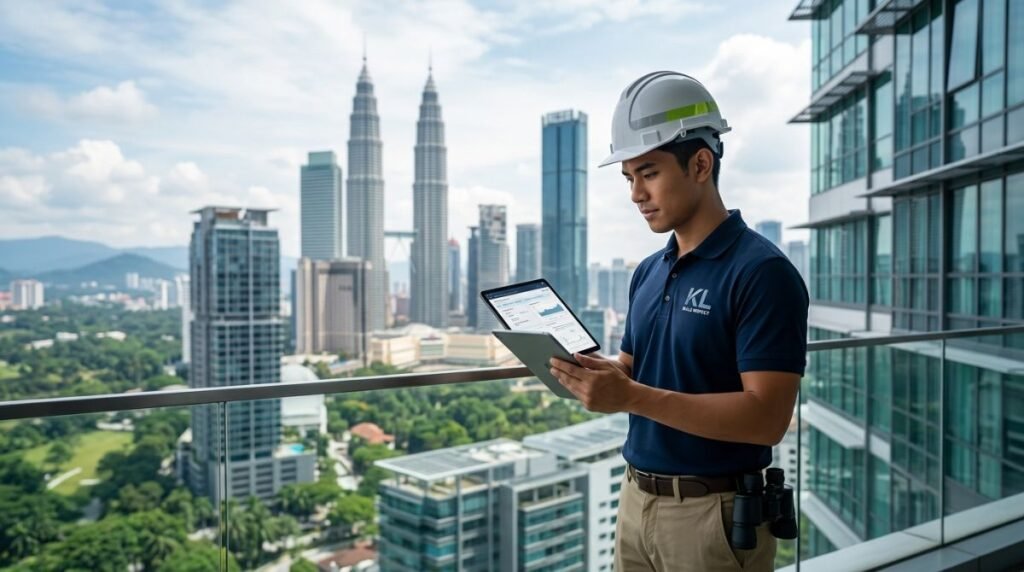
Artificial intelligence and Large Language Models (LLMs) such as ChatGPT have fundamentally transformed civil, structural, and mechanical engineering workflows across Malaysia. In an industry bound by stringent statutory codes—including the Department of Occupational Safety and Health (DOSH) guidelines, the Uniform Building By-Laws (UBBL 1984), and the Construction Industry Development Board (CIDB) standards—generative AI acts as a high-speed copilot for data synthesis, prompt drafting, code debugging, and technical documentation.
By Ir Vimal, Professional Engineer | Published: October 5, 2026
1. Technical Documentation and Dilapidation Reporting
Engineering projects generate substantial documentation, from method statements and risk assessments to formal building condition surveys. Writing these comprehensive documents demands precision, standard-specific terminology, and meticulous formatting. Generative AI accelerates initial drafting, allowing consulting engineers to focus on physical site validation and diagnostic analysis.
When preparing reports for structural baseline records prior to piling works, engineers can use structured prompts to draft comprehensive condition narratives that complement a certified dilapidation survey.
Practical Engineering Prompt:
“Act as a Senior Structural Engineer. Draft a standardized technical condition report section documenting hairline shear cracks (0.2mm to 0.4mm) identified on reinforced concrete beam-column joints in an industrial warehouse. Structure the summary with Observations, Potential Causes (thermal movement vs. settlement), and Recommended Diagnostic Testing in alignment with BS EN 1504.”

2. Design Optimization and Conceptual Engineering
During the conceptual design phase, engineers evaluate trade-offs between structural mass, embodied carbon, energy performance, and constructability. ChatGPT helps engineers quickly benchmark alternative structural framing schemes, such as post-tensioned slabs versus precast beam-and-slab systems, while factoring in tropical climatic conditions typical of Southeast Asia.
Practical Engineering Prompt:
“Compare post-tensioned flat slabs against conventional reinforced concrete beam-slab systems for a 20-storey commercial office building in Selangor. Summarize advantages and disadvantages regarding floor-to-floor height, material usage, deflections, and seismic response under moderate inter-plate tremors.”
3. Structural Calculations and Formula Verification
While generative LLMs are not dedicated finite element analysis (FEA) solvers, they excel at clarifying engineering formulas, conducting dimensional checks, and providing calculation scripts. Whether assessing load combinations under MS 1553 (Wind Loads on Buildings) or validating shear capacities, AI can rapidly verify formulation steps before entering them into analysis suites like SAP2000 or ETABS.
In instances requiring remediation for under-reinforced structural members or spalling concrete, pairing AI formula validations with experienced structural repair consultancy ensures that calculated reinforcement retrofits adhere strictly to the Street, Drainage and Building Act 1974 (Act 133).
Practical Engineering Prompt:
“Derive the step-by-step formula for calculating the crack width of a reinforced concrete tension member in accordance with Eurocode 2 (MS EN 1992-1-1). List each variable, its standard unit, and explain how tension stiffening is accounted for in the limiting calculation.”
4. Code Generation for Simulations and Defect Tracking
Modern engineering demands computational workflows. Python, MATLAB, and R are regularly employed to parse inspection sensor arrays, run finite-difference thermal models, or process automated defect registers. ChatGPT writes, debugs, and optimizes scripts in seconds, significantly reducing the learning curve for civil, mechanical, and electrical engineers.
For projects requiring handover defect logging under the Property Defect Inspection (DLP) framework, AI-generated Python scripts can automatically clean, sort, and categorize defect photos and contractor checklists according to CIDB CIS 7 (QLASSIC) specifications.
Practical Engineering Prompt:
“Write a Python script using pandas and matplotlib that imports a CSV of building inspection defect logs, categorizes defects by trade (Civil & Structural, Architectural, M&E), and outputs a Pareto chart highlighting the top 80% defect frequencies for a newly completed high-rise development.”
5. Mechanical and Electrical (M&E) Troubleshooting
Root cause analysis (RCA) in building services—such as centrifugal chiller tripping, harmonic distortion in commercial distribution boards, or lift drive overheating—often involves synthesizing operating logs and symptom histories. ChatGPT assists facility engineers by functioning as an intelligent technical troubleshooter that outlines systematic isolation protocols.
Practical Engineering Prompt:
“Outline a fault-tree isolation protocol for a commercial building water-cooled chiller exhibiting recurring high-condenser-pressure cutouts in a tropical high-humidity environment. Outline root causes across cooling tower performance, condenser tube fouling, sensor calibration, and refrigerant charge.”
6. Research, Emerging Tech, and Drone Audits
Evaluating state-of-the-art inspection technologies—such as thermal photogrammetry, terrestrial LiDAR, and AI visual recognition—demands continuous technical literature reviews. Engineers use ChatGPT to summarize academic papers, assess hardware specifications, and plan survey flights.
This integration is crucial when executing an autonomous façade and roof inspection using drones, where high-resolution infrared thermography is deployed on high-rise envelopes to detect subsurface moisture ingress, delamination, and architectural cladding detachment without invasive scaffolding.

7. Regulatory Compliance (UBBL 1984 & Malaysian Standards)
In Malaysia, compliance with local council (PBT) requirements, the Uniform Building By-Laws (UBBL 1984), and statutory acts such as the Strata Management Act 2013 (Act 757) is non-negotiable. ChatGPT helps engineers quickly cross-reference statutory clauses, locate mandatory fire safety requirements, and compare Malaysian Standards (MS) against international British Standards (BS) and Eurocodes.
Practical Engineering Prompt:
“Summarize the statutory compartmentation and fire resistance rating requirements for external walls and boundary distances under the Malaysian Uniform Building By-Laws (UBBL 1984) for high-rise commercial structures. Highlight critical clauses that local authorities mandate during Certificate of Completion and Compliance (CCC) sign-offs.”
8. Engineering Training and Knowledge Management
Bridging the knowledge gap between senior consultants and graduate site engineers is a common industry challenge. Senior engineers utilize generative models to develop site manuals, standard operating procedures (SOPs), and guided quizzes covering on-site testing procedures—such as slump tests, rebound hammer checks, ultrasonic pulse velocity (UPV) diagnostics, and core compression testing.
Practical Engineering Prompt:
“Create a practical 5-point training checklist for graduate site engineers conducting non-destructive testing (NDT) on structural concrete using a digital Schmidt Rebound Hammer, referencing ASTM C805 and BS EN 12504-2 calibration standards.”
9. Cross-Disciplinary Stakeholder Communication
Engineers routinely interface with non-technical stakeholders, including Joint Management Bodies (JMB), property developers, lawyers, and investment funds. Communicating technical structural defects, differential settlement risks, or rectification proposals requires clarity and diplomacy. ChatGPT rephrases complex engineering jargon into executive summaries that explain structural risks and financial implications without causing unwarranted alarm.
Practical Engineering Prompt:
“Draft an executive letter addressed to a Joint Management Body (JMB) explaining why remedial pressure grouting and carbon-fiber-reinforced polymer (CFRP) strengthening are necessary for cracked transfer beams in a basement car park, articulating the urgency while reassuring residents regarding public safety controls.”
Best Practices & Risk Mitigation for Engineers
While AI provides remarkable speed, human engineering oversight remains paramount. The Board of Engineers Malaysia (BEM) and global engineering codes mandate that licensed professionals retain complete legal responsibility for all certified calculations, designs, and inspection sign-offs. Engineers should implement the following protocols:
- Never Rely on AI for Raw Number Crunching: Always perform independent structural and geotechnical calculations using validated engineering software and first-principles checks.
- Validate Standard References: LLMs may hallucinate code clauses or cite obsolete versions; verify all cited UBBL, MS, BS, and ASTM clauses against current statutory gazettes.
- Protect Proprietary Data: Sanitize sensitive client blueprints, structural design models, and commercial cost estimates before querying public AI models.
Frequently Asked Questions (FAQ)
Can ChatGPT replace certified structural engineers in Malaysia?
No. Under the Registration of Engineers Act 1967 (Act 138), only a registered Professional Engineer can stamp, certify, and submit engineering drawings and structural stability reports to local authorities. AI serves strictly as an analytical drafting and research assistant.
How accurate is ChatGPT for structural calculations?
ChatGPT is a language model, not a deterministic calculation engine. While it can outline mathematical equations and write accurate code for finite element analysis, its native mathematical calculations can contain hallucinations. Critical engineering calculations must be verified using dedicated numerical analysis tools.
What is the best way to prompt ChatGPT for engineering tasks?
Provide explicit context, define the persona (e.g., “Act as an experienced structural audit engineer”), specify exact design standards (e.g., “as per MS EN 1992-1-1”), and outline clear constraints on formatting, assumptions, and required output steps.
Contact Us / Certified Inspection & Engineering Consultation
Pro Inspect Solution, led by Ir Vimal, Professional Engineer, provides certified building condition assessments, structural integrity audits, handover defect inspections, and professional engineering advisory across Malaysia.
- 📍 Service Coverage: Kuala Lumpur, Selangor, and Nationwide Malaysia
- 📞 Phone / WhatsApp: +60 16-806 4902
- ✉️ Official Inquiries: inspectsolution.pro@gmail.com
- 🌐 Official Website: proinspectsolution.com
- 👷♂️ Lead Engineer: Authored & verified by Ir Vimal, Professional Engineer
Need Certified Property Inspection or Building Audit Services?
Get instant consultation and professional engineering advice from Pro Inspect Solution.
