
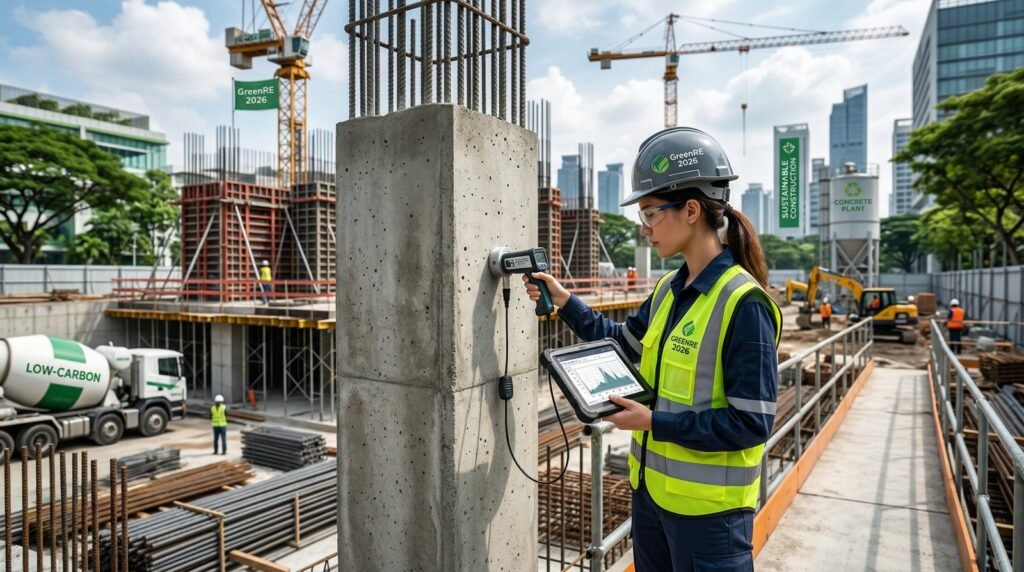
As the Malaysian construction industry accelerates towards a greener future, developers, property owners, and contractors are facing increasingly stringent environmental regulations. Leading this charge is the push for GreenRE 2026 compliance, a pivotal benchmark in Malaysia sustainable construction. At the heart of meeting these new sustainability goals lies a crucial innovation: the Low-Carbon Concrete Mix Design.
At Pro Inspect Solution, we understand that balancing structural integrity, cost-efficiency, and environmental responsibility is paramount. This comprehensive guide explores how transitioning to green concrete, validated by rigorous audits and Non-Destructive Testing (NDT), is not just an environmental necessity, but a strategic advantage for your next project.
1. Understanding GreenRE 2026 Compliance
Established to drive the adoption of green building practices, GreenRE is Malaysia’s leading green building certification body. The upcoming GreenRE 2026 compliance standards will place an unprecedented emphasis on reducing the “embodied carbon” of building materials. Embodied carbon refers to the greenhouse gas emissions arising from the manufacturing, transportation, installation, and disposal of building materials.
For contractors and developers, this means that traditional, high-clinker ordinary Portland cement (OPC) mixtures will no longer meet the stringent requirements of premier sustainable developments. To achieve high GreenRE ratings—which often translate to better financing rates, higher property valuations, and regulatory incentives—projects must drastically lower their carbon footprint right from the foundational pouring phase. You can read more about global initiatives on concrete’s environmental footprint through the World Green Building Council (WorldGBC).
2. The Core of Sustainability: Low-Carbon Concrete Mix Design
The cornerstone of reducing embodied carbon in any structural project is implementing a Low-Carbon Concrete Mix Design. Traditional concrete production is notoriously carbon-intensive, primarily due to the calcination process of limestone required to create cement clinker.
What Makes a Mix Design “Low-Carbon”?
A Low-Carbon Concrete Mix Design utilizes Supplementary Cementitious Materials (SCMs) to replace a significant percentage of OPC. Common SCMs include:
- Pulverized Fuel Ash (PFA) / Fly Ash: A byproduct of coal-fired power plants that enhances workability and long-term strength.
- Ground Granulated Blast-furnace Slag (GGBS): Sourced from steel manufacturing, GGBS significantly reduces carbon emissions while improving durability against chemical attacks.
- Silica Fume: Used for high-performance, high-strength concrete applications.
While the environmental benefits are clear, replacing cement with SCMs changes the rheology, setting time, and early-age strength development of the concrete. This is where professional Concrete Technology Consultancy becomes indispensable. Our experts at Pro Inspect Solution formulate optimized mix designs that not only meet GreenRE 2026 compliance but also adhere to stringent Malaysian structural codes.

3. The Crucial Role of a Ready-Mix Batching Plant Audit
Having a brilliant Low-Carbon Concrete Mix Design on paper is only half the battle. If the ready-mix supplier fails to accurately proportion the materials, control the water-to-cementitious ratio, or manage the moisture content of aggregates, the concrete’s structural integrity and green credentials will be compromised.
Conducting a comprehensive Ready-Mix Batching Plant Audit ensures that the plant possesses the technical capability, calibrated equipment, and quality control systems necessary to produce complex low-carbon mixes reliably. During an audit, our consultants evaluate:
- Calibration records of weighing scales and dispensers.
- Storage conditions of sensitive SCMs like GGBS and Fly Ash to prevent moisture contamination.
- Automated batching software parameters to ensure strict adherence to the approved mix design.
- Quality assurance protocols for fresh concrete, including slump and temperature controls.
By enforcing strict quality control at the source, developers can prevent costly on-site rejections and structural remediation later in the project timeline.
4. Validating Quality with Non-Destructive Testing NDT
Because low-carbon concrete often exhibits different curing behaviors—such as slower early-strength gain—validating the in-situ quality of the hardened concrete is critical. This is achieved through Non-Destructive Testing NDT.
NDT allows our engineers to assess the concrete’s strength, uniformity, and durability without causing any damage to the structural elements. Essential NDT methods used in concrete audits include:
- Rebound Hammer Test: Provides a quick assessment of surface hardness and compressive strength uniformity.
- Ultrasonic Pulse Velocity (UPV): Measures the speed of sound waves through the concrete to detect internal voids, honeycombing, and crack depths.
- Cover Meter Surveys: Ensures the steel reinforcement has adequate concrete cover, which is vital for long-term corrosion protection in Malaysia’s humid environment.
- Carbonation Depth Testing: Assesses the concrete’s resistance to carbon dioxide penetration, a crucial factor for the longevity of structures using high volumes of SCMs.
If NDT reveals substandard concrete properties, property developers can rely on our Structural Repair Consultancy to design effective, targeted remediation strategies that restore safety and compliance without requiring total demolition.

5. Integrating Sustainable Practices with Lifecycle Building Inspections
Sustainable construction doesn’t end when the concrete cures. True sustainability involves maximizing the lifespan of a building while minimizing future resource consumption. Pro Inspect Solution offers a suite of services designed to maintain and monitor structural health throughout a building’s lifecycle.
For new developments reaching the handover stage, a meticulous Property Defect Inspection (DLP) ensures that all construction elements, including concrete finishes, meet the required standards before the liability period expires.
For existing portfolios, routine Periodic Building Inspections and comprehensive Building Condition Assessments help property owners identify minor wear and tear before it escalates into major structural failure. By integrating advanced technology, such as our Façade & Roof Inspection (Drone), we can efficiently safely assess hard-to-reach areas, ensuring your asset remains safe, compliant, and sustainable for decades.
6. Why Choose Pro Inspect Solution?
Achieving Malaysia sustainable construction goals requires more than just good intentions; it requires deep technical expertise. Pro Inspect Solution bridges the gap between ambitious GreenRE 2026 targets and on-the-ground construction realities.
Our team of certified engineers and concrete technologists brings decades of experience to your project. From formulating the initial Low-Carbon Concrete Mix Design to executing rigorous batching plant audits and verifying in-situ quality via Non-Destructive Testing NDT, we protect your investment at every phase. We are committed to helping Malaysian developers build safer, greener, and more resilient structures.
7. Frequently Asked Questions (FAQs)
What is a Low-Carbon Concrete Mix Design?
A Low-Carbon Concrete Mix Design is an engineered formulation that significantly reduces the use of ordinary Portland cement (OPC) by substituting it with sustainable alternatives like fly ash, slag (GGBS), or silica fume. This drastically lowers the overall embodied carbon of the concrete while maintaining or improving structural durability.
Why is GreenRE 2026 compliance important for developers in Malaysia?
GreenRE 2026 compliance represents the next generation of green building standards in Malaysia. Achieving this compliance not only helps combat climate change but also increases property value, unlocks green financing options, and ensures properties remain competitive in an increasingly eco-conscious market.
How does a Ready-Mix Batching Plant Audit protect my project?
A Ready-Mix Batching Plant Audit verifies that the concrete supplier has the proper equipment, calibrated scales, and quality control procedures to produce your low-carbon mix design accurately. It prevents substandard concrete from ever reaching your site, saving time, money, and structural risks.
Is Non-Destructive Testing (NDT) accurate for assessing green concrete?
Yes. Non-Destructive Testing NDT, when performed by experienced engineers, is highly accurate for evaluating the in-situ compressive strength, density, and integrity of low-carbon concrete without damaging the structure. It is a critical tool for quality validation.
Ready to Optimize Your Concrete Mix for GreenRE 2026?
Partner with Pro Inspect Solution for expert Concrete Technology Consultancy, Batching Plant Audits, and NDT services. Ensure your next project is sustainable, compliant, and structurally sound.
