
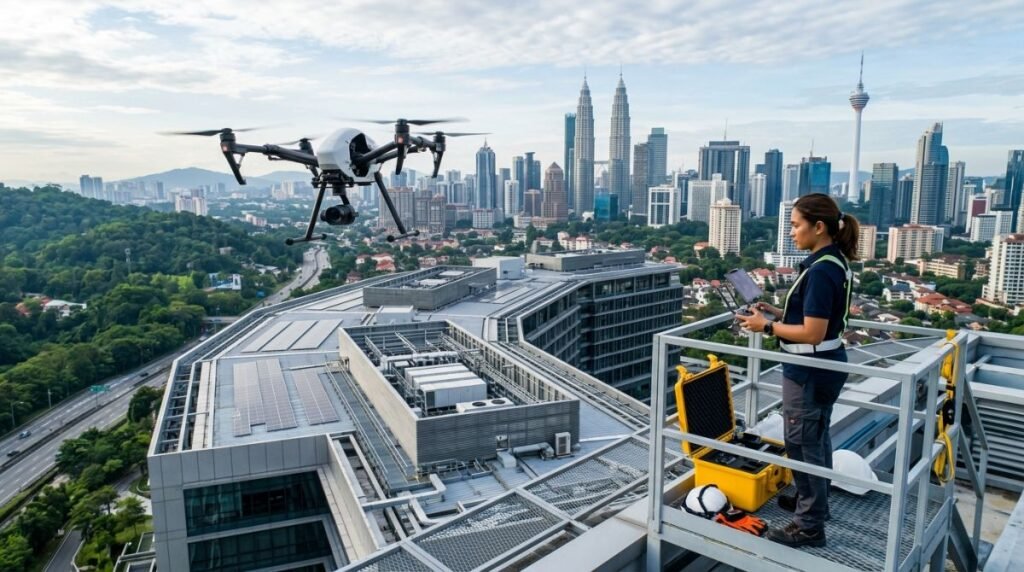
Kuala Lumpur, Malaysia — October 5, 2026
As Malaysia navigates the intensified monsoons and localized flash storms of late 2026, building owners, Joint Management Bodies (JMB), Management Corporations (MC), and industrial plant directors face a formidable operational hurdle: maintaining the structural water-tightness of vast roof envelopes. Recent meteorological patterns highlighted by The Star underscore how sudden, torrential cloudbursts exploit minor roof defects, leading to catastrophic internal inundation, machinery downtime, and structural degradation.
Historically, commercial roof inspections in Malaysia relied on manual rope access, scaffolding, or skylift cranes. These traditional methodologies carry immense occupational safety hazards under Department of Occupational Safety and Health (DOSH) frameworks, demand disruptive site closures, and frequently fail to pinpoint subsurface water entrapment. Deploying a professional drone roof inspection Malaysia solution has transitioned from an innovative luxury into an essential engineering benchmark. By pairing high-payload unmanned aerial vehicles (UAVs) with calibrated optical zoom and radiometric infrared sensors, facility managers can now detect hidden structural anomalies with pinpoint accuracy while keeping personnel safely on the ground.
The Shift from Hazardous Manual Audits to Aerial Drone Roof Inspections
Roof inspection of high-rise commercial towers and sprawling industrial warehouses in industrial corridors such as Shah Alam, Pasir Gudang, and Bayan Lepas has traditionally been one of the highest-risk facilities management tasks. Under the DOSH Guidelines for Prevention of Falls at Workplaces, building custodians hold a statutory duty of care to eliminate fall-from-height hazards wherever reasonably practicable.
Erecting scaffolding or renting 40-meter mobile elevating work platforms (MEWPs) routinely incurs tens of thousands of ringgit in preliminary logistics before an inspector even sets eyes on the target area. Furthermore, physical foot traffic across aging corrugated metal decks, fragile skylight panels, or weathered torch-on waterproofing membranes frequently punctures the very protective layers inspectors are trying to evaluate.
Modern Façade & Roof Inspection (Drone) methodologies completely redefine this paradigm. An industrial drone audit allows qualified engineers to survey several hundred thousand square feet of complex roof architecture in a single shift. High-resolution 48-megapixel optical cameras identify physical anomalies such as loose sheet lap fasteners, rusted metal decking, blocked perimeter box gutters, and degraded perimeter flashing with millimeter-level precision, all executed from an established terrestrial ground control station.

Navigating CAAM Drone Regulations & CAD 6011 Compliance
Deploying an aerial platform over a Malaysian commercial property, industrial compound, or dense urban mixed-development is governed strictly by the Civil Aviation Authority of Malaysia (CAAM) under the Malaysian Civil Aviation Regulations 2016 (MCAR 2016) and Civil Aviation Directives (CAD) 6011.
Flying an off-the-shelf consumer drone over a factory or commercial asset without statutory regulatory clearances exposes property owners and corporations to heavy financial penalties, confiscation of equipment, and severe liability under the Civil Aviation Act 1969 (Act 3). Legitimate commercial drone inspection demands rigorous operational planning:
- Remote Pilot Competency: Drone pilots must hold valid CAAM-accredited remote pilot certifications (such as RCOC-B) demonstrating verified competency in multi-rotor flight control, fail-safe procedures, and emergency return-to-home protocols.
- Special UAS Operational Authorization: Commercial flights conducted within controlled airspace (CTR)—especially zones proximate to airports such as Sultan Abdul Aziz Shah Airport (Subang), KLIA, or Senai—require formal flight authorization permits from CAAM and coordination with local air traffic control (ATC).
- Public & Structural Safety Buffer Zones: Standard operating procedures demand pre-survey risk assessments (SORA), terrestrial cordon perimeters, and clear separation margins from public vehicular roadways and overhead electrical transmission lines.
By engaging an accredited engineering consultancy like Pro Inspect Solution, asset owners bypass operational and legal liabilities. Our certified pilots and professional engineers orchestrate the full regulatory clearance pipeline, securing all necessary CAAM authorizations prior to site deployment.
Industrial Drone Thermal Imaging: Detecting Subsurface Moisture Ingress
Visual inspections alone are fundamentally inadequate for flat concrete roofs, multi-ply built-up roofing (BUR), and thermoplastic polyolefin (TPO) single-ply membranes common across modern Malaysian logistics hubs. Water ingress rarely begins with an overt, gaping fissure; it manifests as microscopic seepage that travels through insulation boards and settles above the structural concrete slab, invisible to optical lenses.
Industrial drone thermal imaging leverages quantitative infrared thermography (IRT) governed by international standards including ASTM C1153 (Standard Practice for Location of Wet Insulation in Roofing Systems Using Infrared Imaging). The thermal diagnostic workflow operates on the principle of differential thermal capacitance:
During daytime solar loading, dry roof insulation and saturated insulation absorb heat. As the sun sets, dry substrate materials dissipate thermal energy rapidly, whereas trapped moisture exhibits high thermal mass, retaining latent heat much longer. Radiometric thermal drone sensors capture these temperature deltas (often differing by 2°C to 6°C), rendering subsurface moisture saturation as brilliant, glowing anomalies.
These thermal orthomosaic maps provide quantifiable boundary markers of trapped water pockets. Instead of replacing an entire 50,000-square-foot roof membrane costing hundreds of thousands of ringgit, facility teams can accurately slice out and remediate only the compromised insulation sections during scheduled Property Defect Inspection (DLP) periods before warranties expire.

5 Strategic Advantages of Drone Roof Audits for Industrial & Commercial Assets
Integrating unmanned aerial robotics into your property lifecycle and maintenance schedules unlocks immediate operational and financial advantages:
- Zero-Harm Risk Elimination: Completely removes the requirement for technicians to walk on steep pitches or structurally compromised roof surfaces, slashing corporate exposure under the Occupational Safety and Health (Amendment) Act 2022.
- Accelerated Inspection Velocities: Large-scale industrial plants spanning multiple hectares that once required two weeks of manual climbing and rigging are comprehensively mapped in 24 to 48 hours.
- Sub-Millimeter Orthomosaic Mapping: Photogrammetry algorithms process thousands of overlapping aerial snapshots into georeferenced 2D digital twins and 3D point-cloud models, pinpointing defect coordinates down to the millimeter.
- Predictive Maintenance Budgeting: Early identification of minor sealant failures, seam delamination, and corrosion stops moisture before it corrodes primary structural steel rafters, preventing catastrophic structural repairs.
- Defensible Baseline Records for Legal & Insurance Audits: High-resolution radiometric and optical deliverables serve as unassailable chronological proof during a Dilapidation Survey or when resolving warranty disputes under the Strata Management Act 2013 (Act 757).
Integrating Aerial Telemetry with Structural Remediation & Statutory Audits
Drone telemetry is only as dependable as the engineering acumen interpreting the raw pixels. A repository of uncurated aerial photos provides zero actionable legal or technical value to a corporate board or JMB. Professional drone roof auditing demands the diagnostic oversight of an accredited professional engineer.
Under Section 85A of the Street, Drainage and Building Act 1974 (Act 133), local municipal councils (such as DBKL, MBPJ, and MBSA) mandate periodic visual and structural inspections of buildings exceeding five storeys or reaching specific age thresholds. Drone surveys provide the foundational baseline data required for these statutory engineering submissions.
When aerial infrared scans reveal extensive moisture retention, or when visual sensors uncover severe concrete spalling along roof parapets, the telemetry directly informs our specialized Structural Repair Consultancy. Rather than implementing temporary patchwork sealants, our engineering team specifies root-cause remedial solutions—such as polyurethane (PU) chemical grouting, carbon fiber reinforced polymer (CFRP) composite strengthening, or modified elastomeric re-roofing systems—engineered to withstand Malaysia’s equatorial climate for decades.
Frequently Asked Questions (FAQ)
How does a drone roof inspection compare in cost to traditional scaffolding in Malaysia?
A commercial drone roof inspection is typically 40% to 70% more cost-effective than traditional scaffolding or boom-lift rentals. Traditional methods incur heavy capital expenditure for transport, erection, dismantling, and road closure permits, whereas drone audits require zero structural staging and can be mobilized in hours.
Can drone inspections detect roof leaks if it is not currently raining?
Yes. By utilizing radiometric industrial thermal sensors during dusk or sunset, drones detect trapped moisture beneath the waterproofing membrane due to heat dissipation differentials (thermal capacitance). Water absorbed beneath the surface retains heat longer than dry materials, revealing hidden leaks days after the rain has stopped.
Who handles CAAM flight permits for our commercial facility?
When you engage Pro Inspect Solution, our certified flight team and professional engineers manage the entire regulatory submission. We handle airspace risk assessments, flight authorizations under CAD 6011, and coordinate with air traffic control where necessary, ensuring complete legal indemnity for the property owner.
Are drone roof inspection reports accepted for statutory compliance and insurance claims?
Yes. Our comprehensive inspection reports are endorsed by a registered Professional Engineer, providing verified photographic, thermal, and geospatial documentation. These engineering reports are fully compliant for local authority submissions under Act 133, Strata Management Act 757 documentation, and corporate insurance claims.
Contact Us / Certified Inspection & Engineering Consultation
Pro Inspect Solution, led by Ir Vimal, Professional Engineer, provides certified building condition assessments, structural integrity audits, handover defect inspections, and professional engineering advisory across Malaysia.
- 📍 Service Coverage: Kuala Lumpur, Selangor, and Nationwide Malaysia
- 📞 Phone / WhatsApp: +60 16-806 4902
- ✉️ Official Inquiries: inspectsolution.pro@gmail.com
- 🌐 Official Website: proinspectsolution.com
- 👷♂️ Lead Engineer: Authored & verified by Ir Vimal, Professional Engineer
Need Certified Property Inspection or Building Audit Services?
Get instant consultation and professional engineering advice from Pro Inspect Solution.
