
By Ir Vimal, Professional Engineer | June 26, 2026
Professional Engineer (PEng) providing an insider’s perspective on Malaysian structural integrity and compliance.
The Silent Epidemic of Illegal House Renovations in Malaysia
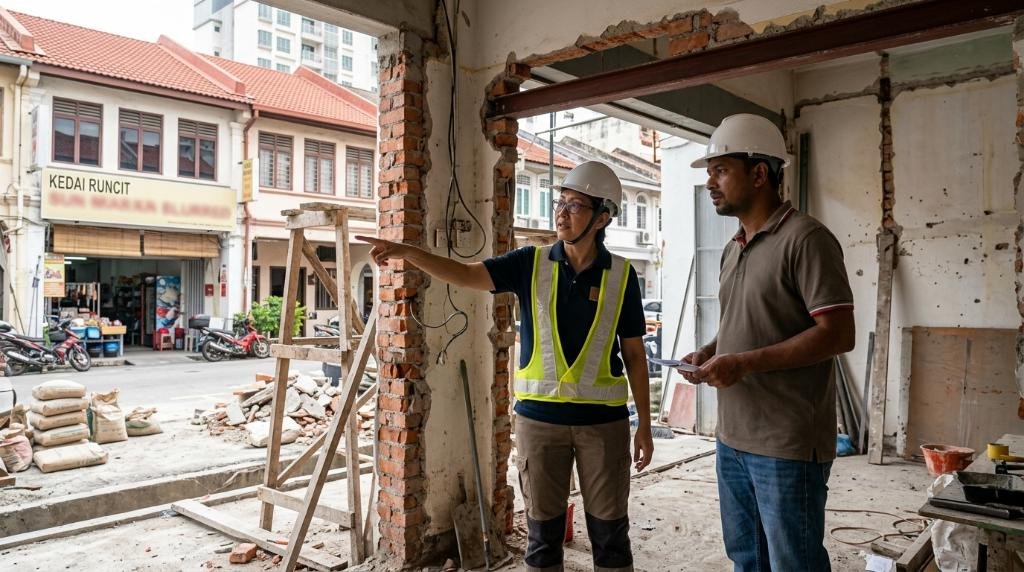
Walk down any established terrace house neighborhood in the Klang Valley, and you will undoubtedly spot them: cantilevered balconies defying gravity, rear kitchen extensions encroaching into back lanes, and removed internal walls to create a modern “open concept.” While aesthetically pleasing, a significant percentage of these modifications are legally and structurally compromised. In my years evaluating local structures, the sheer volume of illegal house renovations across Malaysia represents a ticking time bomb for property buyers and existing homeowners.
Many contractors operate with a “build first, ask later” mentality. However, from a structural engineering standpoint under the Board of Engineers Malaysia (BEM) and Construction Industry Development Board (CIDB) guidelines, overlooking standard protocols is dangerous. We evaluate structural safety based on MS EN 1992 (Malaysia’s National Annex to Eurocode 2 for concrete). When homeowners bypass these standards, they compromise the building’s integrity, risk severe penalties from local authorities, and drastically diminish the property’s market viability.
The Engineering Reality of Unpermitted Structural Changes
When you remove a load-bearing wall or add an entirely new floor without proper engineering calculations, you are redistributing the dead and live loads of the entire structure. Most Malaysian terrace and semi-detached homes were built with specific tolerance limits based on original soil investigations and foundation designs.
Unpermitted structural changes often lead to differential settlement. A cheap contractor might use Y10 steel bars instead of the required high-tensile Y12 or Y16 reinforcement bars for a beam, or pour concrete that fails to meet Grade 25 or Grade 30 strength requirements. The immediate result isn’t a dramatic collapse; it is micro-cracking, excessive deflection, and concrete spalling over a period of three to five years.

Without the oversight mandated by the Ministry of Housing and Local Government (KPKT), homeowners frequently end up paying double: once for the shoddy construction, and again for professional structural underpinning and retrofitting when the building begins to fail.
Decoding Local Council Renovation Approval
A common misconception among Malaysian homeowners is that if an extension is at the back of the house where nobody can see it, it doesn’t require permits. Under the Street, Drainage and Building Act 1974 (Act 133), any structural addition, alteration, or roofing modification legally requires local council renovation approval.
Navigating the DBKL renovation guidelines (or equivalents like MBPJ, MBSJ, and MPKj) isn’t just bureaucratic red tape—it’s a fundamental safety net. These councils require architectural drawings and structural calculations endorsed by a registered Principal Submitting Person (PSP), typically an Architect or Professional Engineer. They ensure:
- Proper setbacks are maintained for fire safety (Bomba requirements).
- The existing drainage system can handle the increased surface water runoff, mitigating flash flood risks.
- Ventilation and natural lighting minimums are met to comply with the Uniform Building By-Laws (UBBL) 1984.
Failing to secure these approvals means you do not possess a valid Certificate of Completion and Compliance (CCC) for the extension. If a neighbor complains or a council enforcement officer spots the ongoing work, you face immediate Stop Work Orders, hefty compounds, and potentially forced demolition at your own expense.
Property Valuation Risks in Malaysia
As an expert in the field, I often consult with property buyers who are heartbroken when their bank loan is rejected despite having excellent credit. The culprit? Property valuation risks Malaysia.
When you attempt to sell a home with illegal extensions, professional valuers registered with the Board of Valuers, Appraisers, Estate Agents and Property Managers (BOVAEP) are obligated to cross-check the built-up area against the approved floor plan. If your beautifully renovated 3,000 sq ft home is legally only registered as a 2,000 sq ft property because of unapproved extensions, the valuer will exclude the unpermitted 1,000 sq ft from the valuation report.
Consequently, the property’s formal valuation plummets. Banks will not finance illegal structures. In 2026, compliance audits are stricter than ever. Buyers are becoming savvier, often demanding proof of council approvals and turning to a dedicated home inspection firm to audit a property before signing the Sale and Purchase Agreement (SPA).
Expert Methods: Spotting Red Flags Early
If you are viewing a newly renovated sub-sale property, how can you spot the markers of illegal or structurally unsound modifications? Look for these engineering red flags:
1. Diagonal Shear Cracks at Corners
Standard plaster cracks are common and usually harmless. However, deep, stair-step cracks or diagonal cracks radiating at 45-degree angles from window or door frames indicate structural distress. This occurs when an unauthorized top floor puts unbearable shear force on a ground-floor wall not designed to carry the load.
2. Mismatched Roof Lines and Sagging Ridges
Stand across the street and look at the roof. Unapproved rear extensions often tie into the existing roof truss poorly. If you see a distinct sag where the old roof meets the new roof, or if water is pooling in the valley gutters, the contractor likely bypassed proper load distribution calculations.

3. Blocked Inspection Chambers
Many illegal kitchen extensions simply build over the Indah Water Konsortium (IWK) sewer inspection chambers at the back lane. If you cannot locate the manhole cover, or if it’s cemented over in the new wet kitchen, the renovation is undeniably illegal. This guarantees future maintenance nightmares.
4. Immediate Lack of Documentation
Always ask to see the approved stamped drawings from the local council. If the seller or agent gives excuses like “it was done a long time ago” or “the previous owner lost the papers,” treat the entire renovation as suspect. In Malaysia, council records can always be verified.
Conclusion: Protect Your Investment
The allure of maximizing space without the “hassle” of permits is a trap. Illegal house renovations disguise structural hazards, invite legal prosecution, and drastically devalue your asset when it is time to sell. Always insist on adherence to Malaysian engineering standards and secure your council approvals before breaking ground.
If you are planning to purchase a renovated sub-sale property, do not leave structural integrity to chance. Getting a comprehensive technical evaluation from an expert like Pro Inspect Solution is the smartest investment you can make to safeguard your finances and your family’s safety.
Suspect structural issues in your property?
Don’t wait for minor cracks to become major failures. Speak directly with engineering inspection professionals.
Frequently Asked Questions (FAQ)
- What happens if I buy a house with illegal house renovations?
- As the new registered owner, you inherit the liability. Local councils can issue you fines, and you will be responsible for the cost of either applying for retrospective approvals (if technically possible) or demolishing the unpermitted structures.
- How do unpermitted structural changes affect my home insurance?
- Insurance companies can easily void your fire or peril policies if investigations reveal that unpermitted structural changes contributed to structural failure or fire spread, leaving you completely unprotected.
- Are DBKL renovation guidelines different from other municipal councils?
- While the foundational Uniform Building By-Laws (UBBL) apply nationwide, DBKL renovation guidelines often contain specific local requirements regarding construction working hours, waste disposal bins (Roll-On-Roll-Off), and specific setback measurements unique to Kuala Lumpur’s density.
- Is there a way to legalize an old illegal extension?
- Sometimes, yes. You can hire an Architect or Engineer to draw up the ‘as-built’ plans and submit them for local council renovation approval retrospectively. However, if the extension violates fundamental safety or setback rules, the council will reject the application and order demolition.
