
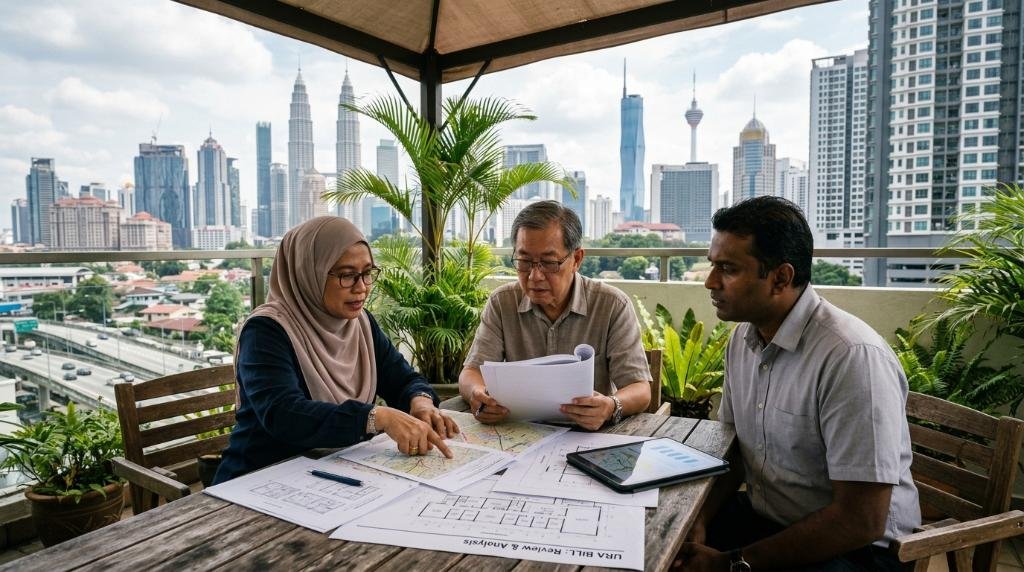
Expert Review: How The URA Bill Impacts Property Owners
By Ir Vimal, Professional Engineer | June 26, 2026
The highly anticipated Urban Redevelopment Act (URA) has officially shifted from an abstract policy discussion to imminent reality. As we navigate the second half of 2026, the URA Bill impacts have become the central focal point for property stakeholders nationwide. Spearheaded by the Ministry of Housing and Local Government (KPKT), the proposal to lower the en-bloc sale consent threshold from an impossible 100% down to a pragmatic 75% for aging stratified buildings is drastically rewriting the future of Malaysian real estate.
However, beyond the heated legal debates frequently headlining today’s Malaysia property news, a fundamental technical reality is being overlooked. As a Professional Engineer leading Pro Inspect Solution, I can state categorically: urban renewal is not merely an administrative exercise. Urban Renewal Act developers and Joint Management Bodies (JMBs) cannot simply declare a structure “old” to justify demolition. The entire en-bloc mechanism is heavily reliant on clear, documented engineering data to prove a building has reached the end of its safe, serviceable lifespan.
The URA Bill: Why the 75% Threshold Changes Everything
Historically, the Strata Titles Act 1985 required unanimous 100% consent from all parcel owners to terminate a strata scheme and sell the land for redevelopment. This created a major bottleneck; a single dissenting voice or untraceable owner could stall the rejuvenation of heavily dilapidated, unsalvageable buildings. The URA essentially unties this legislative knot.
By lowering the threshold to 75% for older buildings, the government is aligning Malaysia with progressive urban frameworks seen in Singapore and Hong Kong. For property owners stuck in aging flats plagued with failing plumbing, chronic concrete spalling, and skyrocketing maintenance levies, the URA Bill impacts offer a lucrative, safe exit strategy. Conversely, for developers, this unlocks prime urban land previously trapped in legal limbo.
Insider Take: The Engineering Reality of Malaysian Buildings
Let’s step away from the boardroom and look at the actual concrete. Under Construction Industry Development Board (CIDB) guidelines, a standard commercial or residential high-rise is engineered for a 50-year design life. Yet, due to a severe historic deficit in preventative maintenance cultures and Malaysia’s unforgiving tropical weathering, we routinely witness structures failing well before their time.

In the Klang Valley alone, thousands of strata properties built in the 1980s and 1990s are exhibiting Stage 3 corrosion. The heavy monsoons and high ambient humidity cause rapid concrete carbonation, dropping the pH levels within the concrete matrix and stripping the passivating layer around the internal rebar. Once the rebar oxidizes and expands, it triggers explosive spalling. Additionally, many of these older structures were designed prior to the strict wind-loading parameters formalized in MS 1553:2002. They simply were not built to withstand the modern micro-climate extremes we see today. The URA isn’t just about gentrification—it is an emergency response to failing structural integrity.
Structural Defect Checks: The Pre-Requisite to Redevelopment
To successfully trigger an en-bloc sale under the proposed URA mechanics, stakeholders must substantiate the building’s dilapidation. The authorities require hard proof that retrofitting the building is either structurally impossible or economically unviable. This mandate triggers a vital need for comprehensive structural defect checks.
Visual walkthroughs are no longer sufficient. At Pro Inspect Solution, we implement advanced diagnostic tools to capture the true structural health of an asset. For sheer walls and inaccessible high-rise exteriors, we rely heavily on specialized Façade & Roof Inspection (Drone) methodologies. Using high-resolution aerial thermography, we can detect subsurface delamination, moisture pooling, and structural cracking that the naked eye misses entirely.
Navigating MS EN and BS Standards in Defect Reporting
A legitimate defect assessment must map against recognized engineering standards. We benchmark our defect identification against the Malaysian Standard MS 2038 (Code of Practice for Building Inspection) and BS EN 1504 (Products and systems for the protection and repair of concrete structures). When an inspection yields precise, standardized classifications of material failure, the justification for urban redevelopment becomes legally airtight.
The Essential Building Condition Report
The ultimate deliverable required to sway both the regulatory bodies and the 75% consensus of owners is the building condition report. This document is the cornerstone of any en-bloc negotiation.

A poorly drafted report filled with generic observations will likely be contested by the remaining 25% minority owners, causing extensive legal delays. A professional Building Condition Assessment provides an objective, quantified analysis. It covers the structural integrity of the foundations, load-bearing columns, roof structural integrity, facade stability, and critical M&E (Mechanical and Electrical) degradation.
For Urban Renewal Act developers looking to acquire older plots, commissioning this building condition report during the early due-diligence phase mitigates massive financial risk, ensuring that the target acquisition genuinely qualifies for redevelopment under the URA guidelines.
Legal and Market Ramifications: Malaysia Property News Today
Keeping an eye on FMT and other major media outlets, it is clear the URA Bill is acting as a massive catalyst for the construction sector. However, it also demands accountability. Property owners must not be displaced without fair market valuations, and those valuations are intrinsically tied to the structural lifecycle remaining on the property.
For JMBs and Management Corporations (MCs), the message is clear: whether you plan to refurbish your aging building or aim for an en-bloc sale, possessing an updated, PE-endorsed engineering audit is your strongest asset.
Frequently Asked Questions (FAQ)
To summarize the core discussions surrounding the upcoming legislation, here are the most common inquiries we receive from property owners:
What is the Urban Redevelopment Act (URA) in Malaysia?
The URA Bill is a proposed legislation intended to lower the en-bloc consent threshold from 100% to 75% for older stratified buildings, accelerating urban renewal.
How do the URA Bill impacts affect property owners?
Property owners can now collectively redevelop properties easier, but face the necessity of empirical structural defect checks to prove a building’s dilapidation.
Why is a building condition report essential before redevelopment?
A building condition report delivers engineering proof of a structure’s safety and remaining lifespan. This report guides developers and joint management bodies on the viability of rehabilitation versus demolition.
Secure Your Property’s Future Today
The changing legal landscape demands rigorous engineering clarity. Whether you are a developer scoping a potential URA acquisition, or a strata owner concerned about the failing safety of your building, empirical data is your only safeguard.
Do not leave your multi-million ringgit investments to chance or visual guesswork. For authoritative structural defect checks, drone-assisted inspections, and comprehensive building assessments, contact our professional engineering experts at Pro Inspect Solution.
Ready to schedule an assessment?
Message us on WhatsApp 60168064902 today.
