
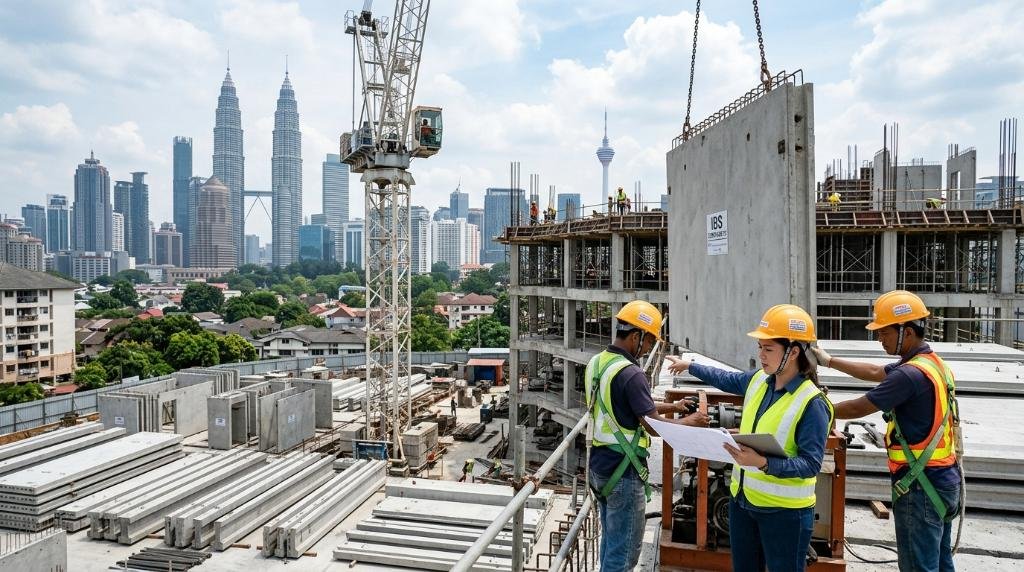
By Ir Vimal, Professional Engineer
KUALA LUMPUR, July 7, 2026 — For decades, the skyline of Malaysia has been forged by sweat, timber formwork, and the continuous pouring of cast-in-situ concrete. However, as the demands for structural integrity, speed, and sustainability escalate, the traditional brick-and-mortar approach is rapidly becoming a relic. As an engineer who has inspected hundreds of residential and commercial structures across the Peninsula, I have witnessed first-hand the transformation driven by IBS construction Malaysia.
The transition toward the Industrialised Building System is not just a passing trend; it is a fundamental restructuring of how we build, governed by stringent standards and driven by an urgent need for efficiency.
An Insider’s Perspective on Traditional Failures vs. IBS Precision
If you have ever dealt with severe honeycombing in structural columns, spalling concrete, or chronic wall cracking in a new property, you have experienced the pitfalls of conventional construction. Traditional methods are heavily reliant on unskilled foreign labor, leaving wide margins for human error. Uneven curing times and inconsistent concrete vibration often result in structural defects that are only uncovered years later during independent building assessments.

The Industrialised Building System drastically shifts this paradigm. By manufacturing components—from load-bearing walls to staircases—in a controlled factory environment, we achieve a level of dimensional accuracy that cast-in-situ simply cannot match. The concrete is cured under optimal conditions, ensuring the compressive strength consistently meets the BS EN 1992-1-1 (Eurocode 2) standards adopted in Malaysia. The result? A denser, more durable matrix that inherently resists the aggressive weathering common in our tropical climate.
Decoding CIDB Guidelines and Malaysian Standards
The push for IBS is not entirely organic; it is heavily regulated and mandated. The Construction Industry Development Board (CIDB) has been instrumental in this shift. Under the current CIDB guidelines, achieving a minimum IBS Score is no longer optional for major developments. Government projects mandate an IBS Score of at least 70, while private developments in major municipalities are increasingly required to hit the 50-point mark.
But what does this mean for property developers and contractors? It means adapting to a new rulebook. Components must now comply with MS 1064 (Guide to Modular Coordination in Buildings) to ensure interoperability between different manufacturers. As engineers, when we review the Structural Drawings for an IBS project, our focus shifts from verifying on-site rebar laps to analyzing the localized stresses at connection joints—because in IBS, the building is only as strong as its connections.
From High-Rises to Building Modular Classrooms
While the Klang Valley skyline highlights the success of precast concrete in luxury high-rises, the true societal impact of IBS is often found in rural Malaysia. One of the most critical applications in recent years has been building modular classrooms to replace dilapidated schools in Sabah, Sarawak, and rural Peninsular Malaysia.
Traditional construction in remote areas is plagued by logistical nightmares—transporting wet concrete and raw materials over unpaved roads often compromises material quality. Utilizing lightweight IBS components (such as steel framing and precast lightweight panels), contractors can transport flat-packed structures and assemble them on-site in a matter of weeks. As highlighted in various reports by The Star regarding the Ministry of Education’s infrastructure upgrades, this method not only bypasses the logistical bottlenecks but provides structurally sound, well-ventilated learning environments for students faster than ever before.
Eco-Friendly Construction: The Unspoken Advantage
As Environmental, Social, and Governance (ESG) criteria become critical in property development, the conversation inevitably turns to sustainability. Eco-friendly construction is a core benefit of IBS that goes beyond marketing jargon.
- Waste Reduction: Traditional sites generate massive amounts of timber waste from formwork and concrete wastage. IBS factory production operates on exact material calculations, reducing waste by up to 60%.
- Lower Carbon Footprint: Reduced on-site machinery operation and fewer material transport trips directly lower greenhouse gas emissions.
- Site Disturbance: Noise and dust pollution are major grievances in urban Malaysian construction. By shifting the “dirty work” to a factory, localized pollution in dense residential areas is drastically minimized.

The Realities on the Ground: Where IBS Can Fail
Despite its advantages, IBS is not a silver bullet. From an engineering inspection standpoint, precast construction introduces its own set of vulnerabilities, primarily at the joints. The gap between two precast panels must be seamlessly grouted and sealed.
In my field experience, when a contractor lacks specialized training in IBS assembly, we see catastrophic sealant failures. Poorly applied polyurethane (PU) sealants or incorrectly mixed non-shrink grout leads directly to severe water seepage during the monsoon season. Furthermore, alignment tolerances are microscopic. If a foundation is cast with a 10mm deviation, forcing a rigid precast wall into place can induce internal stresses that lead to shear cracking over time.
This is why elevating the standard of Malaysian construction requires more than just adopting new technology; it demands rigorous, specialized supervision and uncompromising quality control during the assembly phase.
Frequently Asked Questions (FAQ)
What is IBS construction in Malaysia?
The Industrialised Building System (IBS) is a modern construction technique where components are manufactured in a controlled off-site environment, transported, and assembled on-site. This method minimizes wet trades and significantly improves precision.
Why are CIDB guidelines so strict on IBS scores?
CIDB enforces strict IBS scores to reduce the industry’s reliance on unskilled foreign labor, enhance occupational safety, and elevate the overall quality and sustainability of Malaysian construction projects.
Can IBS prevent water leakage in high-rise buildings?
While IBS provides superior concrete density and reduces honeycombing, preventing water leakage requires rigorous joint detailing and sealant application during assembly. Poorly supervised jointing remains a leading cause of seepage in precast structures.
Ensure Your Property Meets the Highest Engineering Standards
Whether you are dealing with potential defects in a newly handed-over precast home or require professional engineering oversight for your property, expert assessment is non-negotiable. Don’t leave your investment to chance.
Speak directly with a qualified professional today: Chat with Us on WhatsApp (+60 16-806 4902) for an expert consultation on your property’s structural and architectural integrity.
