
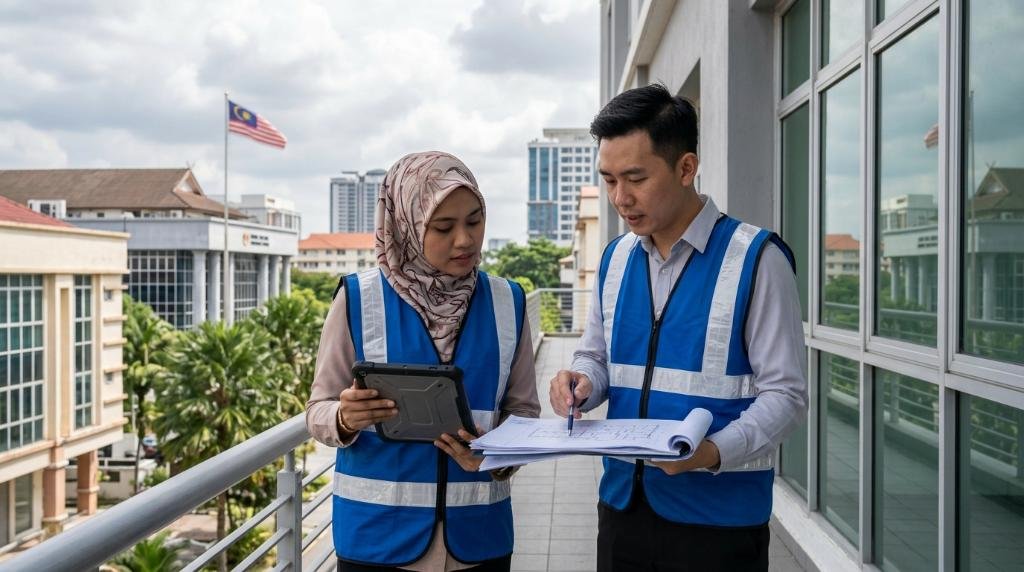
If you manage or own a high-rise building in Petaling Jaya, receiving an official notice from Majlis Bandaraya Petaling Jaya (MBPJ) regarding Section 85A Act 133 can be a stressful experience. Often, JMBs (Joint Management Bodies) and MCs (Management Corporations) scramble to find the cheapest consultant to tick the compliance box. As a practicing engineer in Malaysia, I can tell you firsthand: treating building safety as a mere commodity is a costly mistake.
Malaysia’s aggressive tropical climate—characterized by relentless UV exposure and torrential monsoons—accelerates structural degradation far faster than in temperate regions. When we perform a Pemeriksaan Bangunan Berkala (Periodic Building Inspection), we aren’t just looking for paperwork compliance. We are looking at carbonation-induced corrosion, facade delamination, and critical structural fatigue that, if ignored, leads to catastrophic localized failures.
This guide provides a definitive, engineering-led perspective on how to secure your Certificate of Completed Inspection, navigate MBPJ’s stringent requirements, and actually protect your property asset in the process.
Table of Contents
1. The Reality of Section 85A Act 133
Under the Street, Drainage and Building Act 1974 (Act 133), Section 85A legally mandates that any building exceeding five storeys must undergo a thorough structural inspection 10 years after its Certificate of Fitness for Occupation (CFO) or Certificate of Completion and Compliance (CCC) is issued. Subsequent inspections are required every 10 years.
Many property managers mistake this for a simple visual walkthrough. However, the legislation expects a rigorous assessment of structural integrity. MBPJ is increasingly strict on enforcement. Recent high-profile building defects reported in local media outlets like The Star and FMT have pressured local authorities to crack down on overdue inspections.
From an engineering standpoint, ensuring compliance means validating the structure against established Malaysian Standards (MS EN 1992 for concrete) and guidelines set by CIDB Malaysia. Failing to comply not only risks heavy fines (up to RM100,000) but also invalidates your building insurance in the event of an incident.

2. Why Standard MBPJ Building Inspections Fail (An Engineer’s Take)
In my years of conducting professional property inspections across Malaysia, I’ve seen countless “budget” inspection reports rejected by local councils. Why? Because commodity inspectors provide generic “copy-paste” visual reports that lack technical depth.
Here is what an authentic MBPJ building inspection must address, which generic inspections often miss:
- Spalling Concrete & Carbonation: In older Petaling Jaya commercial blocks built in the 1990s, the concrete cover often carbonates. A visual check just notes “cracked paint,” but a proper engineering assessment uses Non-Destructive Testing (NDT) to measure the depth of carbonation and rebar corrosion.
- Hidden Water Ingress: Flat reinforced concrete (RC) roofs are notorious in Malaysia. Poor waterproofing membranes degrade under our intense sun. We map out moisture pockets before they compromise the underlying reinforcement steel.
- Facade Delamination: Plaster and tiles shearing off high-rises pose a massive public safety risk. This is rarely visible from the ground floor.
When you hire Pro Inspect Solution, you are paying for risk mitigation, not just a bound piece of paper. We identify micro-failures before they require million-ringgit rectifications.
3. The 5-Step Pemeriksaan Bangunan Berkala Process
Navigating the bureaucracy to obtain your Certificate of Completed Inspection doesn’t have to be a headache. Here is the exact roadmap we utilize to ensure your building complies with MBPJ requirements:
Step 1: Preliminary Visual Assessment
A registered Professional Engineer (PE) conducts a comprehensive macro-level review of the building, checking structural elements like beams, columns, shear walls, and slabs for signs of distress.
Step 2: Non-Destructive Testing (NDT)
If defects are spotted, we deploy NDT methods (such as Rebound Hammer tests, Ultrasonic Pulse Velocity, or Half-cell Potential Mapping) to assess the internal health of the concrete without damaging the structure.
Step 3: Preparation of Form B
Under Section 85A Act 133, the findings must be documented in a specific format (Form B). We detail the building’s condition, root cause analysis of any defects, and precise structural recommendations based on BS EN 1504 repair standards.
Step 4: Official MBPJ Submission
We submit the certified structural report directly to MBPJ’s Building Control Department (Jabatan Kawalan Bangunan).
Step 5: Issuance of Certificate of Completed Inspection
Upon satisfactory review, the local council will issue the certificate, clearing your building for the next 10 years. Start this seamless process today by booking our specialized Pemeriksaan Bangunan Berkala service.
4. Leveraging Drone Technology for High-Rise Facades
One of the biggest challenges in assessing 20-storey to 40-storey condominiums in PJ is access. Historically, inspecting the building envelope required expensive gondolas or scaffolding, which disrupted residents and inflated inspection costs.
Today, engineering practices have evolved. To ensure holistic compliance for your MBPJ building inspection, we integrate high-resolution aerial assessments. Drones equipped with thermal imaging can pinpoint water seepage, hollow plaster, and structural micro-cracks on the facade that human eyes simply cannot see from the ground.

By utilizing our Façade & Roof Inspection (Drone) service, JMBs save thousands of ringgit in access costs while acquiring indisputable, highly accurate data to support their structural reports.
5. Frequently Asked Questions (FAQ)
What is Section 85A Act 133?
Section 85A of the Street, Drainage and Building Act 1974 (Act 133) mandates periodic structural inspections for buildings exceeding five storeys, starting 10 years after the issuance of the CFO or CCC, and every 10 years thereafter.
How do I obtain a Certificate of Completed Inspection from MBPJ?
You must appoint a registered Professional Engineer to conduct a visual and structural inspection. Once the building is certified safe, the engineer submits the required Form B report to MBPJ, which then officially issues the Certificate of Completed Inspection.
Who is responsible for initiating the Pemeriksaan Bangunan Berkala?
The legal responsibility falls entirely on the building owner, Joint Management Body (JMB), or Management Corporation (MC). Failure to comply can result in hefty fines.
Don’t Wait for an MBPJ Compound
Compliance with Section 85A Act 133 is non-negotiable, but it shouldn’t be seen as just a legal burden. A proper Pemeriksaan Bangunan Berkala is the best tool a JMB or building owner has to drastically reduce long-term maintenance costs and prevent catastrophic structural failures.
At Pro Inspect Solution, we combine decades of local civil and structural engineering expertise with modern diagnostic technology to deliver inspections you can trust.
Ready to secure your Certificate of Completed Inspection?
Contact our Principal Engineer directly to schedule your MBPJ building inspection. Let us handle the technicalities so you can have peace of mind.
