
Sick Projects In Malaysia: Guide To Concrete Plant Audits
If you are a property developer, contractor, or investor in Malaysia, the term “projek sakit” (sick project) is enough to send shivers down your spine. While most industry discussions revolve around financial mismanagement or contractor scheduling, seasoned engineers know the darker reality: catastrophic building material quality failures are a leading, yet heavily underreported, cause of massive construction delays.
In this guide, I will share an insider’s perspective on the state of sick projects in Malaysia, why ready-mix concrete often dictates a project’s survival, and how partnering with Pro Inspect Solution for expert plant audits can safeguard your investments.
The Multi-Billion Ringgit “Projek Sakit” Crisis
In Malaysia, public and private construction sites are officially categorized as “sick projects” when their physical work progress falls behind schedule by more than two months or 20%. The statistics for 2026 highlight the severity of this epidemic.
As of mid-2026, the government revealed that 44 out of 851 ongoing federal projects—representing 5.2% of the total—are classified as sick. The Ministry of Education currently struggles with the highest number of these delayed public infrastructure works. Meanwhile, in the private sector, the Ministry of Housing and Local Government (KPKT) reported that delayed, sick, and abandoned housing projects represent a staggering Gross Development Value (GDV) of RM107.04 billion.
Authorities frequently point the finger at poor contractor cash flow and administrative weaknesses. However, as engineers walking the ground, we see the physical bottlenecks that trigger these financial crises.

Malaysian Standards: Transitioning from MS 523 to MS EN 206
One of the biggest issues we uncover during plant audits is a fundamental misunderstanding of updated local standards. For years, the Malaysian construction sector relied on the MS 523 specification. However, the Department of Standards Malaysia has superseded MS 523-1 with the more robust MS EN 206:2016.
This critical shift aligns Malaysian concrete practices directly with European standards (BS EN 206), introducing much stricter conformity criteria for compressive strength, durability, and exposure classes. Furthermore, the Construction Industry Development Board (CIDB) strictly enforces CIS 21, a standard governing the independent certification of ready-mixed concrete plants, production controls, and transport systems.
If your concrete supplier is not rigorously adhering to MS EN 206 and CIDB CIS 21 guidelines, you are essentially playing Russian roulette with your building material quality.
What Does a Ready-Mix Concrete Audit Involve?
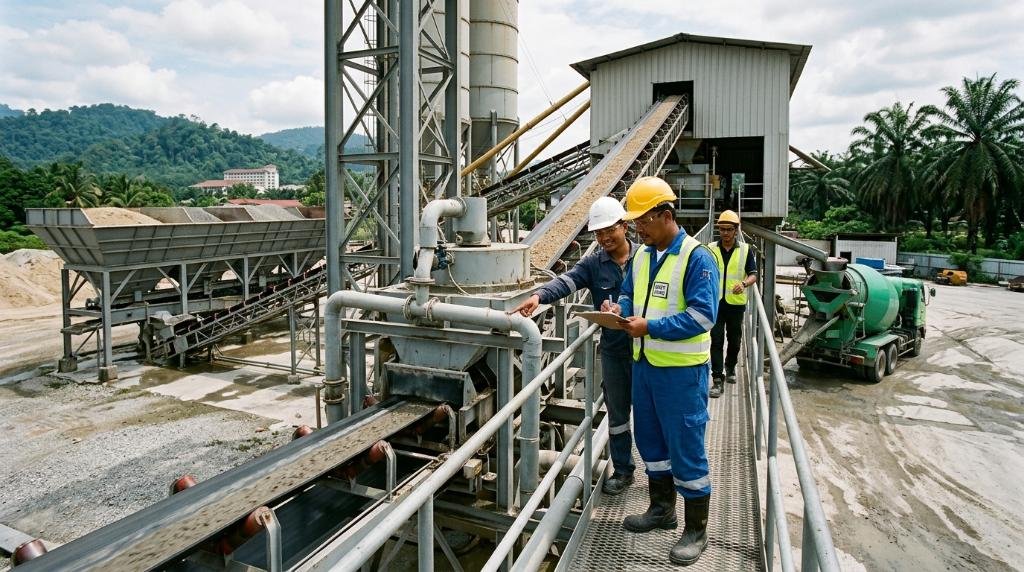
When you engage Pro Inspect Solution for a ready-mix concrete audit, we look far beyond the basic paperwork. We leverage our concrete technology consultancy expertise to expose the hidden vulnerabilities at the batching plant:
- Raw Material Verification: We audit the aggregate grading, assess silt content, and ensure cement silos are completely shielded from moisture. We also verify that chemical admixtures comply with BS EN 934.
- Equipment Calibration: A 2% error in a moisture sensor or weighing scale can severely alter the water-cement ratio. Uncontrolled water additions are a primary cause of low compressive strength.
- Mix Design Validation: We ensure the proposed mix designs are strictly tailored to your specific site’s environmental exposure, fully complying with MS EN 206:2016.
- Delivery and Logistics: Transit mixers must be inspected. Concrete degrades in transit, particularly in Malaysia’s hot and humid climate. We evaluate travel times, drum revolutions, and the illegal—yet common—practice of drivers adding water on-site to increase workability.

Rescuing Sick Projects with Building Condition Assessments
If you are a rescue contractor or a developer taking over an abandoned or sick project, stepping onto the site blindly is a massive liability. The existing concrete structures have likely been exposed to harsh tropical weathering for months or years.
Before any new concrete is poured, it is mandatory to conduct a comprehensive Building Condition Assessment. Our team will evaluate the existing structural integrity, check for severe carbonation, map potential rebar corrosion, and determine if the original concrete actually met the specified grade.
By pairing a thorough Building Condition Assessment with a strict ready-mix concrete audit for your new suppliers, you establish an impenetrable baseline of quality control that will get the project back on track toward its Certificate of Completion and Compliance (CCC).
Frequently Asked Questions (FAQ)
- What defines a sick project in Malaysia?
- A project is officially classified as a sick project (projek sakit) when its physical work progress is delayed by more than 20% or two months compared to the original contract schedule.
- How does a ready-mix concrete audit prevent construction delays?
- An audit ensures batching plants fully comply with MS EN 206 and CIDB CIS 21 standards. By verifying mix designs and raw materials at the source, it prevents catastrophic on-site concrete test failures that lead to structural hacking and prolonged standstills.
- Why is MS EN 206 critical for JKR sick projects?
- The Malaysian standard MS EN 206:2016 replaces the older MS 523. It sets rigorous conformity testing for concrete production. Failure to meet these specs triggers Non-Conformance Reports (NCRs), which halt construction and jeopardize the timeline.
