
The devastating TTDI mud flood in April 2026 sent shockwaves through the Klang Valley property sector. Following intense rainfall, a massive retaining wall collapse at Jalan Abang Haji Openg in Taman Tun Dr Ismail laid bare the hidden vulnerabilities in urban hillside developments. For Malaysian property owners, developers, and contractors, this incident isn’t just news—it is an urgent engineering warning.
At Pro Inspect Solution, we investigate hillside failures across the nation. Time and again, catastrophic events are preceded by subtle, ignored structural defects. In Malaysia’s tropical climate, where annual rainfall frequently exceeds 2,500mm, the margin for error in slope engineering is near zero.
In this comprehensive guide, we unpack the engineering realities behind local retaining wall failures and provide expert methods to spot structural defects early before they threaten lives and property.
Table of Contents
The TTDI Mud Flood: A Wake-Up Call for Hillside Properties
The April 2026 TTDI mud flood near the Bukit Kiara Federal Park development is a textbook case of cascading hydraulic failure. According to Free Malaysia Today (FMT) and Bernama reports, torrential rains triggered an earth bund rupture. This overwhelmed the silt traps and downstream public drainage systems—which were partly obstructed by utilities—causing immense water ponding and hydrostatic pressure buildup that inevitably led to the retaining wall collapse.
This incident forced authorities to issue immediate stop-work orders and mobilized the Public Works Department (JKR) to thoroughly investigate the site’s structural integrity. Unfortunately, by the time authorities intervene, the damage is done. The key is catching structural defects before the soil reaches its breaking point.
Why Do Retaining Walls Collapse in Malaysia?
Through my years as an engineering consultant, I have found that a retaining wall collapse in Malaysia rarely happens overnight. It is the culmination of unaddressed structural defects exacerbated by our unique tropical geography.
1. Hydrostatic Pressure and Poor Drainage
Water is the enemy of stability. When heavy monsoon rain penetrates backfill soil, and drainage systems fail (as witnessed in TTDI), water cannot escape. This drastically increases the hydrostatic pressure (pore water pressure) pushing against the wall, easily exceeding its design limit.
2. Substandard Construction and Non-Compliance
Despite rigorous local guidelines, site execution sometimes falls short. Inadequate reinforcement lapping, poor concrete compaction, and improper installation of geotextiles filter layers often result in hidden anomalies that compromise the structure from day one.

Expert Methods to Spot Structural Defects Early
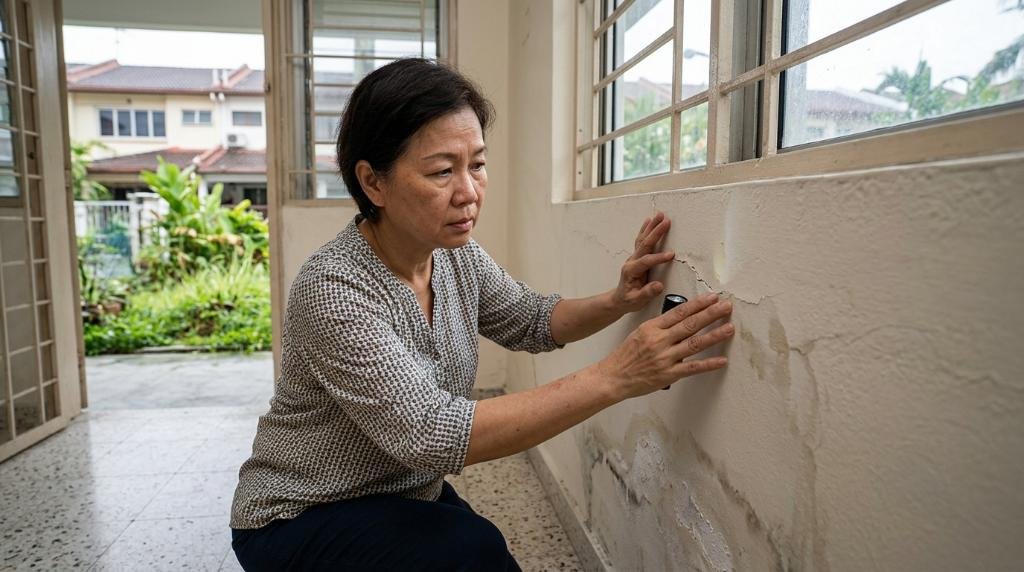
Homeowners and facility managers don’t need an engineering degree to spot the red flags, but they do need to know where to look. Here are insider methods to identify early structural defects:
Inspect Weep Holes for Blockages
Weep holes (PVC pipes protruding from the wall) are the lungs of a retaining wall. If they are dry during heavy rain, or if you see soil and vegetation clogging them, the wall cannot relieve water pressure. Look for mud stains directly beneath the weep holes; active silt discharge implies that the vital geotextile filter behind the wall has ruptured.
Distinguish Between Shrinkage and Tension Cracks
Not all cracks mean imminent doom, but specific patterns are highly dangerous. Hairline map-cracking might just be plastic shrinkage of the concrete. However, diagonal step-cracking in brick walls or wide vertical cracks in reinforced concrete indicate active soil settlement or sliding. Any crack wider than 3mm should prompt an immediate building condition assessment.
Measure Plumbness (Tilting and Bowing)
A retaining wall should stand completely vertically (plumb) or lean slightly backward into the soil (battered). If you notice the wall visibly bowing outward in the middle or tilting away from the slope, the structural anchors or the base footing have likely failed.
The Crucial Role of Building Condition Assessments
Many property managers only react after a minor landslide occurs. Proactive management requires a professional building condition assessment. Our team utilizes advanced non-destructive testing (NDT), ground-penetrating radar (GPR), and drone photogrammetry to detect voids behind walls and assess concrete integrity.
When professionals assess stability Malaysia wide, we don’t just look at the wall itself; we map the entire slope ecosystem, including toe erosion, surface runoff channels, and structural load-bearing capacity. If you reside in a newly handed-over property near a slope, getting an independent assessment before your liability period ends is critical. We highly recommend scheduling a comprehensive Property Defect Inspection (DLP) to hold developers accountable for latent engineering flaws.
Navigating Malaysian Standards (MS & BS EN)
Malaysia’s regulatory framework for slope engineering is stringent, governed by the Construction Industry Development Board (CIDB) and various national standards.
- MS EN 1997 (Eurocode 7): Adopted in Malaysia, this standard demands rigorous geotechnical design, accounting specifically for localized pore water pressures during monsoon seasons.
- MS EN 1992 (Eurocode 2): Dictates the concrete structural integrity necessary to prevent major structural defects from spreading.
When developers cut corners on these standards, the risk of a retaining wall collapse skyrockets. An expert engineer will cross-reference on-site findings with these exact legal and technical baselines to ensure full compliance and safety.

Frequently Asked Questions
How often should retaining walls undergo a building condition assessment in Malaysia?
It is highly recommended to conduct a building condition assessment on retaining walls every 3 to 5 years, or immediately following extreme monsoon rains and flash floods.
What are the first signs of structural defects in a retaining wall?
Early signs include blocked weep holes, active water seepage through the wall face, diagonal tension cracks, and forward tilting or bowing of the structure.
Why did the TTDI retaining wall collapse happen?
Preliminary investigations suggest that exceptionally heavy rainfall caused an earth bund to rupture, overloading local drainage systems. This led to massive hydrostatic pressure buildup that compromised the wall’s structural integrity.
Don’t Wait Until the Next Monsoon
The TTDI mud flood is a harsh reminder of the devastating power of nature when urban infrastructure is neglected. Identifying structural defects early is the most cost-effective and life-saving strategy available to property owners.
Whether you need to assess stability Malaysia standards require, or you suspect failing drainage at your property, immediate action is paramount. Pro Inspect Solution is ready to provide you with an authoritative, independent engineering evaluation.
Protect Your Property Today
Do you notice cracks, leaning walls, or blocked drainage on your hillside property? Don’t risk a collapse. Contact Ir Vimal and the structural engineering experts at Pro Inspect Solution for a comprehensive assessment.
Secure your peace of mind. Drop us a message now:
WhatsApp Us at +6016-8064902
