
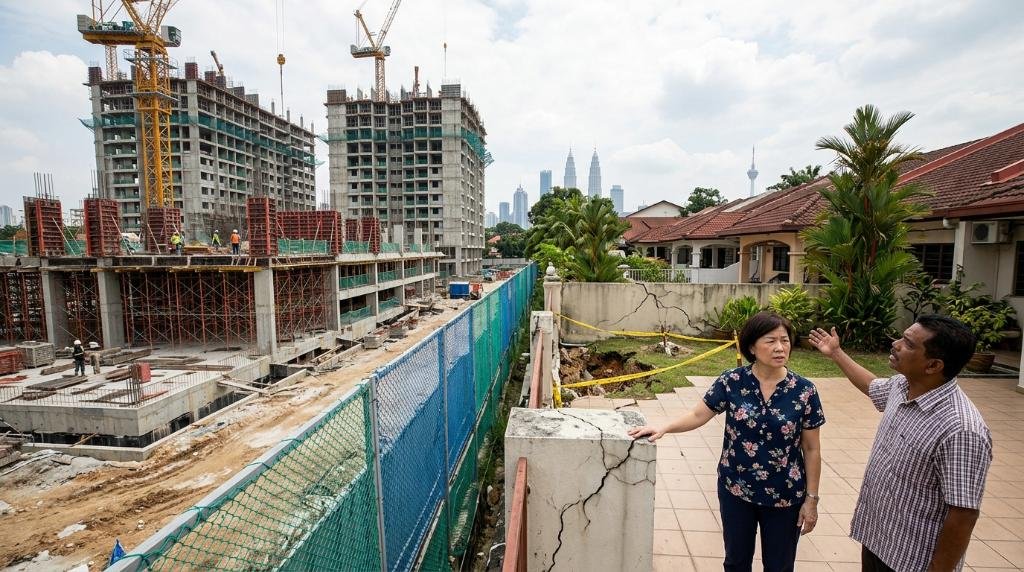
Kuala Lumpur, Malaysia — May 15, 2026 | By Ir Vimal, Professional Engineer
As urban development in Malaysia accelerates, adjacent property owners face unprecedented risks. Discover how to protect your real estate investments from devastating construction-induced damages.
The Rise of Construction Disasters in Malaysia
Malaysia’s rapid urbanization, particularly within the Klang Valley, Penang, and Johor Bahru, has led to a boom in high-density developments. However, this aggressive expansion often comes at a steep cost to surrounding communities. The phrase “construction disasters Malaysia” is no longer just a sensational headline; it is a recurring nightmare for countless property owners.
From severe structural cracks appearing overnight to catastrophic landslips, living next to a major development site introduces profound risks. Heavy machinery vibrations, deep excavation works, and fluctuating water tables can drastically undermine the structural integrity of older adjacent buildings. As the premier authority in building assessments, Pro Inspect Solution has witnessed firsthand the devastating financial and emotional toll these oversights cause.
Case in Point: The TTDI Mud Flood & Retaining Wall Collapses
Recent events have painfully highlighted these vulnerabilities. The widely reported TTDI mud flood earlier this year serves as a stark reminder of what happens when site drainage and soil stabilization protocols fail during heavy monsoon downpours. Torrents of mud not only destroyed public infrastructure but severely damaged private homes, leaving residents stranded and burdened with massive repair bills.

Similarly, the threat of a retaining wall collapse remains one of the highest structural risks in Malaysian hillside developments. When adjacent developers fail to implement adequate earth-retaining structures, the lateral earth pressure can cause catastrophic boundary wall failures, pulling down neighboring properties with them. According to the Construction Industry Development Board (CIDB), strict adherence to safety guidelines is mandatory, yet enforcement and on-site negligence remain persistent issues documented by major news outlets like The Star.
Navigating Property Damage Claims in Malaysia
When disaster strikes, the immediate question for victims is: Who pays for the damages?
Filing property damage claims in Malaysia involves navigating a complex web of legal and technical requirements. Under the Street, Drainage and Building Act 1974 (Act 133), local authorities (PBT) have the power to halt construction that endangers surrounding properties. However, claiming compensation from developers or their insurance companies requires indisputable proof that the damage was directly caused by their construction activities, rather than pre-existing wear and tear.
Without undeniable baseline evidence, developers’ legal teams will predictably argue that the cracks, leaks, or soil settlements existed prior to their project’s commencement. This is where proactive property owners must take decisive action before a single excavator arrives on site.
The Ultimate Safeguard: Why You Need a Dilapidation Survey
The single most critical step you can take to protect your asset is commissioning a dilapidation survey. Also known as a pre-construction condition survey, this is a comprehensive, legally recognized inspection carried out by certified independent engineers.
At Pro Inspect Solution, our specialized teams meticulously document every existing defect, hairline crack, and structural anomaly of your property before neighboring construction begins. By obtaining a professional dilapidation survey, you secure a time-stamped, photographic, and written record of your property’s exact condition.

Benefits of a Professional Survey
- Strong Evidence: Streamlines property damage claims by undermining the developer’s “pre-existing damage” defense.
- Peace of Mind: Ensures that vibrations and ground movements are monitored against a verified baseline.
- Legal Leverage: A formal report prepared by accredited engineers carries substantial weight in Malaysian courts and local council (DBKL, MBPJ, etc.) tribunals.
Do not wait for a TTDI mud flood scenario to strike your neighborhood. Learn more about securing your baseline documentation on our Dilapidation Survey services page.
Addressing Root Causes: Concrete and Structural Integrity
While external earthworks cause landslips, structural failures like a retaining wall collapse are frequently tied to substandard building materials. The structural integrity of any boundary or retaining wall relies heavily on the quality of the concrete mix and curing process utilized by the contractor.
If you suspect that an adjacent developer is utilizing compromised materials that threaten your shared boundary, expert intervention is necessary. Through specialized concrete technology consultancy, independent engineers can conduct non-destructive testing (NDT) to evaluate the compressive strength and durability of the concrete structures being erected next door. Ensuring materials meet Malaysian Standards (MS) and CIDB regulations is a critical line of defense against future construction disasters.
Actionable Steps for Property Owners
If a new development is announced adjacent to your home or commercial building, take these immediate steps:
- Document Everything: Take time-stamped photos of your property’s current state, focusing on boundary walls and structural joints.
- Engage Professionals: Hire an independent engineering firm to conduct a comprehensive pre-construction condition survey.
- Communicate with the Local Council: Ensure the developer has secured all necessary earthwork approvals from your respective local authority.
- Monitor Changes: Report any sudden appearances of cracks, water pooling, or unusual vibrations immediately to the site safety officer and your consultant.
Frequently Asked Questions (FAQ)
What exactly is a dilapidation survey in Malaysia?
A dilapidation survey is a thorough, independent inspection undertaken by professional engineers before adjacent construction begins. It provides a detailed photographic and written record of your property’s current condition, serving as crucial legal evidence if the neighboring construction causes damage.
How do I file property damage claims against a developer in Malaysia?
To successfully file property damage claims, you must prove the developer’s activities caused the damage. You should first notify the developer and the local council (PBT) in writing. Having a pre-construction dilapidation survey report is vital to refute claims that the damage existed beforehand. If the developer disputes the claim, you may need to escalate it legally with the help of independent engineering reports.
Who is liable for a retaining wall collapse affecting my property?
Liability generally falls on the developer, the main contractor, or the consulting engineers of the adjacent site. If negligence in design, lack of concrete technology compliance, or poor earthwork management is proven, they are responsible for restitution and repair costs under Malaysian civil law.
Don’t Wait Until the Damage is Done
Safeguard your property from Malaysian construction disasters today. Secure your baseline with a professional Dilapidation Survey from Pro Inspect Solution.
