
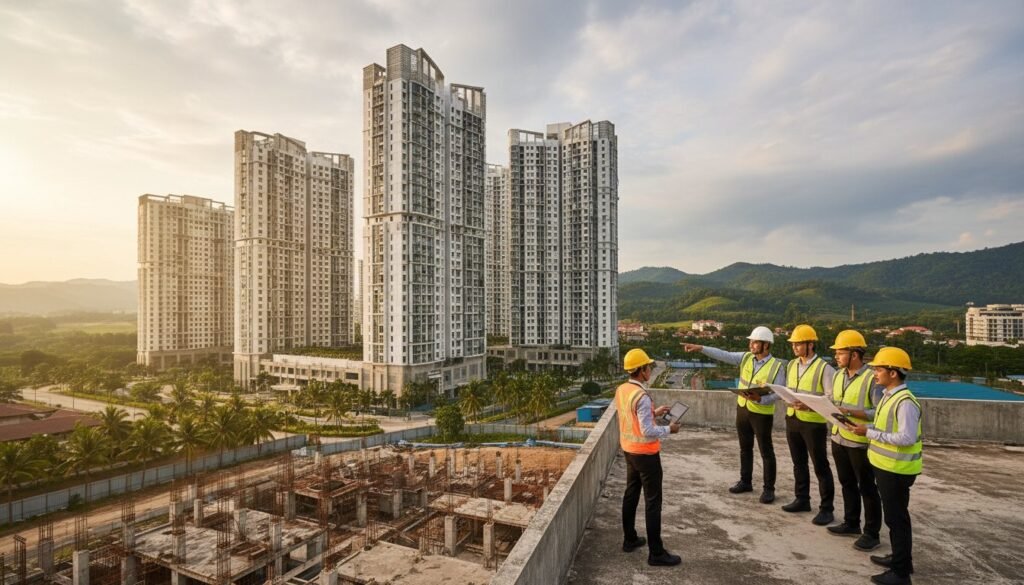
KUALA LUMPUR, April 23, 2026 — By Ir Vimal, Professional Engineer
As the Ministry of Local Government Development (KPKT) intensifies its successful task force initiatives throughout 2026, the real estate headlines are dominated by a massive wave of sick projects Malaysia being rescued. “White knight” developers are stepping in, breathing new life into structures that have sat dormant for years. For anxious property buyers, this is a beacon of hope.
However, behind the celebratory news of resumed construction lies a critical, often-overlooked question: Are these revived structures actually safe to live in?
When half-completed buildings are abandoned, they are left exposed to Malaysia’s harsh tropical climate—heavy monsoon rains, high humidity, and blistering UV rays. Without rigorous abandoned project structural testing, resuming construction is a high-risk gamble. In this comprehensive guide, Pro Inspect Solution explores the structural risks of revived properties and the non-negotiable engineering protocols required to safeguard developers, contractors, and future homeowners.
The Reality of Sick Projects in Malaysia (2026 Update)
According to recent industry reports highlighted by major publications like The Star, the government’s aggressive push to reduce the number of sick and abandoned housing projects has yielded tremendous results. A “sick project” is officially classified as a development that has been delayed by more than 30% of its scheduled progress timeline or whose Sale and Purchase Agreement (SPA) has lapsed.
The urgency to deliver homes to stranded buyers has led to accelerated sick project revival programs. However, rapid resumption of work can sometimes bypass deep structural validations. Rescuing developers are legally and morally obligated to ensure that the skeleton of the building is still sound before adding loads such as brickwork, mechanical systems, and roofing.

The Hidden Dangers: Why Structures Deteriorate
When a construction site is suddenly halted, the structural framework is rarely properly sealed or protected. Years of abandonment lead to severe degradation, primarily due to:
- Rebar Corrosion: Exposed steel reinforcements rust rapidly in Malaysia’s high-humidity environment. Rust expands the steel, causing concrete spalling (flaking and cracking), which significantly reduces the structural load-bearing capacity.
- Concrete Carbonation: Carbon dioxide penetrates the exposed concrete, lowering its alkalinity. Once the pH drops, the protective passivation layer around the steel rebars is destroyed.
- Ponding Water and Micro-cracks: Monsoon rains lead to water ponding on unfinished slabs, causing seepage and micro-cracking that weakens the foundation over time.
Why Abandoned Project Structural Testing is Non-Negotiable
Before a “white knight” developer lays a single new brick, conducting a thorough Building Condition Assessment is a mandatory first step. Proceeding without knowing the exact structural health of the building can lead to catastrophic failures, failing CIDB (Construction Industry Development Board) compliance, and future litigation.
Effective abandoned project structural testing identifies exactly which elements can be salvaged and which require immediate demolition or strengthening. This is where specialized engineering consultants provide immense value, utilizing advanced forensic engineering to paint a clear picture of the project’s viability.
Crucial Concrete Inspection Malaysia Protocols
To ensure structural integrity, professional engineers deploy a battery of tests. High-quality concrete inspection Malaysia involves both destructive and Non-Destructive Testing (NDT) methods.
Non-Destructive Testing (NDT)
NDT is the preferred starting point to evaluate the building without causing further damage. Standard procedures include Rebound Hammer testing for surface hardness and Ultrasonic Pulse Velocity (UPV) to detect internal voids, honeycombing, or deep cracks within the abandoned beams and columns.
Concrete Core Extraction
To definitively prove the compressive strength of the aging structure, our experts at Pro Inspect Solution provide specialized Concrete Technology Consultancy. We extract concrete cores from critical load-bearing elements and subject them to laboratory crushing tests, ensuring they still meet the original design specifications.
Drone-Assisted High-Rise Inspections
For high-rise developments abandoned midway, accessing the upper, uncompleted floors safely is a massive challenge. Utilizing modern technology, a thorough Façade & Roof Inspection (Drone) allows engineers to map out high-level defects, exposed lift shafts, and degraded roof slabs safely and efficiently.
The Developer’s Roadmap to a Safe Sick Project Revival
For developers taking over sick projects Malaysia, mitigating risk requires a systematic, legally sound approach. Here is the recommended roadmap to structural safety:
1. Establish the Existing State of the Project
Because original plans and current site realities rarely match on an abandoned site, developers must commission As-Built Survey & Drawing Services. This ensures that the newly assembled project team is working with accurate, updated dimensions of what has actually been built.
2. Assess Adjacent Properties
Resuming heavy piling or construction work can disturb neighboring properties that have settled during the years of abandonment. A pre-construction Dilapidation Survey protects the developer from false damage claims by documenting the existing condition of adjacent buildings.

3. Design a Retrofitting Strategy
If testing reveals weakened columns or slabs, the structure does not necessarily need to be demolished. Through expert Structural Repair Consultancy, engineers can design retrofitting solutions such as carbon fiber wrapping, epoxy crack injection, or concrete jacketing to restore the building beyond its original strength.
4. Implement Long-Term Monitoring
Even after construction successfully completes, large-scale revived projects require ongoing vigilance. Implementing a system of Pemeriksaan Bangunan Berkala (Periodic Building Inspection) ensures that any delayed settling or micro-cracks are caught and addressed long before they become hazards.
Protecting Buyers: Defect Inspections and Warranties
For the buyers who have waited years—sometimes decades—to receive their keys, the handover process is highly emotional. However, the history of a revived sick project means buyers must be hyper-vigilant.
Upon receiving the Notice of Vacant Possession (VP), buyers are entitled to a Defect Liability Period (DLP). Given the project’s history, hiring an independent consultant for a thorough Property Defect Inspection (DLP) is highly recommended. This ensures the finishing works meet QLASSIC standards and that there are no hidden structural or water-proofing issues masked by fresh paint.
In cases where developers refuse to acknowledge structural faults, buyers or Joint Management Bodies (JMBs) may need to escalate the matter legally. Having a qualified engineer provide Expert Witness & Dispute Resolution services ensures that your claims hold weight in the Strata Management Tribunal or civil courts.
Conclusion
The revival of sick projects Malaysia is an overwhelmingly positive trend for the nation’s housing sector in 2026. However, turning an abandoned concrete skeleton into a safe, thriving community requires uncompromising dedication to structural integrity. Proper abandoned project structural testing and meticulous concrete inspection Malaysia are the only ways to ensure these revived buildings stand the test of time.
Whether you are a white-knight developer stepping in to rescue a project, or a buyer finally receiving the keys to your long-awaited home, independent engineering verification is your strongest asset.
Ensure Your Project’s Structural Integrity Today
Don’t leave the safety of your revived development to chance. Consult with Malaysia’s leading structural inspection experts.
Frequently Asked Questions (FAQ)
What defines a “sick project” in Malaysia?
In Malaysia, a housing development is classified as a “sick project” if its construction progress is delayed by more than 30% compared to its scheduled timeline, or if the Sale and Purchase Agreement (SPA) timeline has completely lapsed without completion.
Why is abandoned project structural testing necessary before resuming construction?
When a project is abandoned, its exposed framework suffers from weathering, rebar corrosion, and concrete carbonation due to Malaysia’s tropical climate. Structural testing ensures the existing framework can still safely bear the required loads before new construction is added.
What methods are used for concrete inspection in Malaysia?
Engineers utilize Non-Destructive Testing (NDT) such as Ultrasonic Pulse Velocity (UPV) and Rebound Hammer tests, alongside destructive methods like concrete core extraction for laboratory compressive strength testing, to comprehensively assess structural health.
Can an abandoned building with structural defects be saved?
Yes. Through professional structural repair consultancy, engineers can design targeted retrofitting solutions—such as carbon fiber wrapping or concrete jacketing—to repair and strengthen weakened columns and beams, preventing the need for total demolition.
