
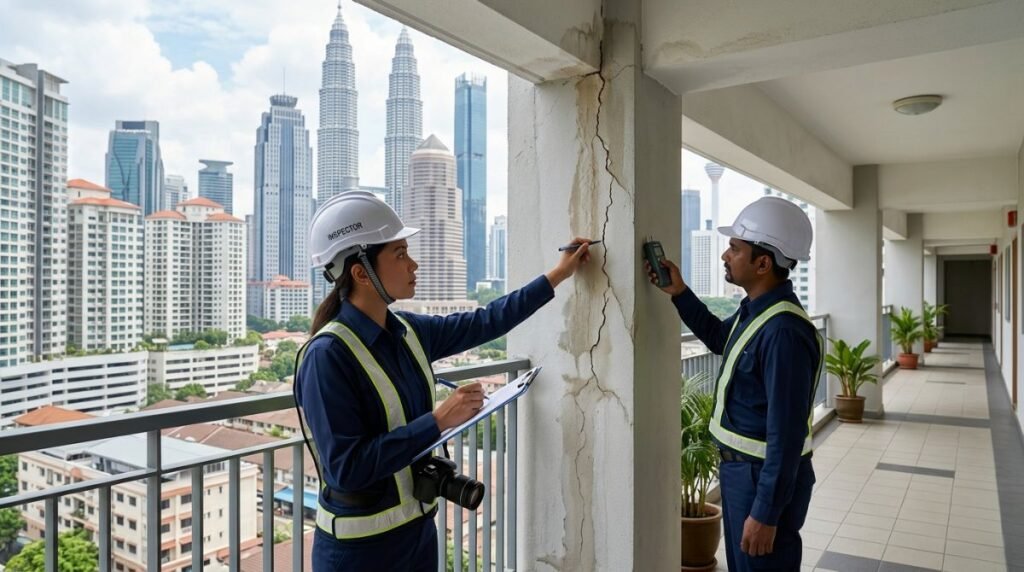
By Ir Vimal, Professional Engineer | October 5, 2026
Expert insights from Pro Inspect Solution
As a practising forensic structural engineer consulting on commercial high-rises and residential strata schemes throughout Kuala Lumpur and Selangor, I regularly witness an avoidable legal tragedy: Malaysian property owners and Joint Management Bodies (JMBs) heading into property defect lawsuits or the Homebuyer Claims Tribunal armed solely with mobile phone snapshots, marked-up floorplans, and WhatsApp logs. In response, developer legal teams and panel consultants easily neutralise these claims by characterising structural distress, chronic inter-floor seepage, and concrete honeycombing as “standard building settlement” or “routine occupant maintenance neglect.”
This technical disparity is the primary reason valid defect claims collapse. Winning a construction litigation or statutory dispute in Malaysia requires moving beyond cosmetic observations. Claimants must establish an unbroken forensic evidentiary chain grounded in recognized Malaysian engineering codes, statutory duties, and impartial expert validation.
Urgent Hearing Notice: If your strata scheme or residential unit faces an upcoming hearing before the Tribunal for Homebuyer Claims (TTPR), Strata Management Tribunal (SMT), or the Civil Courts, generic documentation will forfeit your claim. Contact our forensic engineering team immediately via WhatsApp (+60 16-806 4902) to review your structural dossier before submission deadlines expire.
The Evidentiary Crisis in Malaysian Property Defect Lawsuits
Despite statutory protections under the Housing Development (Control and Licensing) Act 1966 (Act 118) and the Strata Management Act 2013 (Act 757), building defect disputes have spiked across urban centres. Pushed by aggressive handover milestones and contractor cost compression, projects often bypass comprehensive Quality Assessment System in Construction (QLASSIC / CIS 7:2021) audits on primary concrete frames, confining assessments to show units.
Consequently, up to 75% of high-density handover claims involve water intrusion, baseline structural cracking, and debonded facade systems. When purchasers file a claim under statutory contracts (Schedule G or H of Act 118), judges and tribunal presidents evaluate the claim based on the balance of probabilities, requiring empirical substantiation of:
- Breach of Statutory Duty: Non-compliance with the Uniform Building By-Laws 1984 (UBBL 1984) or Street, Drainage and Building Act 1974 (Act 133).
- Material Deviation: Departures from the approved structural and architectural drawings endorsed by the Principal Submitting Person (PSP).
- Substandard Workmanship: Measurable failure to achieve standards prescribed under Malaysian Standards (MS 523 for concrete production, MS 1064 for dimensional coordination) or BS EN Eurocodes.
Photographic representations alone cannot establish whether a continuous horizontal fracture on a podium transfer slab stems from superficial drying shrinkage or structural shear distress. Without scientific assessment, legal actions frequently collapse during cross-examination.
Legal Precedents & Admissibility of Engineering Testimony
In Malaysian civil jurisprudence, physical damage must be linked to statutory non-compliance or contractual negligence. Under Section 45 of the Evidence Act 1950, courts admit expert testimony on points of science, art, and technical failure when formulated by qualified specialists.

Judicial rulings continuously emphasize the strict independence of technical experts. In landmark property decisions involving defective multi-storey strata buildings, the High Court and Court of Appeal have clarified that reports prepared by in-house contractor personnel or general handymen carry minimal evidentiary weight compared to independent, certified engineering assessments.
Key legal frameworks governing expert engineering evidence include:
- Order 40A of the Rules of Court 2012: An expert’s duty to assist the court on technical matters overrides any obligation to the commissioning client. An engineering investigation must objectively address causal mechanisms, concrete core compressive tests, and remediation scopes, rather than serving as partisan advocacy.
- Strict Causation Demonstrations: In claims involving latent defects and building water leaks, Malaysian appellate courts consistently dismiss developer assertions of “tenant abuse” when non-destructive testing (such as thermal imaging and core drilling) demonstrates absent damp-proof courses or flawed slab designs violating UBBL By-Law 84 (water-proofing of wet areas).
- Quantified Remediation Schedules: Damages are calculated based on reasonable rectification costs. Courts reject arbitrary estimates, admitting only documented bills of quantities verified against current CIDB market schedules.
To withstand judicial interrogation, engaging a structured property defect inspection (DLP) ensures that all technical findings are methodically mapped to contractual specifications before litigation commences.
The DLP Trap vs. Latent Defect Claims (15-Year Rule)
The standard Defect Liability Period under Schedule G (landed property) and Schedule H (strata property) of the Housing Development (Control and Licensing) Regulations runs for 24 months from the delivery of Vacant Possession (VP). Developers routinely engage in superficial “hack-and-seal” rectifications—such as applying surface coats over weeping cracks or temporary silicone over failing joint seals—designed to survive until the 24-month threshold passes.
Once the DLP expires, developers often disclaim all liability. However, Malaysian law distinguishes between visible patent defects and hidden latent defects:
| Parameter | Patent Defects (DLP) | Latent Defects (Civil Action) |
|---|---|---|
| Statutory Foundation | Act 118 (Schedule G/H Clause 26/30) | Limitation Act 1953 (Section 6A Amendment) |
| Claim Window | 24 Months post-VP | 3 Years from discovery; capped at 15 Years from occurrence |
| Nature of Damage | Surface hairline cracks, unaligned doors, hollow tiles | Differential settlement, spalling concrete, embedded conduit failure |
| Required Evidence | Visual defect lists & joint inspection records | Forensic testing (NDT), structural design verification, timeline logging |
Under Section 6A of the Limitation Act 1953, plaintiffs in negligence actions can initiate court proceedings within 3 years from the date of discovering latent damage, bounded by an ultimate 15-year longstop from the date the negligence occurred. Proving negligence after 5 or 10 years requires robust baseline records. Executing a comprehensive dilapidation survey or condition audit creates the temporal benchmark required to substantiate that a structural failure originated from historical contractor oversights rather than subsequent environmental wear.
Housing Tribunal (TTPR) vs. High Court Civil Litigation
Selecting the appropriate legal avenue impacts both procedural costs and evidence strategy. Claimants in Malaysia navigate two principal dispute forums for building failures:
1. Tribunal for Homebuyer Claims (Tribunal Tuntutan Pembeli Rumah – TTPR)
The TTPR operates under the Ministry of Housing and Local Government (KPKT). It is designed to deliver fast, economical, and lawyer-free dispute resolution for residential purchasers holding contracts governed by Act 118, within 12 months from the expiry of the DLP.
- Statutory Jurisdiction Cap: Established under Section 16M of Act 118, recent legislative amendments have pushed compensation claim ceilings to RM250,000 to reflect modern real estate valuations [1].
- Absence of Counsel: Because advocates and solicitors are barred from TTPR proceedings unless permitted under strict exceptions, property owners must personally present their case against experienced developer project directors. Submitting an authenticated engineering audit provides the lay claimant with the technical authority needed to establish liability without legal jargon.
2. Subordinate and High Court Litigation
For industrial structures, commercial developments, mixed-use assets, or claims exceeding statutory limits, civil court action represents the required pathway. In high-value disputes—such as major structural movements or expansive facade delamination—the JMB, Management Corporation (MC), or owner files an action sounding in contract and the tort of negligence.
In multi-million ringgit litigation, developers invariably present counter-opinions. For multi-storey residential towers, structural failure frequently correlates with exterior envelope deterioration, requiring an aerial façade and roof inspection (drone) to produce thermal and orthomosaic evidence detailing external cracking, loose cladding anchors, or flashing omissions that permit hidden interior damage.
Step-by-Step Forensic Defect Evidence Gathering Checklist
To compile an unassailable dossier for tribunal adjudicators, judges, or arbitration panels, follow this systematic engineering-driven checklist:

Forensic Litigation Evidence Protocol
- Establish Chronological Documentation: Collate the Sale and Purchase Agreement (SPA), Certificate of Completion and Compliance (CCC), formal Vacant Possession notices, and all historical defect submission forms stamped by the developer’s site office.
- Deploy Calibrated Crack-Monitoring: Replace uncalibrated smartphone captures with standardized optical crack-width comparators. For dynamic fractures, install calibrated Avongard-type tell-tale displacement gauges to document progressive dimensional movement over 30, 60, and 90-day intervals.
- Execute Non-Destructive Testing (NDT):
- Rebound (Schmidt) Hammer Testing: Verifies in-situ concrete surface hardness and uniform structural compressive strength according to BS EN 12504-2.
- Ultrasonic Pulse Velocity (UPV): Detects internal voids, honeycombing, and deep structural cracks under BS EN 12504-4 standards.
- Rebar Cover-Meter Surveys: Measures electromagnetic rebar depth to verify compliance with fire and structural cover tolerances defined in BS 8110 / MS EN 1992.
- Conduct Moisture & Waterproofing Profiling: Map internal damp patches using high-resolution thermal imaging (FLIR infrared thermography) alongside calibrated pin/pinless electrical impedance moisture meters, helping trace the likely source of ingress through positive or negative pressure failure.
- Verify Approved As-Built Plans: Requisition and cross-examine the certified architectural and structural as-built drawings lodged with the Local Council (Pihak Berkuasa Tempatan – PBT) against physical site reality to identify unapproved structural omissions.
- Commission an Independent Technical Assessment: Secure an independent structural engineer’s condition audit containing a quantified repair Bill of Quantities (BQ), signed and endorsed by an independent professional engineer registered with the Board of Engineers Malaysia (BEM).
The Role of Certified Structural Repair Consultancy
Litigation is not won by demonstrating that a building possesses defects; it is won by demonstrating why the defect exists, who is liable under contract and statute, and what specific financial sum is required for permanent rectification. This requires expert-tier support.
Engaging a specialized structural repair consultancy equips claimants with critical forensic advantages:
- Failure Causation Analysis: Isolating root structural mechanisms, distinguishing poor materials, substandard batch-mixes, and missing reinforcement steel from surface finishing variations.
- Statutory Alignment: Formulating legal positions around established breaches of the Strata Management Act 2013 (such as the statutory presumption of inter-floor leakage under Section 142) and the Uniform Building By-Laws.
- Remediation Engineering: Producing comprehensive engineering remedial specifications (e.g., carbon-fibre reinforced polymer [CFRP] strengthening, structural pressure epoxy grouting, full cavity membrane restoration) to prevent low-quality contractor patch jobs.
- Credible Courtroom Testimony: Standing as an expert witness under Order 40A of the Rules of Court 2012, capable of defending forensic methodologies under rigorous cross-examination by developer counsel.
At Pro Inspect Solution, our forensic engineering dossiers routinely assist individual property buyers, corporate real estate portfolios, and strata management councils in recovering substantial rectifications, preserving sinking funds and safeguarding long-term asset value.
Frequently Asked Questions (FAQ)
What is the difference between patent and latent defects under Malaysian law?
Patent defects are visible, discoverable flaws evident upon reasonable visual examination during the 24-month Defect Liability Period (DLP), such as cracked tiles or misaligned window sashes. Latent defects are concealed design or construction deficiencies—including compromised foundations, sub-slab plumbing leaks, or undersized steel reinforcement—that manifest years after handover. Under Section 6A of the Limitation Act 1953, latent defect claims can be initiated within 3 years of discovery, up to an absolute maximum limit of 15 years from the date the negligent work was performed.
Can a developer reject an independent defect inspection report in Malaysia?
A developer may attempt to dispute an independent defect report, but they cannot legally ignore it. Under Schedule G and H statutory contracts, developers must respond to defect notices within 30 days. If the developer fails to rectify the reported items, purchasers can serve a formal notice of intention to engage independent contractors and recover costs from the stakeholder lawyers holding the retention sum. In court or tribunal proceedings, an independent engineering report signed by a Professional Engineer carries strong evidentiary weight over unsubstantiated developer denials.
Is it necessary to hire a lawyer to resolve a defect claim at the Housing Tribunal?
No. Under Section 16U of the Housing Development (Control and Licensing) Act 1966, legal advocates and solicitors are strictly barred from representing parties during standard Tribunal for Homebuyer Claims (TTPR) hearings, unless complex questions of law arise and both parties receive written approval from the Tribunal President. Because claimants must present their claims directly against developer technical representatives, submitting an objective, certified engineering assessment is critical to establishing liability and securing an award.
How does the Strata Management Act 2013 assist in proving inter-floor water leaks?
Section 142 of the Strata Management Act 2013 creates a statutory presumption that an inter-floor leak originates from the parcel directly above it, unless the upper-floor owner proves otherwise. Regulation 57 of the Strata Management (Maintenance and Management) Regulations 2015 empowers the Joint Management Body (JMB) or Management Corporation (MC) to conduct an official Form 28 inspection. If the developer retains unsold units or if the defect lies within common conduits under the DLP, an independent forensic engineering assessment definitively tracks water pathways, making settlement or tribunal recovery straightforward.
Contact Us / Professional Inspection & Engineering Consultation
Pro Inspect Solution, led by Ir Vimal, Professional Engineer, provides professional building condition assessments, structural integrity audits, handover defect inspections, and professional engineering advisory across Malaysia.
- 📍 Service Coverage: Kuala Lumpur, Selangor, and Nationwide Malaysia
- 📞 Phone / WhatsApp: +60 16-806 4902
- ✉️ Official Inquiries: inspectsolution.pro@gmail.com
- 🌐 Official Website: inspectsolution.pro
- 👷♂️ Lead Engineer: Authored & verified by Ir Vimal, Professional Engineer
Need Professional Property Inspection or Building Audit Services?
Get instant consultation and professional engineering advice from Pro Inspect Solution.
