
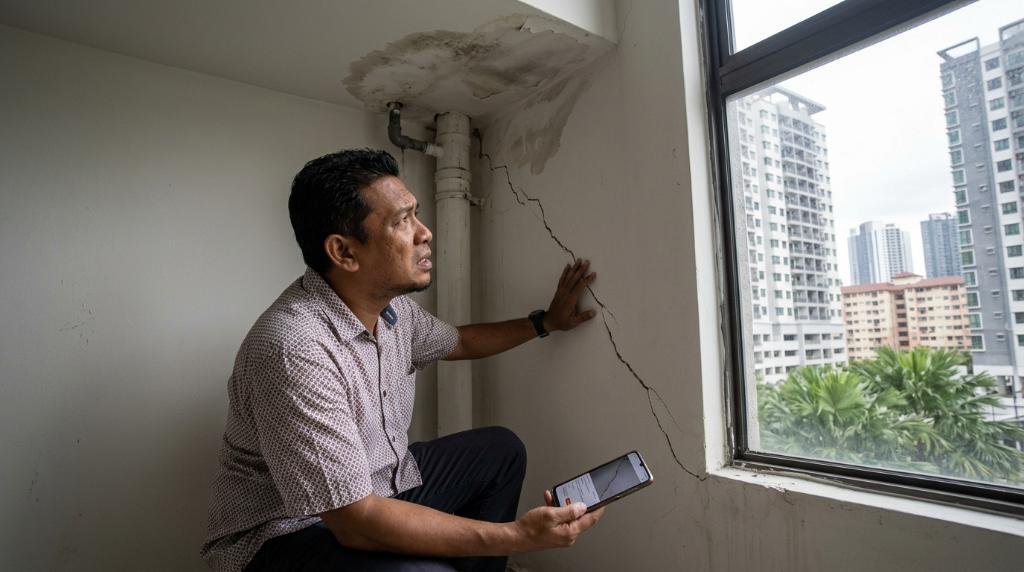
Shoddy Condo Work: Step-By-Step Guide To Claim Damages
By Ir Vimal, Professional Engineer | Published: July 14, 2026
Getting the keys to a newly completed condominium in Malaysia is supposed to be a milestone worth celebrating. Unfortunately, for an increasing number of property owners, that joy is quickly replaced by the sheer anxiety of hollow tiles, chronic water seepage, and alarming hairline cracks across load-bearing walls. Filing a successful condo defect claim Malaysia requires more than simply submitting a form to your developer; it requires strategic, legally robust engineering documentation.
As a Professional Engineer (Ir) witnessing the aftermath of rushed high-rise projects across Kuala Lumpur, Selangor, and Penang, I can confidently tell you that developers frequently leverage the information asymmetry between contractors and unit owners. To protect your investment, you need to understand the local construction framework—from the Construction Industry Development Board (CIDB) standards to Malaysian Standard (MS) compliances. Here is your insider guide to legally compelling developers to rectify structural failures.
The Engineering Reality Behind Developer Shoddy Workmanship
If you take a close look at recent high-profile strata disputes reported by The Star, a common thread emerges: massive structural compromises masquerading as cosmetic defects. Developer shoddy workmanship in Malaysia rarely stems from a lack of engineering knowledge; it is almost always the result of fast-tracking, cost-cutting, and poor site supervision by main contractors.
Under the surface, many condominiums fail to adhere strictly to the MS EN 1992-1-1 (Eurocode 2) design standards for concrete structures. For example, inadequate concrete cover over steel reinforcements—a widespread issue in rushed developments—accelerates carbonation in Malaysia’s humid climate. Within a few years, this leads to rebar corrosion, concrete spalling, and compromised shear walls. When developers assess these issues during the defect period, their in-house contractors frequently resort to superficial PU (Polyurethane) grouting instead of rectifying the root structural deficiency.
At Pro Inspect Solution, we routinely uncover these hidden compromises, transforming what the developer calls a “minor aesthetic crack” into a heavily documented code violation.
Step-By-Step Guide to a Condo Defect Claim in Malaysia

Step 1: Exploit the 24-Month Defect Liability Period (DLP)
Under the Housing Development (Control and Licensing) Act 1966 (HDA), property owners are granted a 24-month DLP starting from the date of Vacant Possession (VP). Do not wait until month 23 to submit your findings. Document everything immediately using the standard defect form provided by the developer, but back it up with a comprehensive digital trail—photos, videos with timestamps, and precise locations.
Step 2: Commission a Structural Defect Assessment
Developers are notoriously slow to act, and when they do, their repairs are often sub-par. If you are dealing with recurring water leaks, severe wall cracks, or suspected foundational shifting, you need to elevate your claim. Engaging an independent consultant for a formal structural defect assessment shifts the balance of power. A report stamped by a registered Professional Engineer provides unshakeable evidence that references specific violations of CIDB’s QLASSIC benchmarks and local building codes.
Step 3: Escalate to the Strata Management Tribunal (SMT) or Civil Court
If the developer fails to rectify the documented defects within the stipulated 30 days, you have legal recourse. You can obtain a quotation from an independent contractor to fix the issues, notify the developer of your intent to deduct the repair costs from the stakeholder’s sum (held by lawyers), or file a case with the Ministry of Housing and Local Government (KPKT) via the Strata Management Tribunal. An independent engineering report is your most critical asset in these hearings.
Moving Beyond the DLP: Tackling JMB Structural Issues
What happens when massive defects appear in the common areas after the 24-month DLP expires? This is where many Joint Management Bodies (JMB) and Management Corporations (MC) panic. Managing JMB structural issues requires navigating the concept of “latent defects”—flaws that existed during construction but were completely concealed until years later.
Fortunately, the Limitation (Amendment) Act 2018 revolutionized property rights in Malaysia. JMBs now have up to 3 years from the date of discovering a latent defect to take legal action against the developer, capped at an absolute maximum of 15 years from the date the defect occurred. However, proving a latent defect requires highly sophisticated forensic engineering.
For high-rise properties, we often deploy advanced façade and roof drone inspections. Thermal imaging and high-resolution aerial data can instantly prove whether a massive façade water seepage issue is a recent maintenance failure by the JMB, or a latent defect caused by the developer’s failure to install adequate waterproofing membranes during the initial build.

Why Professional Building Repair Supervision is Non-Negotiable
Winning a condo defect claim Malaysia dispute is only half the battle; ensuring the developer executes the repair correctly is the true challenge. Never allow the original contractor to perform major structural rectifications unsupervised. Their primary goal is cost-minimization, which inevitably leads to the dreaded “patch and dash” technique.
This is where stringent building repair supervision becomes non-negotiable. Whether you are an individual owner dealing with a compromised load-bearing beam, or a JMB executing a million-ringgit façade overhaul, a third-party engineering consultant must oversee the Method Statement. Through professional structural repair consultancy, we ensure that contractors utilize the correct structural epoxies, maintain proper curing times, and strictly adhere to BS EN 1504 standards for the protection and repair of concrete structures.
Frequently Asked Questions (FAQ)
How long do I have to file a condo defect claim in Malaysia?
Under the standard Sales and Purchase Agreement (SPA), the Defect Liability Period (DLP) is typically 24 months from the date of vacant possession. For latent defects discovered later, the Limitation (Amendment) Act 2018 allows up to 3 years from the date of discovery, capped at 15 years from the defect occurrence.
Can a JMB claim for latent structural defects?
Yes, Joint Management Bodies (JMBs) and Management Corporations (MCs) can pursue claims for common property structural issues discovered after the DLP. Utilizing the Latent Defect amendments, a JMB can legally compel developers to rectify structural failures provided they have competent engineering proof.
Why is an independent structural defect assessment necessary?
An independent assessment provides legally binding documentation rooted in Malaysian Standards (MS). Without an independent engineer’s report, developers often reject claims as “wear and tear” or perform superficial cosmetic repairs that fail to address the root structural integrity of the building.
