
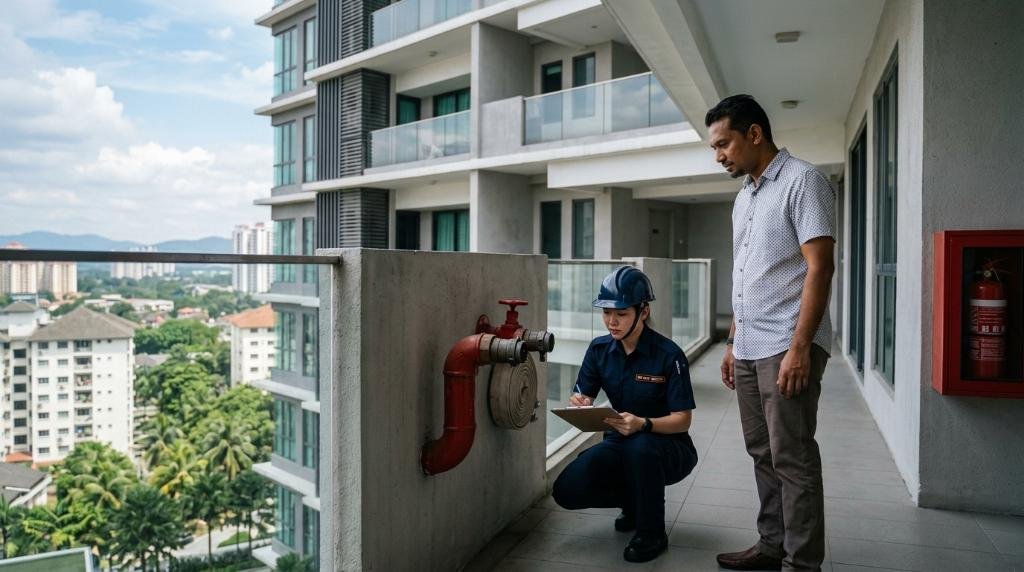
Industry Insights & Regulatory Audit
Strata Property Fire Safety: Essential Inspection Guide for Malaysian High-Rises
A sobering reality recently highlighted in national media revealed that alarming numbers of multi-storey residential and commercial buildings across Malaysia are living on borrowed time. According to a investigative report covered by Google News, All it takes is a spark: Nearly half of strata properties fail fire safety checks, unmaintained systems top hazard risks – Malay Mail. Broken pumps, depleted extinguishers, wedged-open escape doors, and unserviced alarm panels top the list of hazardous compromises.
For property managers, Joint Management Bodies (JMB), Management Corporations (MC), and developers, establishing comprehensive strata property fire safety Malaysia protocols is no longer just a regulatory checkbox—it is an absolute statutory duty and moral imperative. When a fire breaks out in a high-rise structure, life safety depends entirely on two factors: structural containment (passive protection) and functioning suppression systems (active protection).
Legal Framework: Act 757, UBBL 1984, and Bomba Mandates
In my years conducting engineering audits across Kuala Lumpur, Selangor, and Penang, I frequently encounter management committees unaware of the strict legal liabilities attached to neglected fire installations. Under the Strata Management Act 2013 (Act 757), the JMB or MC holds direct legal responsibility to maintain common property in a safe, functional condition.
Key regulatory codes governing high rise fire safety and overall fire safety compliance Malaysia include:
- Uniform Building By-Laws (UBBL) 1984 (Part VIII – Fire Controls): Mandates design standard specifications for fire resistance, travel distances to exits, compartmentation size, and active fire fighting installations based on building height and purpose group.
- Fire Services Act 1988 (Act 341): Empowers Jabatan Bomba dan Penyelamat Malaysia (JBPM) to inspect premises, issue notices of non-compliance, and require designated commercial and high-density residential properties to hold an annual Fire Certificate (FC).
- Street, Drainage and Building Act 1974 (Act 133 – Section 85A): Requires mandatory structural and safety inspections every 10 years for buildings exceeding 5 storeys. Engaging professional engineering services for Pemeriksaan Bangunan Berkala (Periodic Inspection) ensures both fire protection systems and underlying structural integrity satisfy legal thresholds.
- CIDB & Malaysian Standards (MS): Technical guidelines such as MS 1489 (Wet/Dry Riser Systems) and MS 1745 (Fire Alarm Systems) established under CIDB Construction Industry Standards (CIS) define the exact technical parameters for maintenance.

Active vs. Passive Fire Safety Systems: What Engineers Look For
During a rigorous fire safety inspection Malaysia, a professional engineer evaluates two distinct defense lines:
1. Active Fire Protection Systems
Active systems require automatic or manual activation upon detecting heat or smoke. In modern Malaysian strata high-rises, this network includes:
- Automatic Sprinkler & Deluge Systems: Maintained under precise pressure via main electrical pumps, standby diesel pumps, and jockey pumps.
- Wet & Dry Risers (MS 1489): Internal pipework providing water pressure to fire hoses on elevated floors. Missing breach inlet caps or seized landing valves are severe non-compliances.
- Smoke Control & Pressurisation Systems: Smoke spill fans and stairwell pressurisation fans designed to keep emergency evacuation staircases free of toxic smoke.
- Fire Alarm Central Panel & Addressable Detectors: Master control units integrated with heat/smoke sensors, emergency break-glass points, and audio-visual alarms.
2. Passive Fire Protection Systems
Passive systems contain fire within a specified fire cell (compartmentation), preventing rapid spread and giving occupants crucial time to evacuate safely. These structural elements require no manual trigger:
- Fire-Rated Doors & Intumescent Seals: 1-hour or 2-hour fire doors along stairwells and utility shafts. Auto-door closers must never be removed or wedged open.
- Structural Compartmentation & Fire Dampers: Concrete floors, fire-rated drywall, and automatic mechanical duct dampers that seal off air ducts during a thermal event.
- Fire Stopping Penetrations: Cable trays and plumbing pipes passing through fire-walls must be sealed with certified intumescent sealant. Failure to seal utility risers creates a vertical blowtorch effect during fires.
In cases where unapproved architectural modifications or structural cracks compromise fire cells, property management should immediately engage professional Structural Repair Consultancy to rectify load-bearing and fire-stopping defects.
Top Engineering Failures Spotted During Strata Inspections
Based on real-world engineering audits across residential condos and commercial complexes in Malaysia, these are the most prevalent safety hazards leading to inspection failures:
1. Degraded Diesel Starter Batteries in Fire Pump Rooms
In the event of a fire-induced main electrical blackout, the standby diesel fire pump must kick in automatically. In over 40% of older buildings, the 24V starter batteries are flat, dry, or unserviced, rendering the entire sprinkler/wet riser system useless.
2. Illegal Corridors and Escape Route Obstructions
Residents placing shoe racks, bicycles, or potted plants in common hallways violate escape corridor width regulations prescribed by UBBL 1984. Worse, JMBs converting escape stairwell landings into storage rooms create catastrophic bottlenecks.
3. External Façade and Roof Line Fire Hazards
Unregulated rooftop additions, damaged lightning protection systems, or combustible ACP (Aluminium Composite Panels) on high-rise exterior walls accelerate vertical flame spread. Utilizing advanced aerial tools like Façade & Roof Inspection (Drone) allows engineers to rapidly spot exterior structural and thermal anomalies before they lead to catastrophic risks.

Step-by-Step Fire Safety Inspection Roadmap for JMBs & MCs
To ensure absolute compliance, protect asset value, and safeguard occupants, property management committees should adhere to this systematic engineering checklist for strata building maintenance:
- Conduct Monthly Active System Flow Tests: Verify that the jockey pump maintains line pressure and that main electrical and diesel pumps trigger automatically upon pressure drops. Test all hose reel nozzles.
- Audit Fire-Rated Escape Doors Quarterly: Ensure door closers fully latch doors without human assistance. Replace missing rubber smoke gaskets and repair damaged intumescent strips.
- Verify Annual JBPM Fire Certificate (FC) Renewal: Engage registered competent persons and professional engineers early to test smoke spill systems, fire alarm zones, and emergency generator sets prior to Bomba’s official audit.
- Integrate Occupational Safety & Structural Audits: Align fire safety routines with workplace safety standards monitored by the Department of Occupational Safety and Health (DOSH).
- Appoint Independent Engineering Inspectors: Avoid relying solely on maintenance vendors who service the systems. An independent engineering assessment ensures unbiased evaluation of system readiness.
Frequently Asked Questions (FAQ)
Why do nearly half of Malaysian strata properties fail fire safety checks?
Main factors include delayed maintenance of active systems like wet risers and pump sets, tampered or unmaintained passive fire doors, lack of regular periodic inspections, and budget neglect by Joint Management Bodies (JMB) or Management Corporations (MC).
What is the legal requirement for fire safety under the Strata Management Act 2013 (Act 757)?
Under Act 757, JMBs and MCs have a legal statutory duty to maintain common property in good repair, including all fire fighting installations and life safety equipment required by Jabatan Bomba dan Penyelamat Malaysia (JBPM).
How often should a strata property conduct fire safety inspections in Malaysia?
Active systems require monthly routine checks and annual certification for Fire Certificate (FC) renewal. Furthermore, visual checks of passive elements should be continuous, while mandatory periodic structural and building safety inspections under Section 85A of Act 133 occur every 10 years.
What is the difference between active and passive fire safety systems in high-rise buildings?
Active fire systems require manual or automatic action to detect and suppress fires (e.g., sprinklers, hose reels, fire alarms, smoke extraction fans). Passive fire safety relies on structural building components to contain fire and smoke (e.g., fire-rated doors, concrete compartment walls, fire dampers, and intumescent seals).
Need Professional Property Inspection or Building Audit Services?
Get instant consultation and professional engineering advice from Pro Inspect Solution.
