
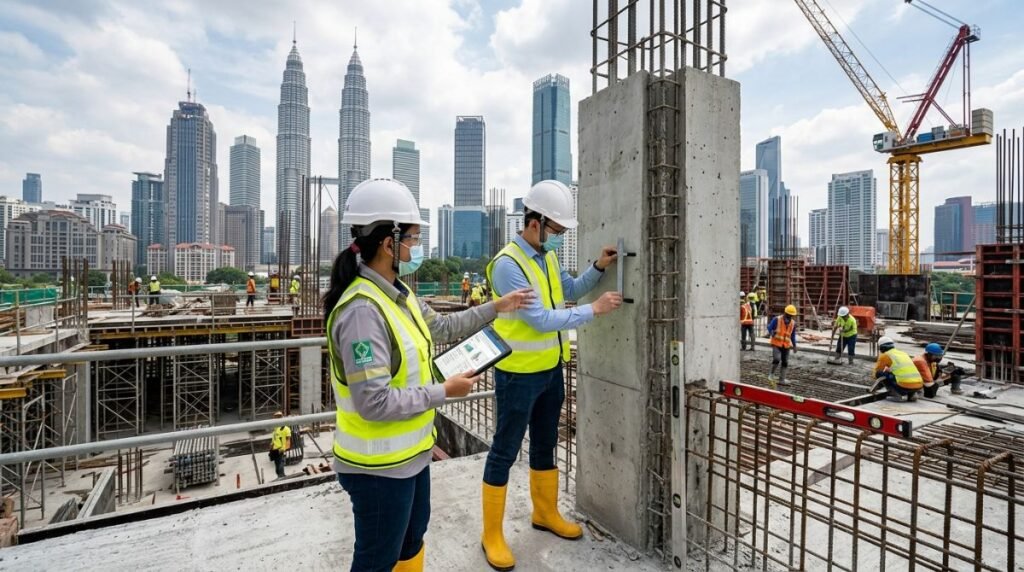
By Ir Vimal, Professional Engineer | Published: October 5, 2026
Across Malaysia, rapid urbanization and aggressive infrastructure expansion continue to reshape the skylines of Kuala Lumpur, Penang, and Johor Bahru. From the nationwide corridors of the East Coast Rail Link (ECRL) and rapid transit expansions to high-density mixed developments, Malaysian mega projects command hundreds of billions of Ringgit in national and private investments. However, towering flyovers, subterranean tunnels, and hyper-tall commercial towers all rely on a singular, indispensable construction material: structural concrete. As timelines compress and supply chains tighten, a critical technical question confronts developers, asset owners, and consulting engineers: Are these capital-intensive developments strictly compliant with the CIDB CIS 21 quality and certification framework?
Ensuring compliance with statutory ready-mixed concrete standards under the purview of the Construction Industry Development Board (CIDB) Malaysia is neither an administrative formality nor a procedural afterthought—it is a critical legal and structural safeguard. At Pro Inspect Solution, our engineering forensic audits and diagnostic building assessments frequently uncover the devastating long-term financial and structural liabilities triggered by substandard batching, unauthorized mix alterations, and uncertified concrete supplies. In this comprehensive technical analysis, we dissect the regulatory mechanics of CIS 21, the mandates of Act 520, and the concrete quality controls essential to safeguarding Malaysia’s built environment.
Understanding CIDB CIS 21 and the Act 520 Regulatory Regime
In Malaysia, the structural integrity and material specification of modern construction are governed under the Lembaga Pembangunan Industri Pembinaan Malaysia Act 1994 (Act 520). Under enforcement revisions enacted to combat widespread material non-conformance, Act 520 explicitly mandates that all critical building products—including reinforcing steel bars, cementitious binders, and ready-mixed concrete—must achieve formal product certification and hold a valid Certificate of Standard Compliance (Perakuan Pematuhan Standard, or PPS) issued by CIDB prior to importation, sale, distribution, or placement on site.
What Is Construction Industry Standard (CIS) 21?
CIDB CIS 21 (Specification for Quality Management System for Ready-Mixed Concrete Production) establishes the technical, testing, and procedural benchmarks that every commercial ready-mixed concrete batching plant must satisfy. Operating in synergy with national design and material codes published by the Department of Standards Malaysia (MS EN 206), CIS 21 enforces strict quality control across the entire operational chain, including:
- Batching Plant Calibration: Mandatory routine verification and calibration of aggregate scales, water meters, and chemical admixture dispensers to prevent unapproved water-cement ratio deviations.
- Constituent Material Verification: Certification compliance for Portland cement (MS EN 197-1), graded coarse and fine aggregates (MS EN 12620), and chemical admixtures to mitigate alkali-silica reactions (ASR).
- Slump and Rheology Control: Rigorous point-of-batching and point-of-discharge slump testing to ensure workability without unauthorized site-water addition.
- Compressive Strength Conformity: Structured sample casting, standard water-curing regimes, and crushing tests at 7 and 28 days in accredited SAC-SAMM laboratories.
Under Section 33D of Act 520, any contractor, supplier, or developer deploying uncertified construction materials listed under the Fourth Schedule faces severe penal liabilities, including statutory fines reaching RM500,000, stop-work orders issued directly by CIDB enforcement divisions, and personal prosecution of principal company directors.

The Fourth Schedule: Mandatory Certification of Ready-Mixed Concrete
Prior to the full enforcement of CIS 21, the local construction market suffered from inconsistent site-batched mixes and uncertified portable batching setups. Ready-mixed concrete suppliers cutting costs often substituted lower-grade fly ash, unwashed aggregates containing excessive silt or chlorides, or uncalibrated weigh-batchers. These shortcuts directly undermine the long-term durability of structural elements.
By listing ready-mixed concrete under the Fourth Schedule of Act 520, the regulatory authority shifted quality compliance from reactive post-failure litigation to proactive production-facility licensing. To maintain a valid PPS under CIS 21, ready-mix batching plants must undergo annual surveillance audits, unannounced batch sampling, and rigorous traceability tracking from aggregate quarry to transit mixer discharge chute. This statutory chain of custody ensures that when grade C40/50 or high-performance self-compacting concrete (SCC) is specified for structural columns, the delivered product achieves the precise characteristic compressive strength and durability parameters calculated by the project's submitting Professional Engineer.
Mega Infrastructure Quality: Scrutinizing Concrete on the ECRL and Rail Corridors
When analyzing quality control across public-sector developments, national transportation networks like the East Coast Rail Link (ECRL), LRT3, and mega expressway viaducts consistently lead public infrastructure discussions. As reported in mainstream investigative industry coverage by The Star Malaysia, these strategic megaprojects deploy advanced engineering methods, including precast segmental box girders, deep marine piles, and cast-in-situ continuous balance-cantilever bridge piers.
Tier-One Contractors vs. Subcontractor Supply Chains
On primary work packages, tier-one main contractors and multi-national joint ventures typically deploy on-site automated batching plants subjected to stringent internal quality assurance regimes, third-party laboratory verification, and supervision by accredited resident engineers. However, practical engineering field audits reveal that compliance vulnerability points frequently emerge deeper down the subcontractor hierarchy:
- Transit Time Delays in Tropical Ambient Temperatures: Malaysia's high daytime ambient temperatures (regularly exceeding 33°C) accelerate cement hydration and initial setting. When transit mixer trucks encounter metropolitan traffic congestion without retarding admixtures calibrated to CIS 21 standards, concrete slumps decline rapidly, tempting errant workers to unlawfully add water on site.
- Unvetted Commercial Batching Plants for Secondary Facilities: While primary viaduct piers and tunnel portals use fully certified batching yards, secondary auxiliary facilities—such as passenger depot platforms, retaining earth walls, and drainage culverts—sometimes procure concrete from smaller, commercial batchers whose PPS licenses may be lapsed or poorly monitored.
- Inadequate Compaction and Vibrating Protocols: High-performance concrete supplied under CIS 21 mix designs can still suffer localized structural defects—such as honeycomb voids, cold joints, and internal bleed channels—if sub-contractors deploy insufficient pokers or undermanned concrete placement crews.

Tropical Environmental Stresses and the Hidden Costs of Non-Compliance
Malaysia's tropical climate operates as a punishing exposure environment for reinforced concrete structures. High atmospheric relative humidity (averaging 80% to 90%), intense tropical monsoons, and cyclic thermal expansion accelerate degradation mechanisms whenever concrete density and durability requirements are compromised.
Premature Carbonation and Reinforcement Corrosion
When concrete fails to achieve the specified water-cement ratio or compaction density mandated by CIS 21 and MS EN 206, its permeability increases dramatically. Atmospheric carbon dioxide permeates deep into the porous paste, neutralizing the alkaline protective passivation layer (pH < 9) surrounding internal high-tensile rebar. In the presence of moisture and dissolved oxygen, corrosion initiates, producing ferric oxide expansion that spalls the concrete cover, cracks structural columns, and reduces critical shear capacity.
Escalating Defect Liability Period (DLP) Claims
For high-rise commercial developers and strata residential builders, sub-standard concrete batching manifests as severe operational headaches during the statutory Defect Liability Period (DLP). Discerning commercial tenants and joint management bodies frequently engage certified third-party engineers to conduct an exhaustive property defect inspection (DLP). Evidence of widespread thermal shrinkage micro-cracking, crazing, water ponding leakage, or hollow slab screeding immediately triggers developer liabilities under the Housing Development (Control and Licensing) Act and Strata Management Act 757.
Prohibitive Structural Repair Costs
When localized core drilling or non-destructive testing (NDT) confirms that cast-in-situ concrete fails to achieve structural design strength, retrofitting becomes unavoidable. Asset owners must then commission comprehensive structural repair consultancy to design costly remedial interventions—such as carbon-fiber-reinforced polymer (CFRP) wrapping, micro-concrete jacketing, or chemical pressure grouting—to re-establish load-bearing capacities without condemning the asset.
Engineering Safeguards: From Dilapidation Audits to Structural Diagnostic Inspections
Maintaining regulatory and structural compliance demands proactive verification across the entire lifecycle of a construction project, from initial groundbreaking through to decades of post-handover occupancy.
Pre-Construction Dilapidation Surveys
Heavy piling, deep basement diaphragm wall excavation, and extensive crawler-crane movements on mega project sites generate substantial ground-borne vibrations. To insulate developers from frivolous third-party structural damage claims from neighboring property owners, executing a formal, documented dilapidation survey prior to commencing site works is essential. Independent engineers establish photographic and crack-gauge baselines across all adjacent assets to isolate pre-existing settlement defects from real-time construction impacts.
Advanced Façade and Roof Diagnostic Audits
Structural integrity extends vertically throughout the completed envelope. In high-rise towers and elevated transit station architecture, water ingress through degraded expansion joints or uncertified precast concrete panels severely compromises structural health. Deploying specialized façade & roof inspection (drone) services equipped with high-resolution optical and thermal infrared thermography enables engineering teams to inspect hard-to-reach envelopes rapidly, identifying spalling concrete hazards, water retention voids, and anchor bolt corrosion before building safety is breached.
Periodic Building Inspections Under Act 133
Under Section 85A of the Street, Drainage and Building Act 1974 (Act 133) and the Uniform Building By-Laws (UBBL 1984), owners of commercial and residential high-rise buildings exceeding five storeys must engage a registered Professional Engineer to conduct mandatory Periodic Building Inspections every ten years post-completion. These comprehensive structural integrity audits evaluate whether the concrete elements, load-bearing transfer plates, and foundation basements continue to satisfy safe occupancy standards, confirming that historical concrete batching quality has held firm over operational decades.
Frequently Asked Questions (FAQ)
What is the primary difference between MS EN 206 and CIDB CIS 21?
MS EN 206 is the national technical standard specifying concrete performance, constituent raw materials, mix design calculations, and conformity rules. CIDB CIS 21 is the mandatory regulatory standard that specifically governs the quality management system, equipment calibration, and facility certification required for ready-mixed concrete batching plants to operate legally in Malaysia.
Can a contractor be prosecuted if ready-mixed concrete fails strength tests on site?
Yes. Under Act 520, deploying non-compliant, uncertified, or structurally sub-standard materials listed under the Fourth Schedule carries statutory penalties of up to RM500,000, immediate issuance of CIDB stop-work orders, and contractual breach liabilities enforced by the project submitting engineer.
What testing methods determine whether cured concrete meets structural specifications?
Verification starts with standard 28-day water-cured concrete cube crushing tests (BS EN 12390-3). If cube results indicate non-conformance, engineers utilize non-destructive testing (NDT)—such as rebound hammer tests (BS EN 12504-2) and Ultrasonic Pulse Velocity (UPV)—followed by extracted core drilling compression testing (BS EN 12504-1) to evaluate in-situ strength.
Why does unauthorized site-water addition violate CIDB CIS 21 guidelines?
Adding water to transit mixer trucks on site significantly increases the calibrated water-cement (w/c) ratio. While this temporarily increases slump workability, it directly lowers ultimate compressive strength, increases porosity, promotes drying shrinkage cracking, and accelerates reinforcement corrosion.
Contact Us / Certified Inspection & Engineering Consultation
Pro Inspect Solution, led by Ir Vimal, Professional Engineer, provides certified building condition assessments, structural integrity audits, handover defect inspections, and professional engineering advisory across Malaysia.
- 📍 Service Coverage: Kuala Lumpur, Selangor, and Nationwide Malaysia
- 📞 Phone / WhatsApp: +60 16-806 4902
- ✉️ Official Inquiries: inspectsolution.pro@gmail.com
- 🌐 Official Website: proinspectsolution.com
- 👷♂️ Lead Engineer: Authored & verified by Ir Vimal, Professional Engineer
Need Certified Property Inspection or Building Audit Services?
Get instant consultation and professional engineering advice from Pro Inspect Solution.
