
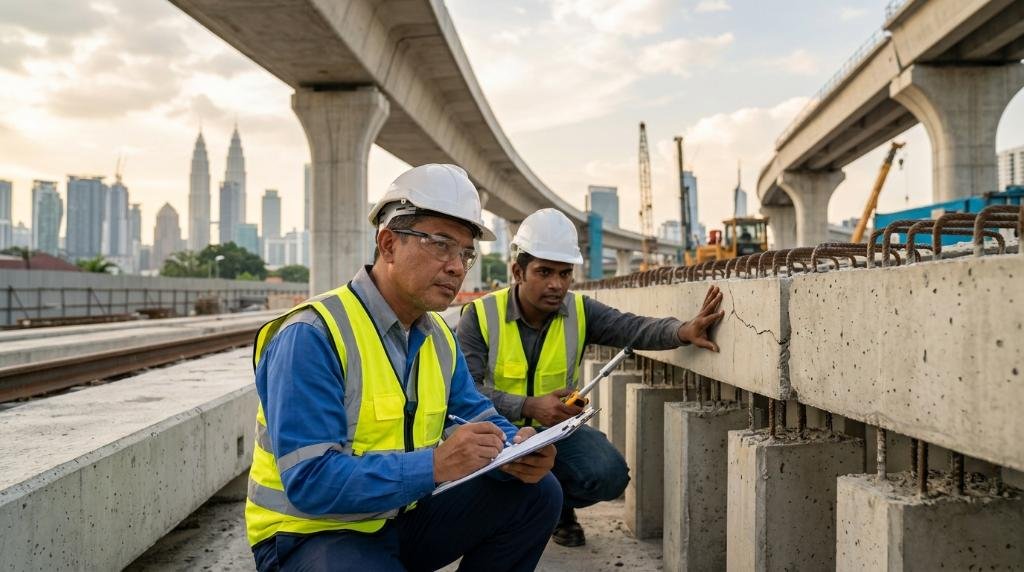
By Ir Vimal, Professional Engineer | Kuala Lumpur, Malaysia — May 10, 2026
Table of Contents
- Malaysia’s Mega Projects at a Crossroads
- The Root of the Issue: Concrete Mix Design Problems Explained
- Penang LRT Concrete Testing: Securing Coastal Transit
- Johor Data Center Construction: The Hidden Concrete Risks
- Navigating Ready-Mix Concrete Quality in Malaysia
- Infrastructure Defect Solutions for Developers
- Frequently Asked Questions (FAQ)
Malaysia’s Mega Projects at a Crossroads
As of 2026, Malaysia is experiencing a monumental construction boom, driven by massive transit expansions and foreign direct investment in digital infrastructure. However, an underlying threat looms over these multi-billion ringgit investments: concrete mix design problems. From the ambitious transit networks in the north to the sprawling technology hubs in the south, the integrity of these structures relies entirely on the foundation of construction materials.
When concrete fails to meet the stringent standards set by the Construction Industry Development Board (CIDB) Malaysia, the consequences go beyond delayed timelines—they present severe safety hazards and devastating financial losses. As the leading authority at Pro Inspect Solution, we frequently witness how minor miscalculations in material science escalate into major structural failures.
The Root of the Issue: Concrete Mix Design Problems Explained
Concrete is not just cement, water, and aggregates; it is a highly sensitive chemical compound. In Malaysia’s tropical, highly humid climate, concrete mix design problems are often exacerbated by extreme weather conditions. High ambient temperatures can accelerate curing times, causing thermal cracking, while unexpected heavy downpours can alter the water-to-cement ratio at the job site.
Common issues encountered by contractors include:
- Improper Water-to-Cement Ratio: Leads to decreased compressive strength and high permeability.
- Poor Aggregate Grading: Causes honeycomb formations and voids within structural pillars.
- Inadequate Admixtures: Fails to retard setting times during long transportation routes in traffic-heavy cities like Kuala Lumpur.
To mitigate these risks proactively, developers must invest in specialized Concrete Technology Consultancy. Engaging experts to review batching plant designs and verify mix proportions is the most cost-effective way to avoid catastrophic failures.
Penang LRT Concrete Testing: Securing Coastal Transit
One of the most heavily scrutinized infrastructure initiatives this year is the Penang Light Rail Transit (LRT) network. Building an elevated railway in a coastal and marine environment introduces complex durability challenges. Consequently, rigorous Penang LRT concrete testing has become a focal point for authorities and engineering consultants.

In coastal areas, the presence of airborne chlorides and seawater splashes accelerates the corrosion of steel reinforcement rebar inside the concrete. The concrete mix must be meticulously designed to be highly impermeable. Any lapse in quality necessitates immediate Building Condition Assessment to evaluate chloride ingress and carbonation depths before the infrastructure is opened to the public.
Johor Data Center Construction: The Hidden Concrete Risks
Down south, the explosion of Johor data center construction is positioning Malaysia as Southeast Asia’s digital epicenter. While these low-rise structures might seem less complex than towering skyscrapers, they present unique structural demands. Data centers require massive, heavily reinforced concrete slabs to support the immense weight of server racks, cooling systems, and backup generators.
Because these projects operate on hyper-aggressive timelines to meet the demands of global tech giants, the curing process of concrete is often rushed. If micro-cracks develop on a data center floor, it can compromise the dust-free environment required for sensitive servers. Therefore, stringent Property Defect Inspection (DLP) protocols must be implemented the moment the concrete is set to ensure the structural slabs meet international tolerances.
Navigating Ready-Mix Concrete Quality in Malaysia
The vast majority of Malaysian mega-projects rely on concrete supplied by commercial batching plants. Maintaining consistent ready-mix concrete quality is a massive logistical challenge. Traffic congestion in urban centers often delays transit mixer trucks, causing the concrete to lose its workability (slump loss) by the time it reaches the site. Unscrupulous workers might illegally add water to the mix on-site to regain workability, entirely destroying the engineered design strength.
Under CIDB Act 520, structural materials must meet specific compliance standards. When disputes arise between main contractors and ready-mix suppliers over failed compressive strength tests, independent verification is necessary. Having an impartial Expert Witness & Dispute Resolution consultant can help pinpoint exactly where the concrete quality degraded—whether at the batching plant, during transport, or during the on-site pouring and compaction process.
Infrastructure Defect Solutions for Developers
What happens when concrete fails to meet the specified strength after 28 days? Tearing down a partially constructed transit pillar or a data center foundation is financially paralyzing. Fortunately, modern engineering offers advanced infrastructure defect solutions.

Through comprehensive Non-Destructive Testing (NDT) such as ultrasonic pulse velocity (UPV) and rebound hammer tests, engineers can map the extent of the weak concrete. Depending on the severity, developers can implement Structural Repair Consultancy strategies. Solutions may include:
- High-pressure epoxy resin injections to seal deep structural cracks.
- Carbon Fiber Reinforced Polymer (CFRP) wrapping to increase the load-bearing capacity of under-strength pillars.
- Micro-concreting and pressure grouting to eliminate internal honeycombing.
To ensure long-term safety, especially for aging assets or rapidly built structures, scheduled Periodic Inspections (Pemeriksaan Bangunan Berkala) are mandated by local councils to continuously monitor structural health.
Frequently Asked Questions (FAQ)
- What are the most common concrete mix design problems in Malaysia?
- Common issues include improper water-to-cement ratios due to the tropical climate, poor aggregate grading, and insufficient curing times, leading to shrinkage cracks and compromised structural integrity.
- Why is Penang LRT concrete testing so stringent?
- Penang LRT concrete testing is critical because the infrastructure spans marine and highly urbanized environments. The concrete must resist chloride ingress, sulfate attacks, and sustain heavy dynamic train loads without degrading.
- Why is ready-mix concrete quality a major risk in Johor data center construction?
- Data centers require highly durable, perfectly level slabs to support heavy server racks. Fluctuations in ready-mix concrete quality can cause severe floor cracking or uneven settling, delaying the installation of sensitive technological equipment.
- What infrastructure defect solutions are available for existing concrete flaws?
- Solutions include comprehensive non-destructive testing (NDT), structural strengthening using carbon fiber reinforced polymer (CFRP), epoxy crack injections, and expert concrete technology consultancy to rectify batching errors.
Protect Your Investment from Concrete Failures
Don’t let concrete mix design problems derail your project timeline or budget. Ensure your infrastructure is built to last with Pro Inspect Solution’s industry-leading testing and consultancy services.
