
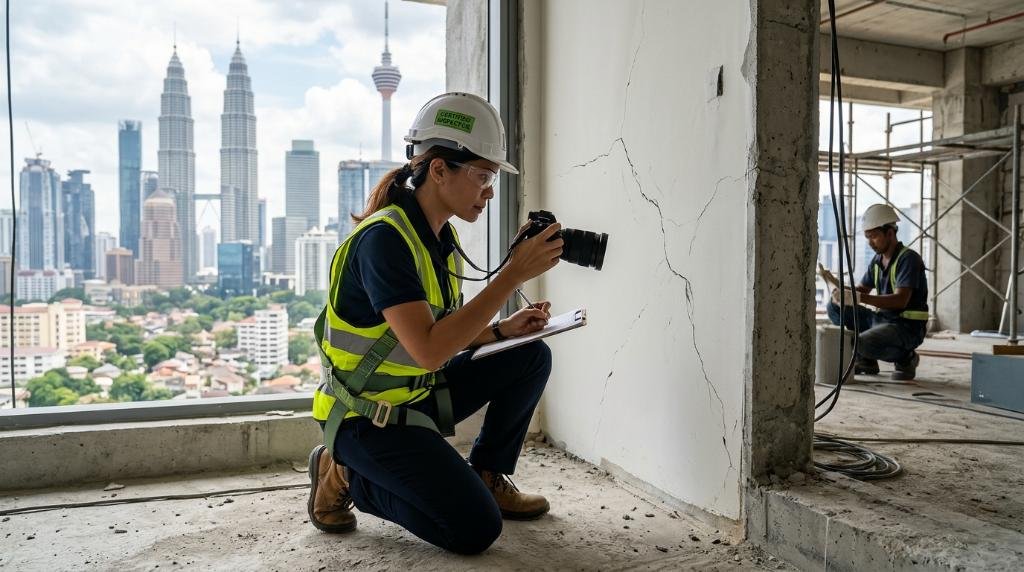
By Ir Vimal, Professional Engineer | October 28, 2026
Statutory adjudication under the Construction Industry Payment and Adjudication Act 2012 (Act 746 – CIPAA 2012) was enacted to maintain the cash flow lifecycle of the Malaysian built environment. Yet, more than a decade since its enforcement, the battleground in adjudication rooms across the Asian International Arbitration Centre (AIAC) has fundamentally shifted. Adjudications are no longer simple disputes over missing certified interim valuations; they are routinely dominated by complex, high-stakes cross-claims and backcharges grounded in alleged defective construction, latent building failures, and unapproved material substitutions.
The judicial lens on technical testimony has never been sharper. In a milestone address covered in AIAC Asia ADR Week 2025 | Justice Philip Jeyaretnam calls for reform in expert evidence: A Kairos Moment for Construction Disputes – SCC Online, the international dispute community was urged to eliminate partisan “hired guns” and restore absolute independence in forensic engineering testimony. For any claimant contractor or respondent developer, selecting the right expert witness Malaysia CIPAA professional is no longer an afterthought—it is the structural spine of your legal survival.
The Collision of Cash Flow and Defects: CIPAA Statutory Realities
Under Section 5 of CIPAA 2012, an unpaid party serves a Payment Claim for work carried out under a construction contract. In response, main contractors or developers frequently issue a Section 6 Payment Response claiming set-offs, liquidated damages (LAD), or substantial deductions based on alleged defective workmanship. When latent water ingress, cracking in transfer slabs, differential foundation settlement, or non-compliant MEP installations are cited, the dispute pivots instantaneously from an accounting review into forensic engineering analysis.
In standard forms of building contracts commonly used across Kuala Lumpur, Selangor, and Penang—such as the PAM Contract 2018, IEM Form, or PWD (JKR) Form 203A—an employer cannot arbitrarily withhold monies without proving the existence of the defect, the legal contractual breach, and the reasonable quantum required to rectify it. Where a developer attempts to set off millions of Ringgit without an objective professional building condition assessment, adjudicators are bound by judicial precedent to dismiss unsubstantiated counterclaims.

The “Kairos Moment”: Neutrality vs. Partisan Advocacy
Historically, parties to Malaysian construction litigation have treated expert evidence as an extension of their legal submissions. Subcontractors hire engineers who claim no defect exists, while developers hire engineers who claim total structural failure requiring full reconstruction. As highlighted during the AIAC ADR Week, this culture of subjective advocacy is facing severe judicial pushback across commonwealth jurisdictions, including the Malaysian High Court and Construction Courts.
Under Order 40A of the Malaysian Rules of Court 2012 and Section 45 of the Evidence Act 1950, an expert’s duty is paramount to the tribunal or court, completely superseding any financial obligation to the client who pays their invoice. When an AIAC adjudication expert witness demonstrates unvarnished impartiality—conceding minor points when facts dictate, while standing firm on empirical forensic tests—the adjudicator assigns their testimony decisive weight.
Malaysian Technical Baselines: MS, Eurocodes, and CIDB Standards
In a CIPAA construction dispute, establishing whether a construction element is “defective” requires an unyielding engineering baseline. In Malaysia, contractual specifications must be interpreted alongside statutory building codes and guidelines enforced under the Uniform Building By-Laws 1984 (UBBL) and the Construction Industry Development Board (CIDB Malaysia).
Subjective opinions such as “the floor finish looks unsightly” or “the concrete finish feels rough” carry zero evidentiary standing. Expert analysis must anchor to recognized technical standards:
- Structural Concrete: BS EN 1992-1-1 (Eurocode 2) with the Malaysian National Annex (MS EN 1992-1-1), which dictates strict crack width limits (typically 0.3 mm for standard durability, 0.2 mm for water-retaining structures).
- Quality of Workmanship: CIS 7 (Quality Assessment System in Construction – QLASSIC) published by CIDB, establishing objective tolerances for surface evenness, alignment, and joint detailing.
- Waterproofing Integrity: Compliance with MS 1756 and strict adherence to membrane manufacturers’ British Standards or ASTM elongation parameters.
- Strata Inter-Floor Ingress: Statutory presumptions and forensic tracing established under Section 142 of the Strata Management Act 2013 (Act 757).
Anatomy of an Unassailable Building Defect Expert Report
Adjudicators have an extraordinarily narrow window—typically 45 working days from the delivery of the Adjudication Response or Reply under Section 12 of CIPAA—to review evidence and deliver their decision. They do not have time to wade through disorganized site diaries or raw WhatsApp screenshots. A successful building defect expert report must be methodical, concise, and structured for swift judicial digestion.
Essential Components of an Admissible Engineering Report:
- Statement of Truth & Independence: Explicit declaration that the engineer acts independently of the instructing party and acknowledges their primary duty to the tribunal.
- Executive Summary & Schedule of Defects: A cross-referenced defect matrix identifying the defect, location, severity, contractual non-compliance, and proposed remediation cost.
- Empirical Investigation Findings: Comprehensive data backed by calibrated non-destructive testing (NDT), thermography, or laboratory core testing.
- Root Cause Analysis: Clear differentiation between design deficiencies, poor contractor workmanship, normal wear-and-tear, or unauthorized employer modifications.
- Rectification Quantum Justification: Costing backed by the CIDB Schedule of Rates or current Malaysian market rates, avoiding inflated or speculative allowances.
Forensic Diagnostic Methodologies in Defect Disputes
Engineering opinion without physical verification will collapse under cross-examination. In modern defect litigation, registered engineers must employ rigorous non-destructive and semi-destructive testing regimes on site.
When addressing structural integrity or widespread micro-cracking, engineers deploy ultrasonic pulse velocity (UPV) testing, rebound hammer tests, and core extractions tested under MS 26. For complex building enclosures, high-rise glass curtain walls, and inaccessible roof flashings, utilizing a specialized façade and roof inspection via drone provides high-definition photogrammetry and aerial thermographic imagery. This documents heat loss, localized moisture entrapment, and loose cladding elements without the need for high-risk, expensive scaffolding during an ongoing dispute.

Managing Tight CIPAA Deadlines with Technical Teams
The speed of CIPAA adjudication is brutal. Once the Notice of Adjudication is served and the adjudicator is appointed by AIAC, timelines move with statutory momentum:
| Pleading Stage | Statutory Timeline | Expert Witness Action Plan |
|---|---|---|
| Payment Claim & Response | Pre-adjudication initiation | Initial preliminary defect audit, photographic preservation, review of project specifications. |
| Adjudication Claim | 10 working days from acceptance | Claimant finalizes factual documentation or preempts anticipated defect allegations. |
| Adjudication Response | 10 working days from Claim | Respondent must submit their full forensic defect report and detailed bill of quantities for repairs. |
| Adjudication Reply | 5 working days from Response | Claimant’s expert submits rebuttal analysis attacking methodology, causation, or inflated rates. |
Attempting to commission a comprehensive forensic structural audit within the 10 working days allocated for the Adjudication Response is a recipe for procedural failure. Legal counsel and developers must engage the forensic engineering team the instant substantial defects are identified on site, preserving the evidentiary chain long before the formal notice lands.
From AIAC Adjudication to High Court Enforcement
An adjudication decision under CIPAA is statutorily binding on the parties until the dispute is finally determined by arbitration or litigation in the High Court under Section 13. However, poorly reasoned or partisan expert evidence produced during adjudication can have long-lasting consequences for your wider dispute strategy.
In subsequent construction litigation Malaysia proceedings, contradictory statements made by an unvetted party representative in adjudication documents will be seized upon by opposing trial counsel. Securing an independent, professional engineer who formulates an evidence-based position early ensures seamless continuity. Whether defending against enforcement under Section 28 or seeking to set aside a decision under Section 15 for breach of natural justice, technical clarity remains your most potent commercial asset.
Frequently Asked Questions (FAQ)
Can an adjudicator under CIPAA 2012 determine liability for building defects?
Yes. While CIPAA 2012 primarily addresses progress payments, employers frequently raise set-offs, backcharges, or cross-claims based on rectification costs for defective or non-compliant work. An adjudicator has jurisdiction to evaluate whether non-payment or withholding is substantiated by forensic engineering evidence.
What makes a building defect expert report admissible and persuasive in AIAC adjudication?
An admissible report must be objectively prepared by a registered professional engineer, adhering to statutory design codes such as Eurocodes with Malaysian National Annexes or BS EN standards. It must demonstrate clear root cause analysis, non-destructive testing data, photographic evidence with chain of custody, and fair quantification of repair costs rather than speculative summaries.
What is the difference between a factual witness and an expert witness in Malaysian construction litigation?
A factual witness testifies strictly to facts within their direct observation (e.g., project engineers or clerks of work). An expert witness gives opinion evidence within their specialised engineering discipline under Section 45 of the Evidence Act 1950, owing an overriding, independent duty to the tribunal rather than the instructing party.
When should a contractor or employer appoint an expert witness during a CIPAA dispute?
Given the aggressive statutory timelines under CIPAA 2012 (where responses and replies must be submitted within 10 working days), an expert witness should be engaged as soon as a Payment Dispute arises or at the Payment Claim/Payment Response stage, before formal adjudication kicks off.
Contact Us / Certified Inspection & Engineering Consultation
Pro Inspect Solution, led by Ir Vimal, Professional Engineer, provides certified building condition assessments, structural integrity audits, handover defect inspections, and professional engineering advisory across Malaysia.
- 📍 Service Coverage: Kuala Lumpur, Selangor, and Nationwide Malaysia
- 📞 Phone / WhatsApp: +60 16-806 4902
- ✉️ Official Inquiries: inspectsolution.pro@gmail.com
- 🌐 Official Website: proinspectsolution.com
- 👷♂️ Lead Engineer: Authored & verified by Ir Vimal, Professional Engineer
Need Certified Property Inspection or Building Audit Services?
Get instant consultation and professional engineering advice from Pro Inspect Solution.
