
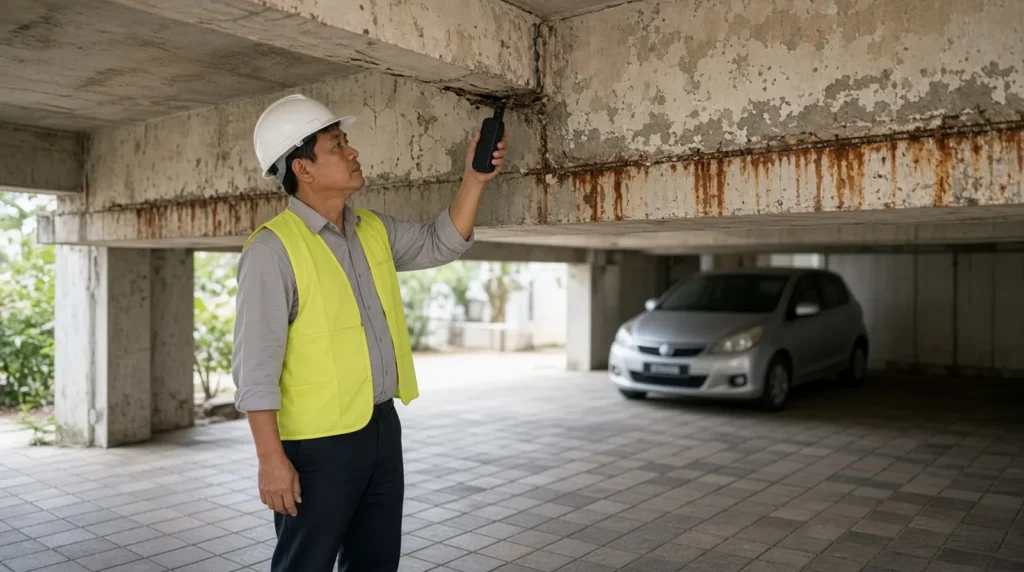
Rust stains on a beam, a crack running straight along a column, or a chunk of concrete falling off a balcony soffit. These are some of the most common defects in Malaysian buildings, and many of them start with one small number on the drawings: the concrete cover. This article explains the concrete cover requirements in Malaysia in plain terms, why too little cover leads to early corrosion, and what developers, contractors and buyers can check.
Concrete cover is the distance from the outer face of the concrete to the nearest steel bar. If it is too thin, carbonation or chlorides reach the steel sooner, the bar rusts, and the rust then cracks and spalls the concrete. The project engineer’s design always governs the figure on the drawings.
- Cover protects the steel from corrosion, helps the bar bond with the concrete, and gives fire protection.
- In Malaysia, the designer sets exposure class using MS EN 206, then determines cover under MS EN 1992-1-1 and its Malaysian National Annex.
- The figure on the drawings is the nominal cover: the minimum cover plus an allowance for deviation, commonly 10 mm, which may be reduced to 5 mm only where quality control includes measuring the cover.
- Indicative Eurocode recommended durability covers for structural class S4 (a 50-year design life) run from 15 mm for XC1 up to 45 mm for XD3/XS3, before the deviation allowance is added. The project engineer’s design governs.
- Early warning signs include rust stains, cracks along the line of the bars, and spalling. Do not simply patch over spalled areas with plaster.
01What Concrete Cover Actually Does
Concrete cover is the distance from the outer face of the concrete to the nearest steel bar, including links and stirrups. It does three jobs:
- Protects the steel from corrosion. Fresh concrete is highly alkaline, and this keeps a thin protective film on the steel. As long as that film stays intact, the bar does not rust.
- Helps the steel bond with the concrete. The steel can only carry load if the concrete around it can grip it.
- Gives fire protection. The cover slows the heat from reaching the steel in a fire.
If the cover is too thin, all three are weakened. The corrosion risk is usually the first to show.
02Concrete Cover Requirements In Malaysia Start With Exposure Class
Malaysia uses the Eurocode for concrete design: MS EN 1992-1-1 with its Malaysian National Annex. The designer first decides the exposure class of each element, using the classes in MS EN 206 (EN 206). The main groups are:
- XC – corrosion caused by carbonation (for example, dry indoor concrete, or concrete that is exposed to rain and dries out again).
- XD – corrosion caused by chlorides other than seawater (for example, some industrial settings or concrete exposed to chlorinated water).
- XS – corrosion caused by chlorides from seawater (coastal air, splash zones, marine structures).
Each group is split into levels. The harsher the environment, the more cover and the better the concrete quality needed.
03Minimum Cover, Deviation And Nominal Cover
The Eurocode builds up the cover in steps:
- Minimum cover for durability (cmin,dur). This depends on the exposure class and the “structural class”. The structural class reflects the design life and the concrete quality.
- Minimum cover (cmin). This is the largest of the durability cover, the cover needed for bond (related to bar size), and 10 mm.
- Allowance for deviation (Δcdev). Steel fixing on site is never perfect, so the designer adds an allowance for it. The Eurocode recommends 10 mm. The Malaysian National Annex adopts 10 mm and allows it to be reduced to as low as 5 mm only where quality control includes measuring the cover.
- Nominal cover (cnom = cmin + Δcdev). This is the figure shown on the drawings and the one the spacers must achieve.
For a sense of scale, the Eurocode’s recommended durability cover values for structural class S4 (the recommended class for a 50-year design life) are 15 mm for XC1, 25 mm for XC2/XC3, 30 mm for XC4, 35 mm for XD1/XS1, 40 mm for XD2/XS2 and 45 mm for XD3/XS3. The deviation allowance is then added on top.
These are indicative only. The Malaysian National Annex points designers to tables based on BS 8500-1 for durability cover. Those tables link the cover to the concrete strength, cement type and water-cement ratio, so the right value depends on the mix specified. The project engineer’s design and drawings always govern.
04How Rust Starts When Cover Is Too Thin
Corrosion rarely starts on day one. It waits until something breaks down the protective film on the steel. There are two usual causes.
Carbonation. Carbon dioxide from the air slowly reacts with the concrete from the surface inwards and lowers its alkalinity. When this carbonated zone reaches the steel, the protective film is lost. If moisture and oxygen are present, which is common in our humid climate with heavy rain, the steel starts to rust. Thin or porous cover lets this front reach the steel much sooner.
Chlorides. In coastal areas, or where salts are present, chlorides travel through the concrete. When enough of them collect at the steel surface, they break the protective film, even if the concrete is still alkaline. Chloride attack can cause local pitting, which eats into the bar.
Rust takes up more space than the steel it comes from. As it builds up, it pushes on the surrounding concrete and causes this typical sequence:
- Rust stains seeping out at the surface, often in lines.
- Cracks running along the line of the bars, especially at corners, edges and soffits.
- Spalling, where the cover concrete breaks away and exposes corroded steel.
By the time spalling appears, the steel may already have lost section, and repair costs rise sharply. Our guide to cracks in walls explains how to tell common crack patterns apart.
05Practical Checks For Developers And Contractors
Good cover is mostly about site discipline. Some simple controls make a big difference:
- Use the right spacers and chairs. Use proper concrete or plastic spacers sized to the nominal cover on the drawings. Avoid broken brick, timber offcuts or stones. Space them closely enough that the cage does not sag.
- Tie the cage firmly. Loose links and top bars get pushed down or sideways when workers walk on them or when concrete is placed.
- Inspect before every pour. Check cover at the bottom, sides and top of the cage, and at congested areas like beam-column joints. Record it with photos.
- Compact and cure properly. Honeycombed or poorly cured cover is porous. Even the correct thickness then gives less protection.
- Consider a cover meter survey. A cover meter detects the steel without breaking the concrete and estimates its depth. It is useful for spot checks after casting, or when problems are suspected. See also our note on concrete technology and cover meter surveys.
06What Buyers And Owners Should Look Out For
You do not need equipment to notice early warning signs. Look at balconies, car porch beams, roof parapets, external columns and areas near the sea:
- Brown or orange stains on concrete or plaster.
- Straight, thin cracks that follow the line of a beam, column edge or slab soffit.
- Hollow-sounding or bulging plaster on concrete surfaces.
- Exposed bars or pieces of concrete that have fallen off.
Call a Professional Engineer to inspect when you see cracks along the bars, any spalling, exposed steel, or stains that are spreading. Do the same if the building is near the coast or a source of salts. An engineer can carry out cover meter readings and carbonation or chloride testing, then advise whether repair is needed and what type. Do not just patch over spalled areas with plaster. That hides the problem while the steel keeps rusting.
Meeting the concrete cover requirements in Malaysia is cheaper than any repair. For developers and contractors, it means the right spacers and careful checks before each pour. For buyers and owners, it means spotting early signs and getting the right advice in time. Pro Inspect Solution can arrange a building inspection, including non-destructive checks of concrete cover where suitable.
Frequently Asked Questions
What Is Nominal Cover On The Drawings?
Nominal cover is the minimum cover plus an allowance for deviation. It is the figure shown on the drawings and the one the spacers must achieve. The Eurocode recommends a 10 mm deviation allowance, and the Malaysian National Annex adopts 10 mm, with a reduction to as low as 5 mm only where quality control includes measuring the cover.
Are The Eurocode Cover Figures In This Article The Malaysian Requirements?
No. The figures given for structural class S4 are the Eurocode’s recommended durability cover values and are indicative only. The Malaysian National Annex points designers to tables based on BS 8500-1, which also depend on the concrete mix. The project engineer’s design and drawings always govern.
Why Does Thin Cover Cause Rust Stains And Spalling?
Thin or porous cover lets carbonation or chlorides reach the steel sooner. Once the protective film on the bar is lost, the steel rusts. Rust takes up more space than the steel it comes from, so it stains the surface, opens cracks along the bars, and can eventually spall the cover concrete.
What Should A Buyer Do If They See Rust Stains Or Cracks Along The Bars?
Call a Professional Engineer to inspect, especially if there is spalling, exposed steel, spreading stains, or a building near the coast. An engineer can carry out cover meter readings and carbonation or chloride testing, then advise on repair. Do not simply patch over spalled areas with plaster.
References

Leads building inspection, concrete assessment and defect investigation work at Pro Inspect Solution, and writes guidance for owners, JMBs/MCs, developers, contractors and engineers. LinkedIn
Protect Your Building Before The Rust Shows
Contact Pro Inspect Solution on WhatsApp or call +60 16-806 4902. Email inspectsolution.pro@gmail.com