
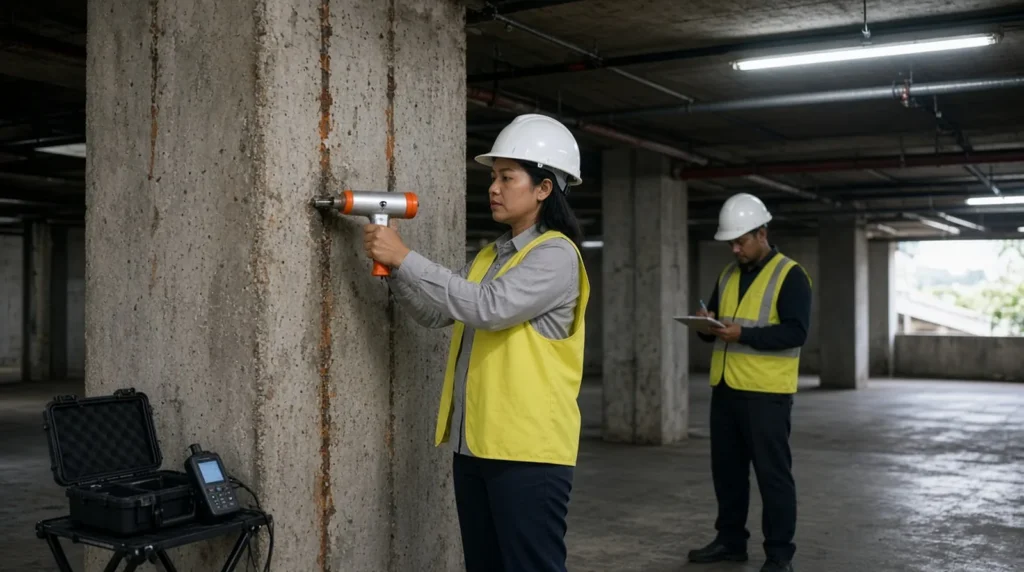
A visual inspection can tell you that a column is spalling, a slab is stained, or a crack has opened at a beam soffit. It cannot, on its own, tell you how hard the concrete is, how much cover sits over the reinforcement, or whether a void is hidden inside a member. That is when structural integrity testing in Malaysia is added to the brief — usually a mix of non-destructive tests, and sometimes cores, chosen to answer a specific question.
The usual starting set is a rebound hammer for surface hardness, ultrasonic pulse velocity (UPV) for internal uniformity, a cover meter to locate reinforcement, and cores where a laboratory strength or a close look at the concrete is needed. The tests support a structural integrity assessment; they do not replace the engineer’s inspection and judgement.
- Choose tests to answer a question raised by the inspection — suspected low strength, hidden voids, inadequate cover, or corrosion — not as a standard package for every building.
- A rebound hammer estimates surface hardness. It is not, by itself, a compressive-strength certificate.
- UPV helps compare internal quality and can point to cracks, voids or poor compaction.
- A cover meter locates bars and estimates cover. Cores are the usual way to obtain a laboratory strength or to examine the concrete itself.
- Results should be interpreted by the engineer who has seen the building, and tied back to a clear assessment and, where needed, a repair plan.
01When Visual Inspection Is Not Enough
Most structural work still starts with a walk-through: mapping cracks, noting spalling and rust stains, checking alignments, and comparing what you see with the drawings if they can be found. Our guide to cracks in walls covers the patterns that should slow you down. Testing is added when the visual evidence raises a question that looking harder will not answer.
Typical triggers include spalling or exposed reinforcement, cracks that run into a slab or a beam, a planned change of use or a heavier floor load, an old building whose drawings are missing, poor compaction or honeycombing, and a repair that needs to be designed rather than guessed. In those cases, a structural integrity assessment sets the questions, and the tests supply measurements the inspection cannot. An engineer should say what each test is for, where it will be done, and how the results will be used, before anyone brings a hammer or a coring rig to site.
02What The Main Tests Are For
Non-destructive testing (NDT) aims to learn about the concrete or the reinforcement without taking the member apart. Semi-destructive work, such as coring, removes a small sample so it can be measured in a laboratory. Pro Inspect Solution’s concrete technology work uses the four methods below when they help answer a specific question about the actual concrete in the structure.
| Test | What It Helps Answer | What It Cannot Do |
|---|---|---|
| Rebound Hammer | Compare surface hardness from point to point, and screen areas that may be weaker or carbonated. | Give a stand-alone compressive strength for the member, especially on a wet, carbonated or uneven surface. |
| Ultrasonic Pulse Velocity (UPV) | Compare internal uniformity, and help locate voids, poor compaction or cracks along the pulse path. | Replace a close visual inspection, or give a precise strength on its own. |
| Cover Meter | Locate reinforcement and estimate cover depth and, with care, bar size. | Measure how badly a bar has corroded, or the remaining capacity of the member. |
| Concrete Core | Provide a laboratory compressive strength and a direct look at compaction, cover and, if tested, carbonation or chlorides. | Represent the whole building if only one or two locations are sampled, or avoid any making-good of the hole. |
Recognised methods for testing concrete in structures are set out in the EN 12504 series, adopted in Malaysia as MS EN 12504, including cores, rebound number and ultrasonic pulse velocity. The standard tells you how the test should be done and what the reading actually is. It does not, by itself, tell you whether the building is safe. That judgement stays with the engineer.
03Rebound Hammer And Ultrasonic Pulse Velocity
A rebound, or Schmidt, hammer strikes the concrete surface and records how far the mass rebounds. The rebound number measures surface hardness and, on a well-prepared surface, can compare one area with another and highlight places that deserve a core. It is quick, which is also the risk: carbonation, moisture, a rough surface, or a reading too close to an edge or a bar can mislead. MS EN 12504-2 is about obtaining a rebound number under controlled conditions, not converting a single reading into a design strength.
UPV, under MS EN 12504-4, sends an ultrasonic pulse through the concrete and measures the travel time. A higher velocity generally indicates denser, more uniform concrete; a lower velocity may point to voids, cracks or poor compaction. The most useful readings are comparative. Estimates of strength that combine UPV with rebound are stronger when they are calibrated against cores, and they are not a substitute for looking at the defect that prompted the test.
04Cover Meter Survey And Concrete Cores
A cover meter is an electromagnetic instrument used to locate reinforcement, estimate cover, and, with care, indicate bar size. Adequate cover helps delay corrosion in Malaysia’s heat and rain; too little cover is a common reason a soffit or column starts to rust early. The survey is most useful before opening-up or coring, and when you need to check as-built cover against the drawings. Congested bars and some finishes can affect the reading, so important results should be checked against a local opening. A cover meter does not tell you whether the bar is already corroding, or how much section it has lost.
Coring is semi-destructive. A cylindrical sample is cut from the member, the hole is later made good, and the core can be tested for compressive strength under MS EN 12504-1. The same sample can be examined for compaction, voids, bar position, and, if required, carbonation or chlorides. Cores are the usual way to obtain a strength that can be discussed with confidence, and to calibrate the non-destructive tests around them. Locations must be chosen by the engineer and planned around reinforcement, services and the member’s remaining capacity.
05Other Tests An Engineer May Add
Other tests are added when the question changes. Carbonation depth, often with a phenolphthalein indicator on a freshly broken surface or a core, shows how far carbon dioxide has lowered the alkalinity of the concrete. Half-cell potential can assess the likelihood of active corrosion. Crack monitoring shows whether a crack is still moving. Infrared thermography, and sometimes a drone survey, can help find delamination or leaks where access is difficult. Ground-penetrating radar is sometimes used to map bars, ducts or slab thickness over a larger area. Each test should be tied to a finding and reported with its limits.
06How The Tests Sit Inside An Assessment
Structural integrity testing in Malaysia is a means, not the assessment itself. A sound sequence is to set the brief, inspect first, choose tests that answer the open questions, interpret the results with the inspection rather than against it, and report clearly: what was tested, where, by which method, what the numbers mean, what remains uncertain, and what should be repaired, monitored or investigated further. Where repairs are needed, that may lead to structural repair consultancy.
For a whole ageing building, testing often sits inside a building condition assessment, which rates defects and helps plan maintenance. For a specific structural concern, it sits inside a structural integrity assessment. The instruments do not change that frame.
Good testing reduces uncertainty. It does not remove it. A rebound or UPV survey is only as good as the surface preparation, the grid of readings, and the engineer who interprets them. A core is only as good as the place it was taken. Results also have a date. Concrete can continue to carbonate, leaks can continue to feed corrosion, and a crack that was stable last year may not be stable after a new load is added.
A Practical Way To Put It. Use structural integrity tests to answer the questions the inspection has already raised, then let an engineer who has seen the building write what the numbers mean for that structure — not for a generic grade of concrete.
Frequently Asked Questions
Is A Rebound Hammer Enough To Confirm Concrete Strength?
No. A rebound hammer measures surface hardness and is useful for comparing areas and choosing where to investigate further. Converting a rebound number into a compressive strength, without cores and without allowing for the surface condition, is not a reliable confirmation of grade.
Do We Always Need To Extract Cores?
No. Cores are justified when you need a laboratory strength, a look at the inside of the concrete, or a way to calibrate the non-destructive tests. If the inspection and a carefully planned NDT survey already answer the brief, coring may be unnecessary. The engineer should say why cores are, or are not, required.
Will The Tests Damage The Building?
Rebound, UPV and cover-meter surveys are non-destructive, though they need a prepared surface and access. Coring is semi-destructive: it leaves a hole that must be made good, and it has to be planned around reinforcement and the member’s capacity. The report should record every location that was opened or cored.
Who Should Specify And Interpret The Tests?
A Professional Engineer who has inspected the building should specify the tests, choose the locations, and interpret the results. A technician may operate the instruments, but the meaning of the readings for that structure is an engineering judgement, not a printout.
Can These Tests Replace A Structural Integrity Assessment?
No. Testing is one part of a structural integrity assessment. The assessment still has to take in the inspection, the drawings where they exist, the use of the building, and a written conclusion about what should be done next.
When Is Testing Needed After Cracks Appear?
Not every crack needs a test. Finish cracks can often be recorded and watched. Testing is more likely when cracks are diagonal or stepped, when they run into a slab or a beam, when there is spalling or rust, or when a new load is planned. Start with the inspection, then add the test that answers the remaining question.
References

Leads building inspection, concrete assessment and defect investigation work at Pro Inspect Solution, and writes guidance for owners, JMBs/MCs, developers, contractors and engineers. LinkedIn
Talk To Us About Structural Integrity Testing
Contact Pro Inspect Solution on WhatsApp or call +60 16-806 4902. Email inspectsolution.pro@gmail.com