
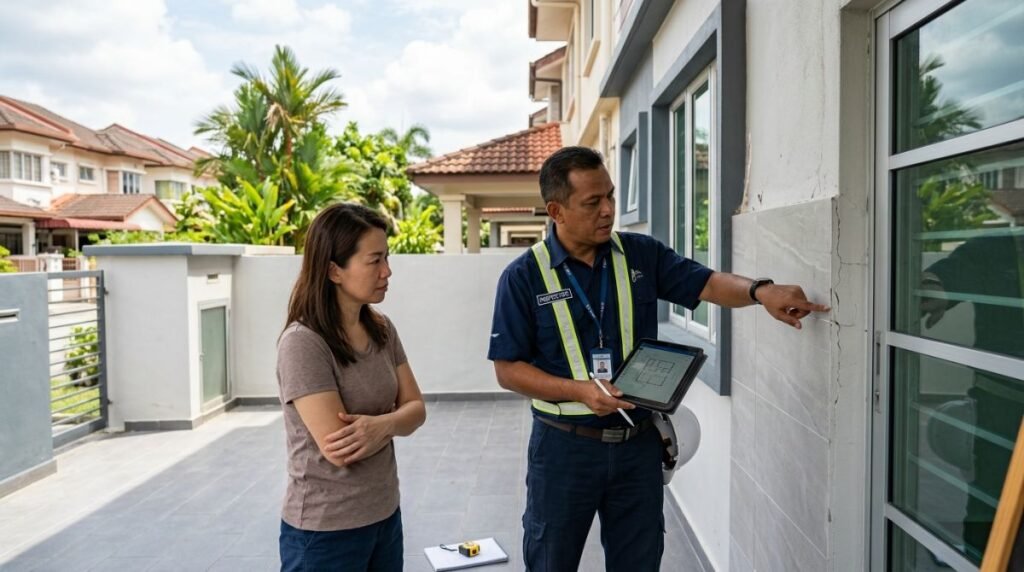
Home renovations represent a substantial financial and emotional commitment. Whether retrofitting an older double-storey terrace house in Petaling Jaya, expanding a kitchen in Shah Alam, or executing a luxury interior fit-out for a high-rise condominium in Mont Kiara, discovering home renovation defects post-handover can instantly derail your plans. In Malaysia, resolving substandard workmanship, illegal structural knocking, chronic moisture intrusion, and non-compliant electrical wiring requires technical precision, formal engineering verification, and a solid grasp of statutory dispute mechanisms. Adhering to technical benchmarks such as the Uniform Building By-Laws (UBBL 1984), Construction Industry Development Board (CIDB) quality specifications, and Malaysian Standards protects your financial investment and safety.
Spot post-renovation defects? Learn how inspections, documentation & legally binding contracts can protect your investment—and what to do next.
- Residential renovation flaws in Malaysia rarely remain purely cosmetic.
- Resolving substandard renovation work requires clear, empirical documentation rather than emotional confrontations on site.
- Disputes frequently reach a standstill when contractors dismiss structural cracking as “routine plaster settlement” or dampness as “homeowner condensation.” Independent technical assessments resolve these subjective disputes.
01Critical Categories of Home Renovation Defects in Malaysia
Residential renovation flaws in Malaysia rarely remain purely cosmetic. Without professional site supervision, shortcuts taken by sub-contractors frequently compromise structural integrity, MEP safety, and weatherproofing envelopes.
1. Structural Compromises and Load-Bearing Alterations
Open-concept living spaces are popular across Malaysian terrace and semi-detached homes, but removing internal walls without an engineer’s structural assessment poses severe risks:
- Unauthorized Knocking of Load-Bearing Walls: Knocking down brick shear walls or reinforced concrete columns without temporary propping (acrow shores) or replacement structural steel universal beams (UB) causes differential load distribution and sagging upper floors.
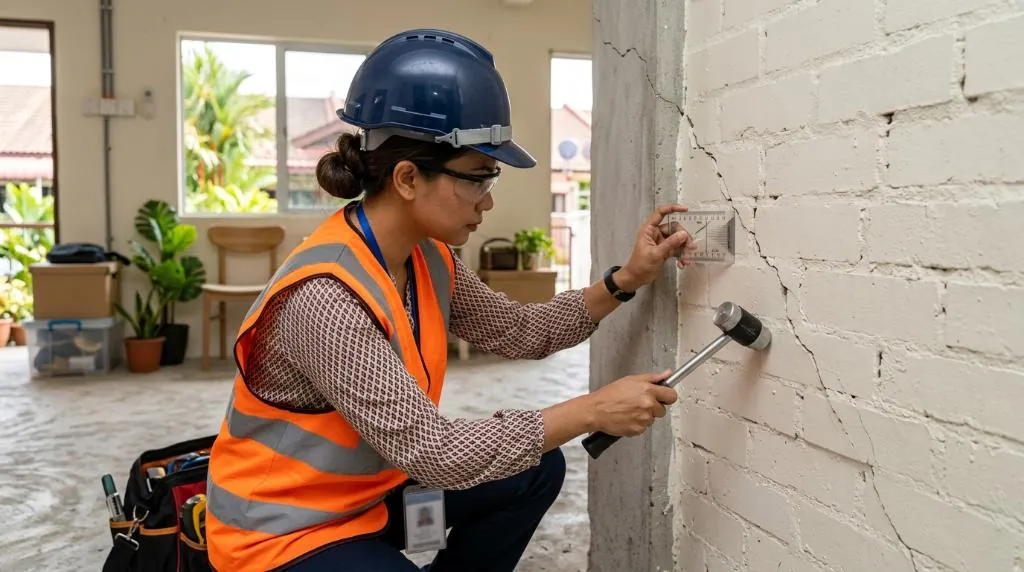
- Lintel Omissions and Diagonal Cracking: Creating new window or door openings without casting proper reinforced concrete lintels leads to immediate 45-degree diagonal shear cracks propagating across plasterwork. In severe instances, property owners must commission an urgent Structural Repair Consultancy to evaluate structural stability and design remedial underpinning.
- Uncured Concrete and Honeycombing: Newly cast reinforced concrete ground slabs or cantilevered balcony slabs stripped of formwork prematurely (violating MS EN 1992 / MS 26 curing durations) develop plastic shrinkage cracking and hollow voids.
2. Mechanical, Electrical, and Plumbing (MEP) Non-Compliance
Unqualified sub-contractors frequently bypass national safety regulations enforced by the Suruhanjaya Tenaga (Energy Commission) and local municipal water authorities (such as Air Selangor or PBA):
- Substandard Electrical Routing: Concealing unsheathed electrical cables directly into wall plaster without heavy-duty uPVC conduit, utilizing undersized 1.5mm² wiring for instantaneous water heaters or high-tonnage air conditioning units, and failing to connect proper copper earth electrodes.
- Plumbing Discrepancies and Inadequate Invert Gradients: Routing sanitary discharge pipes with insufficient falls (less than 1:60), resulting in recurring grease and wastewater chokages beneath tiled ground slabs.
- Poor Joint Solvent Welding: High-pressure concealed water supply pipes joined without proper cleaning and solvent priming, causing catastrophic concealed pinhole leaks behind kitchen cabinet backsplashes.
3. Waterproofing Failures and Architectural Finishes
Malaysia’s tropical weather and high humidity expose poor waterproofing within weeks of handover:
- Membrane Omissions in Wet Areas: Tiling directly onto fresh cement screed in bathrooms, laundry yards, and balconies without applying a formal multi-layer liquid polyurethane or cementitious waterproofing membrane.
- Tile Debonding and Hollow Sounds: Utilizing the “dot-and-dab” spot-fixing method with tile adhesive instead of a continuous notched-trowel bed, violating CIDB QLASSIC (CIS 7) building workmanship tolerances and leading to popped or hollow tiles.
- Missing Damp-Proof Course (DPC): Failing to bridge damp-proof membranes on extended ground-floor slabs, triggering chronic rising damp, skirting rot, and efflorescence along lower brick walls.
02Immediate Actions When Defective Workmanship Is Detected
Resolving substandard renovation work requires clear, empirical documentation rather than emotional confrontations on site.
Step 1: Compile a Timestamped Defect Ledger
Establish a comprehensive digital logbook. Capture high-resolution photographs and continuous video walkthroughs of every defective element. Include measurement rulers, digital spirit levels, or laser rangefinders in the frame to record crack widths, level variances, and out-of-plumb walls accurately.
Step 2: Scrutinize Contract Terms and Retention Clauses
Review your written renovation agreement thoroughly. Critical elements to confirm include:
- Defect Liability Period (DLP): Does the contract stipulate a 6-month or 12-month post-handover DLP?
- Retention Sum Withholding: Did the agreement mandate a 5% to 10% retention sum held back specifically to secure defect rectification?
- Statutory Building Regulations: Does the contract bind the contractor to comply with the Street, Drainage and Building Act 1974 (Act 133) and local council (PBT) renovation permit guidelines?
Step 3: Issue a Formal Rectification Notice
Do not rely solely on casual WhatsApp messages. Prepare and serve a formal, signed Notice of Defect via registered post or tracked email. Explicitly list non-compliant items, attach technical photo references, and establish a reasonable rectification window (typically 14 to 21 working days) before external remediation is engaged at the contractor’s cost.
03The Critical Role of Independent Engineering Inspections
Disputes frequently reach a standstill when contractors dismiss structural cracking as “routine plaster settlement” or dampness as “homeowner condensation.” Independent technical assessments resolve these subjective disputes.
Objective Technical Defect Audits
Commissioning an objective Property Defect Inspection (DLP) equips the property owner with an engineering report cross-referenced against CIDB CIS 7 (QLASSIC) benchmarks and national building by-laws. The audit details architectural finishes, plumbing integrity, floor level variances, and electrical polarity, providing well-supported technical proof.

High-Level Facade and Roof Envelope Audits
Many chronic renovation leaks originate from poor roof flashing junctions, undersized internal box gutters, or improperly pitched roof trusses on newly added extensions. Utilizing an advanced Façade & Roof Inspection (Drone) enables comprehensive high-definition visual and thermal audits of upper roofing envelopes without requiring hazardous, costly scaffolding.
Defending Against Neighbor Claims
Major renovation activities like ground hacking, underpinning, and wall demolitions can transmit vibrational shockwaves to adjoining homes. Conducting a professional Dilapidation Survey before breaking ground establishes a legally recognized photographic baseline of neighboring properties, protecting both you and your builder from frivolous third-party property damage claims under Act 133.
04Legal and Statutory Pathways for Resolving Contractor Disputes
If a renovation contractor refuses to remediate proven defects, abandons the site, or demands unwarranted variation order payments, several statutory remedies are accessible in Malaysia.
1. Tribunal for Consumer Claims Malaysia (TTPM)
Operating under the Ministry of Domestic Trade and Cost of Living (KPDN), the Tribunal for Consumer Claims (TTPM) provides an accessible forum for individual consumers:
- Jurisdiction: Adjudicates consumer disputes valued up to RM50,000 arising from defective goods or substandard services.
- Procedure: Informal, cost-effective hearing process where parties represent themselves without legal counsel.
- Evidence: Independent building defect reports can be submitted as technical evidence to support the claim for rectification costs. The tribunal can generally accept relevant documents and reports, and decides how much weight to give them.
- Enforceability: An award granted by TTPM is legally binding and carries the force of a Magistrate Court order.
2. Subordinate / High Court Civil Litigation
For renovation claims exceeding RM50,000, property owners can initiate civil court proceedings through the Sessions Court (claims up to RM1,000,000) or the High Court. While this route involves legal counsel and higher costs, an independent expert witness report authored by a qualified Professional Engineer forms the backbone of a successful damages claim for breach of contract or negligence.
3. Formal Disciplinary Action via CIDB Malaysia
All contractors operating in Malaysia are legally required under Act 520 to hold an active CIDB registration (Grade G1 to G7). If a contractor delivers hazardous construction, uses unregistered structural materials, or engages in fraudulent practices, owners can lodge a formal complaint with CIDB. Disciplinary actions include severe financial penalties, de-registration, or blacklisting.
05Contractual Safeguards to Prevent Renovation Disputes
Preventative project management during the pre-contract stage eliminates the majority of downstream renovation conflicts:
- Adopt Industry-Standard Contracts: Insist on utilizing standardized domestic building contracts, such as the CIDB Standard Form of Contract for Domestic Building Works, which clearly outline variation order procedures, defect rectification timeframes, and dispute mechanisms.
- Verify CIDB Registration and Competency: Demand the contractor’s CIDB Green Card, company registration certificate, and Suruhanjaya Syarikat Malaysia (SSM) business profile. Confirm their registration grade matches the financial scale of your renovation.
- Tie Progress Payments Strictly to Verified Milestones: Never pay progress claims based on calendar intervals or advance requests. Tie every payment release to a physical milestone verified by an objective inspection, while holding 5% to 10% as a retention sum throughout the contractual Defect Liability Period.
Frequently Asked Questions (FAQ)
How long is the standard Defect Liability Period (DLP) for private home renovations in Malaysia?
Unlike new developer properties governed by the statutory 24-month DLP under the Housing Development (Control and Licensing) Act (HDA), private renovation DLPs are determined entirely by contract. The common industry standard for residential domestic works ranges between 6 and 12 months post-practical completion.
Can a homeowner legally withhold the final progress payment if defects remain unrectified?
Yes, provided the written contract explicitly conditions final payment upon satisfactory completion and rectifications, or establishes a formal retention sum. To avoid an unintentional breach of contract, always issue a formal written Notice of Defect outlining specific non-compliant items before withholding funds.
Can third-party building defect reports be used in TTPM hearings?
Yes. Objective, empirical inspection reports prepared by qualified engineering practitioners that reference established standards (such as QLASSIC CIS 7, UBBL 1984, or Malaysian Standards) can be submitted and may serve as persuasive evidence in the Tribunal for Consumer Claims. The tribunal can generally accept relevant documents and reports, and decides how much weight to give them.
What steps should be taken if a renovation contractor abandons the site?
Immediately secure the premises, capture detailed timestamped photos and videos of existing site conditions, lodge a police report to formally document site abandonment, issue a formal termination notice citing contractual breach, and commission an independent condition audit to confirm completed works before engaging a replacement builder.
Pro Inspect Solution, led by Ir Vimal, provides professional building condition assessments, structural integrity audits, handover defect inspections, and professional engineering advisory across Malaysia.

Leads building inspection, concrete assessment and defect investigation work at Pro Inspect Solution, turning site findings into clear, practical guidance for owners, JMBs/MCs, developers and contractors. LinkedIn
Need an independent engineering inspection?
Talk to our engineers about your building, defect or dispute. Email inspectsolution.pro@gmail.com