
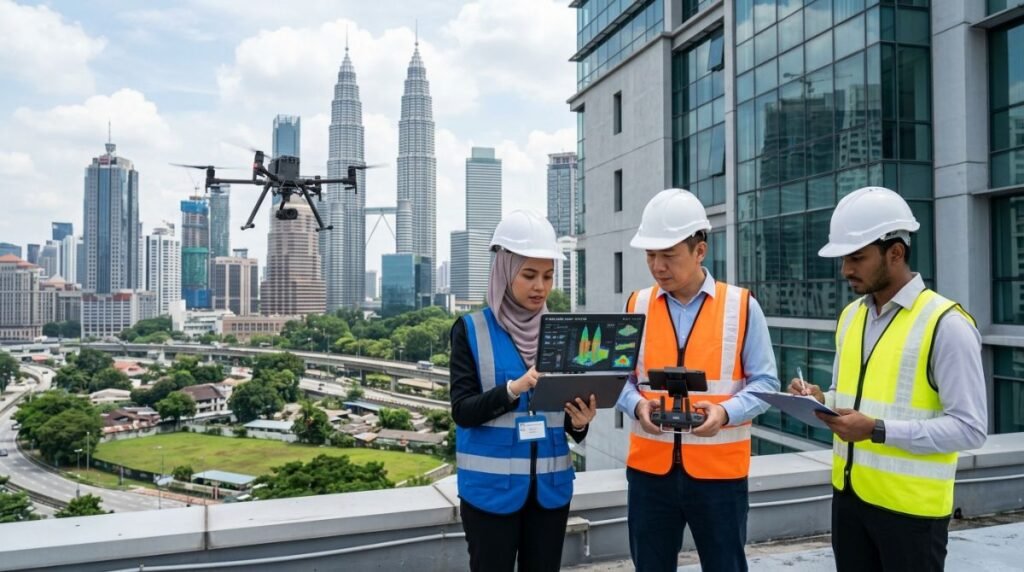
Artificial Intelligence (AI) is transforming the Malaysian engineering and built-environment landscape at an unprecedented pace. From automating complex finite element calculations to driving predictive maintenance on mega-infrastructure, computational intelligence has evolved from an experimental novelty into a core statutory necessity. Supported by national digitalization roadmaps and stringent regulatory benchmarks, Malaysia is setting a new regional standard for intelligent construction, automated compliance verification, and resilient asset life-cycle management.
By Ir Vimal, Professional Engineer | Published on October 5, 2026
Table of Contents
- 1. Malaysia’s National AI Frameworks in Engineering
- 2. Civil, Structural & Condition Auditing Innovations
- 3. Drone Photogrammetry and Autonomous Defect Detection
- 4. Aligning AI Workflows with Malaysian Statutory Standards
- 5. Real-World Malaysian Project Implementations
- 6. Engineering Talent, Upskilling, and Economic Outlook
- 7. Frequently Asked Questions (FAQ)
1. Malaysia’s National AI Frameworks in Engineering
The Malaysian government has systematically embedded Fourth Industrial Revolution (4IR) technologies across public infrastructure pipelines and private commercial masterplans. Under overarching strategies such as MyDIGITAL and the National Artificial Intelligence Roadmap (AIRmap), engineering policies mandate higher levels of digital modeling, building information modeling (BIM), and automated analytical diagnostics to drive sector-wide productivity.
Key statutory bodies such as the Construction Industry Development Board (CIDB) and the Malaysian Investment Development Authority (MIDA) actively incentivize smart engineering adoption. These initiatives are bolstered by higher-education catalysts, including the dedicated Faculty of Artificial Intelligence at Universiti Teknologi Malaysia (UTM), establishing an industry-ready workforce capable of deploying machine learning algorithms tailored directly to Malaysia’s humid tropical weather, weathering rates, and complex soil strata.

2. Civil, Structural & Condition Auditing Innovations
In structural asset management, computer vision algorithms and IoT telemetry have upgraded traditional manual inspections into continuous, predictive integrity audits. Machine learning models analyze raw image data, acoustic sensors, and vibrational readings to detect subsurface anomalies and load-bearing micro-distortions long before they manifest as critical failures.
Key technological breakthroughs deployed across Malaysian developments include:
- Neural Concrete Crack Mapping: Computer vision networks cross-examine surface crack geometry, depth, and shear patterns against structural failure libraries, determining whether surface spalling requires routine patch repair or formal structural repair consultancy to restore design load capacity.
- Subsurface Subsidence & Vibration Telemetry: Machine learning algorithms process real-time inclinometer, piezometer, and seismographic data around deep basement excavations, protecting neighboring buildings through an engineered dilapidation survey.
- Algorithmic Quality Handover Auditing: During project completion, AI platforms ingest 3D spatial scans to cross-reference architectural elements against approved drawings, accelerating standard defect logging during a property defect inspection (DLP).
3. Drone Photogrammetry and Autonomous Defect Detection
High-rise building envelopes across tropical Malaysia face severe environmental stressors, from driving monsoon rains to intense ultraviolet thermal cycling. Conventional rope-access methods and suspended scaffolding entail substantial operational risks governed under strict guidelines by the Department of Occupational Safety and Health (DOSH).
Today, asset owners and property managers deploy automated aerial systems to conduct high-precision building audits. Through high-resolution façade & roof inspection (drone) services, unmanned aerial vehicles capture radiometric thermal imagery and sub-millimeter visual data over thousands of square meters in a fraction of traditional timelines. Machine learning classifiers instantly flag debonded mosaic tiles, sealant degradation, rainwater seepage pathways, and fastener corrosion. This digital twin workflow minimizes human exposure to working-at-height hazards while ensuring comprehensive audit records for high-density towers across the Klang Valley, Johor Bahru, and Penang.

4. Aligning AI Workflows with Malaysian Statutory Standards
While computer vision and predictive models accelerate anomaly detection, technology alone does not possess statutory authority. In Malaysia, engineering deliverables must rigorously conform to governing legislation, including the Uniform Building By-Laws 1984 (UBBL 1984), the Street, Drainage and Building Act 1974 (Act 133), and the Strata Management Act 2013 (Act 757).
Under Malaysian engineering legislation, automated defect classifications, diagnostic algorithms, and digital twin models cannot substitute professional accountability. All computational findings must be verified, certified, and officially endorsed by a registered Professional Engineer to ensure legal admissibility before local authorities, courts, and corporate governance bodies.
The Ministry of Housing and Local Government (KPKT) and local municipal councils require diagnostic methodologies to align with Malaysian Standards (MS) and British European Standards (BS EN). Furthermore, data handling and imagery collection must strictly comply with the Personal Data Protection Act 2010 (PDPA) to safeguard occupant privacy during strata property audits.
5. Real-World Malaysian Project Implementations
AI-driven engineering has transitioned from academic proof-of-concept to active commercial and municipal infrastructure operations across Malaysia:
- Kuala Lumpur Smart Drainage & Flood Mitigation: Municipal catchments deploy algorithmic flow-rate tracking and automated sensor controls across retention ponds and pumping networks, mitigating flash flood hazards during high-intensity tropical cloudbursts.
- East Coast Rail Link (ECRL): Advanced geological AI models evaluate real-time tunnel boring data, cutter-head torque, and rock strata classifications, dynamically adjusting grouting regimes and structural tunnel lining placements across challenging mountainous terrains.
- Municipal Non-Revenue Water (NRW) Detection: State water utility operators utilize acoustic sensor arrays linked to neural network classifiers to pinpoint underground pipe bursts and pressure surges before sub-base erosion produces municipal sinkholes.
- Smart Industrial Asset Auditing: Large-scale petrochemical, manufacturing, and distribution centers across Johor and Selangor utilize autonomous robotic scanning to evaluate structural steel deflection, fireproofing integrity, and concrete pad settlements under heavy industrial dynamic loads.
6. Engineering Talent, Upskilling, and Economic Outlook
The convergence of software architecture and civil mechanics is creating high-value employment opportunities within the Malaysian construction sector. Multi-disciplinary practitioners proficient in building information modeling (BIM Level 2 and Level 3), automated photogrammetry, and structural finite element analysis command substantial market remuneration:
- Junior Computational & AI Engineers: RM 5,000 to RM 7,500 monthly
- Senior Infrastructure Data Specialists: RM 8,000 to RM 14,000 monthly
- Lead Project Engineers & Digital Directors: RM 15,000 to RM 22,000+ monthly
Through institutional upskilling programs championed by CIDB and professional engineering institutions, Malaysian practitioners are pioneering a resilient, highly automated construction ecosystem that solidifies the nation’s reputation as a progressive digital engineering hub in ASEAN.
7. Frequently Asked Questions (FAQ)
Can AI replace registered Professional Engineers in Malaysia?
No. AI operates as a decision-support and data-processing tool. By law in Malaysia, all structural safety certifications, periodic building inspections under Act 133, and compliance submissions under UBBL 1984 must be verified, certified, and endorsed by an accredited Professional Engineer.
How does AI enhance building defect inspections?
AI algorithms process thousands of high-definition photographic frames and thermal radiometric scans against extensive material failure databases. This automated pattern matching identifies hairline cracks, moisture delamination, and sub-surface hollows far faster and with greater repeatability than manual sampling alone.
Are AI-driven drone facade inspections legally recognized in Malaysia?
Yes, provided the drone flight operations comply fully with Civil Aviation Authority of Malaysia (CAAM) flight authorization requirements and the final diagnostic report is reviewed, validated, and signed off by a qualified Professional Engineer for submission to local councils, Joint Management Bodies (JMB), or Management Corporations (MC).
Contact Us / Certified Inspection & Engineering Consultation
Pro Inspect Solution, led by Ir Vimal, Professional Engineer, provides certified building condition assessments, structural integrity audits, handover defect inspections, and professional engineering advisory across Malaysia.
- 📍 Service Coverage: Kuala Lumpur, Selangor, and Nationwide Malaysia
- 📞 Phone / WhatsApp: +60 16-806 4902
- ✉️ Official Inquiries: inspectsolution.pro@gmail.com
- 🌐 Official Website: proinspectsolution.com
- 👷♂️ Lead Engineer: Authored & verified by Ir Vimal, Professional Engineer
Need Certified Property Inspection or Building Audit Services?
Get instant consultation and professional engineering advice from Pro Inspect Solution.
