
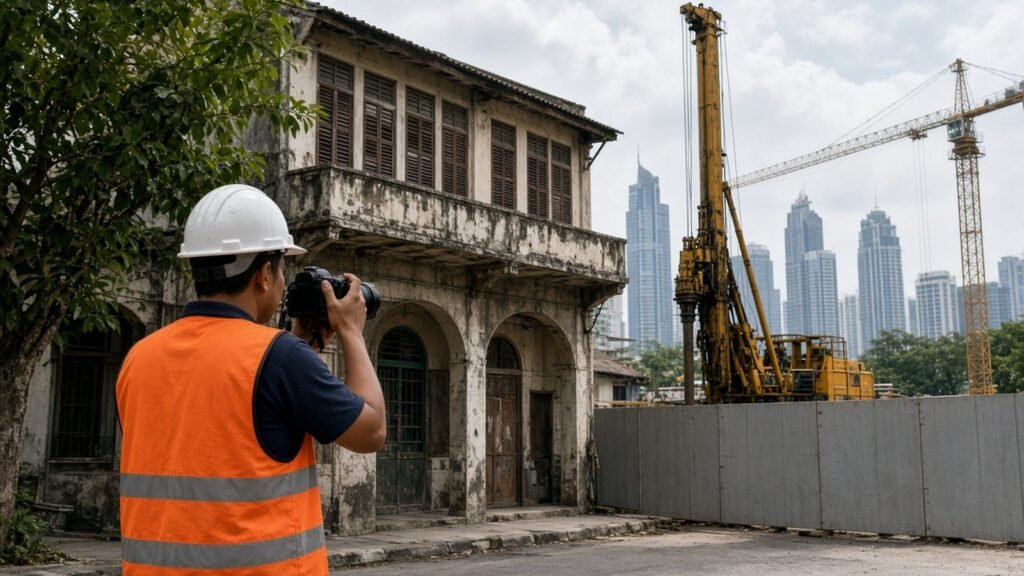
Both inspections involve engineers walking a building, taking photographs and writing a report, so they are easy to confuse. The difference is in why they are done, when, and what the report is used for.
A dilapidation report records the condition of neighbouring properties before, during and after nearby construction, so later damage claims can be checked against a baseline. A building condition assessment (BCA) evaluates the overall condition of your own building to plan maintenance, budgets or a purchase. One protects against third-party damage disputes; the other guides decisions about your asset.
01What is a dilapidation report?
A dilapidation report is the output of a dilapidation survey, also called a pre-construction condition survey. It is an independent, dated record of the visible condition of a property before piling, excavation or demolition starts nearby.
It typically records existing cracks, settlement signs, water damage and external works defects for each property, with photographs and notes. After the works, the property can be surveyed again and compared. This helps separate existing defects from damage that may have been caused by the construction.
Typical users are developers and main contractors, who often have to survey neighbouring properties as part of approval conditions, and owners next to a construction site who want their own record.
02What is a building condition assessment?
A building condition assessment is a structured inspection of an existing building’s structure, visible building services and finishes. The report lists defects, ranks them by priority and recommends repair actions.
Owners, JMBs and MCs, facility managers and buyers use a BCA to plan maintenance, prepare budgets, check compliance or make a purchase decision. Our comprehensive BCA guide walks through the process.
03Side-by-side comparison
| Dilapidation report | Building condition assessment | |
|---|---|---|
| Main purpose | Baseline record in case of damage claims from nearby works | Understand condition and plan repairs and maintenance |
| Trigger | Construction, piling, excavation or demolition nearby | Maintenance planning, ageing building, purchase, compliance |
| Whose building | Usually neighbouring properties | Usually your own building |
| Who orders it | Developer, contractor, or a neighbouring owner | Owner, JMB/MC, facility manager, buyer |
| Timing | Before works, and again during or after | Any time; often repeated periodically |
| Focus | Recording existing visible condition accurately | Assessing condition, priority and repair needs |
| Output | Dated photos, crack records and notes per property | Report with defects ranked by priority and recommended actions |
| Main use later | Comparison after works; supporting claims and their resolution | Maintenance plan, budget, purchase decision |
04Which one do you need?
Choose a dilapidation survey if:
- You are a developer or contractor about to pile, excavate or demolish near existing buildings.
- A new project is starting next to your home or premises.
- Your approval conditions or consultants ask for pre-construction condition records.
Choose a building condition assessment if:
- You manage an ageing building and need a maintenance plan.
- You are buying an existing building or a large unit and want to know repair needs.
- You need to prioritise repair budgets across a property.
You may need both when you own a building next to a major construction site and also want to plan its long-term maintenance. The dilapidation record protects you if new damage appears. The BCA tells you what to fix anyway.
05How each inspection is carried out
Dilapidation survey
- Agree the properties to be surveyed, often within a zone around the site. Our guide on DBKL dilapidation report zone of study covers one example.
- Arrange access with each owner.
- Inspect and photograph each property, inside and outside where accessible, recording existing cracks and defects.
- Issue a dated report for each property.
- Repeat during or after the works for comparison.
Building condition assessment
- Gather drawings, maintenance records and past reports, and agree the scope.
- Inspect structure, visible building services and finishes on site.
- Analyse findings and rank defects by priority.
- Issue a report with recommended repairs.
- Use it to build a maintenance plan and re-inspect as needed.
06Common mistakes
- Doing a dilapidation survey after works start. Once piling begins, it is harder to show which cracks already existed. Survey before work starts.
- Using a dilapidation report as a maintenance plan. It records condition but is not designed to rank repairs or plan budgets.
- Using a BCA as a baseline for third-party claims. A BCA may not record each crack in the detail needed for later comparison.
- Skipping access arrangements. Neighbours must agree to entry; plan this early.
Frequently asked questions
Is a dilapidation report the same as a dilap survey?
“Dilap survey” is a short form for dilapidation survey. The dilapidation report is the document produced from it.
Is a building condition report the same as a BCA?
Yes. The building condition report is the written output of a building condition assessment.
Can one inspection do both jobs?
The scopes are different. If you need both, tell the engineer at the start so the scope and report format cover each purpose.
Who should carry out these inspections?
An independent engineering firm, which helps keep the record impartial. See dilapidation survey in Kuala Lumpur and BCA in Kuala Lumpur and Selangor.

Leads building inspection, concrete assessment and defect investigation work at Pro Inspect Solution, turning site findings into clear, practical guidance for owners, JMBs/MCs, developers and contractors. LinkedIn
Not sure which survey you need?
Not sure which one you need? Contact us with the address and what is happening on site, and we will reply with a written quotation.
Talk to our engineers on WhatsApp or call +60 16-806 4902. Email inspectsolution.pro@gmail.com