
By Ir Vimal, Professional Engineer | | Kuala Lumpur, Malaysia
Malaysia’s tropical urban skyline features some of Southeast Asia’s most ambitious high-rise commercial towers, mixed-use developments, and residential strata communities. However, our equatorial climate presents an unyielding structural challenge: intense ambient ultraviolet (UV) radiation, severe diurnal thermal cycling, and sudden, torrential monsoon downpours across the Klang Valley, Penang, and Johor Bahru. For Joint Management Bodies (JMBs), Management Corporations (MCs), property developers, and asset managers, upholding robust building safety Malaysia standards is not merely a statutory formality—it is a vital operational safeguard against property devaluation, severe liability, and life-threatening structural failures.
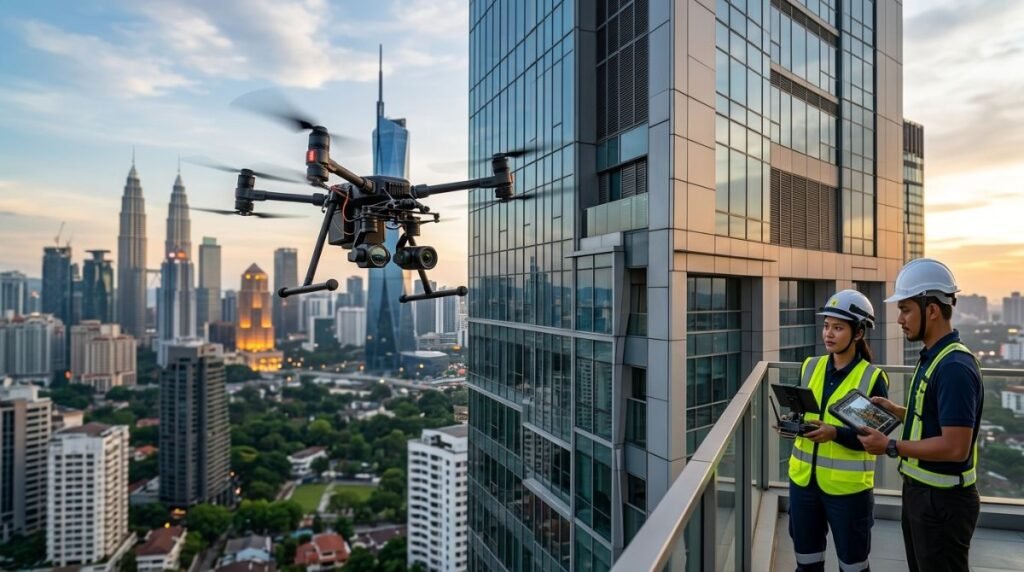
Microscopic hairline fissures on building envelopes, sealant delamination, and sub-membrane moisture ingress rarely present obvious warning signs from ground level until catastrophic concrete spalling or water infiltration causes severe internal property damage. Traditional manual inspections using industrial rope access (abseiling) and suspended gondolas are increasingly viewed as high-risk, cost-prohibitive, and vulnerable to subjective oversight. Today, certified engineering teams leverage high-resolution aerial photogrammetry and radiometric thermography via façade & roof inspection (drone) technology. In this engineering guide, Pro Inspect Solution analyzes the mechanics of building envelope deterioration in Malaysia and outlines how advanced non-destructive UAV technology safeguards high-rise assets.
1. The Impact of Malaysia’s Tropical Climate on High-Rise Building Envelopes
Malaysia operates within an equatorial climate zone characterized by consistent relative humidity exceeding 80%, high solar irradiance, and rainfall intensities exceeding 200 mm/hour during inter-monsoon convective storm surges. This unique weathering pattern triggers continuous cyclic thermal expansion and contraction on external cladding, glass curtain walls, and reinforced concrete surfaces.
During daylight hours, building envelope surfaces can surpass surface temperatures of 55°C under direct solar radiation. When rapid late-afternoon monsoon downpours strike, the external skin experiences sudden quenching shock, dropping temperatures by up to 25°C within minutes. This cyclic differential movement induces intense shear stress across expansion joints, elastomeric sealants, ceramic tile adhesives, and cementitious render. Over time, polymer-based exterior finishes degrade, unplasticized polyvinyl chloride (uPVC) gaskets shrink, and micro-fissures propagate throughout the protective external envelope.

2. Structural Failure Pathways: Facade Cracks and Concrete Spalling
External facade cracking should never be categorized purely as an aesthetic concern. In reinforced concrete (RC) framing and masonry infill walls, cracks represent capillary conduits through which airborne carbon dioxide (CO2) and moisture penetrate the protective alkaline concrete matrix. This triggers two primary failure modes:
- Carbonation and Passivation Layer Breakdown: Ambient carbon dioxide neutralizes calcium hydroxide in the concrete pore fluid, reducing the protective alkaline pH from approximately 12.5–13.0 to below 9.0. Once carbonation reaches the embedded steel reinforcement, the passive oxide film dissolves, initiating rapid atmospheric corrosion.
- Expansive Rusting and Spalling Delamination: As structural rebar oxidizes, iron corrosion products expand up to 600% of their original steel volume. This exerts internal tensile pressures far exceeding the tensile strength of the concrete cover (typically 2.0 to 3.5 MPa), resulting in horizontal or vertical longitudinal cracking, subsurface hollow delaminations, and eventually catastrophic concrete spalling.
In densely populated corridors like Mont Kiara, Bangsar, Georgetown, and Johor Bahru City Centre, detached concrete fragments falling from height pose immense hazards to pedestrian traffic and public infrastructure. Identifying subsurface delamination and micro-fractures prior to structural detachment requires early engineering intervention, such as structural repair consultancy and non-destructive evaluation.
3. Why Conventional Roof Leak Detection Methods Fail in Complex Buildings
Flat roofs, podiums, and rooftop mechanical decks in Malaysian developments traditionally utilize reinforced bituminous torch-on membranes, liquid-applied polyurethanes, or ethylene propylene diene monomer (EPDM) sheets. When persistent water ingress occurs, locating the precise breach point using traditional visual inspection is notoriously inefficient.
Due to the capillary action of concrete substrates and sloped structural screeds, water entering a puncture or defective overlap often travels laterally along the deck interface for tens of meters before penetrating an internal structural joint or pipe penetration. By the time water stains manifest on plaster ceilings or drywall partitions within commercial suites or residential penthouses, extensive saturation has already compromised the structural screed and insulation layers.
Traditional manual leak investigation methods—such as destructive core sampling, random flood testing, and scaffolding access—are time-intensive, disrupt tenants, and often introduce additional punctures to the roofing membrane. Moreover, utilizing scaffolding or swing stages on high-rise parapets poses notable safety liabilities regulated strictly under guidelines issued by the Department of Occupational Safety and Health (DOSH). To avoid disputes between developers and new purchasers, deploying specialized aerial non-invasive diagnostic tools during a property defect inspection (DLP) ensures waterproofing failures are mapped and rectified before the expiry of statutory warranty periods.
4. The Role of Drone Facade Inspection and Radiometric Thermography
The deployment of enterprise-grade Unmanned Aerial Vehicles (UAVs) equipped with synchronized RTK-GNSS positioning, ultra-high-resolution 4K/8K optical sensors, and uncooled long-wave infrared (LWIR) radiometric thermal cameras has modernized modern building envelope maintenance. Using advanced drone facade inspection Malaysia protocols, engineers achieve comprehensive visibility over every elevation.

This technical methodology delivers several distinct operational advantages:
- Radiometric Moisture Mapping: Water possesses a significantly higher volumetric thermal capacity (specific heat capacity of 4,184 J/kg·K) compared to dry roofing aggregates, insulation, or concrete. During diurnal cooling phases (transient thermal transition just after sunset), wet insulation retains residual thermal energy far longer than dry areas. Drone-mounted thermal sensors capture these micro-temperature differentials, allowing engineers to generate detailed thermal isotherm maps highlighting subsurface moisture pooling without puncturing the membrane.
- Sub-Millimeter Crack Detection via AI Photogrammetry: High-resolution optical payloads equipped with mechanical shutters eliminate motion blur, capturing overlapping orthomosaic imagery with Ground Sampling Distances (GSD) under 0.5 mm per pixel. Machine-learning computer vision algorithms automatically detect, quantify, and map hairline crack widths down to 0.1 mm, classing them in accordance with BS 8110 and Eurocode 2 serviceability crack limits.
- Mitigation of Working-at-Height Liabilities: By operating UAVs from secured ground perimeters, building owners and facility managers eliminate the safety risks associated with suspended gondolas, cherry pickers, and rope abseiling crews.
- Precision CAD & BIM Defect Integration: Georeferenced aerial inspection outputs convert directly into digitized 3D mesh models and orthophoto CAD overlays, recording the spatial coordinates (easting, northing, elevation) of failed sealants, hollow tiles, and spalling concrete.
For construction and neighboring infrastructure projects, establishing baseline structural documentation before piling or deep excavation via a dilapidation survey prevents contentious third-party liability disputes.
5. Malaysian Statutory Framework: Act 757, Act 133, and Engineering Compliance
In Malaysia, the maintenance of building envelopes, common property, and high-rise structural integrity is strictly governed by statutory legislation enforce by local councils (PBTs) and the Ministry of Housing and Local Government (KPKT):
- Strata Management Act 2013 (Act 757): Under Section 21 and Section 59 of Act 757, JMBs and MCs bear a statutory duty to properly maintain and keep in good and serviceable repair the common property, which includes exterior walls, external facades, roofs, and rainwater downpipes. Under the Strata Management (Maintenance and Management) Regulations 2015, inter-floor leakages and exterior water penetration trigger a statutory presumption against the management or upper parcel owners, demanding immediate technical investigation.
- Street, Drainage and Building Act 1974 (Act 133) & Uniform Building By-Laws (UBBL 1984): Section 85A of Act 133 mandates visual and structural inspections of buildings over five storeys that are older than ten years. Local authorities (e.g., DBKL, MBPJ, MBSA) hold the authority to mandate comprehensive periodic facade inspections to prevent falling debris hazards.
- Quality Assessment System in Construction (QLASSIC / CIS 7): Formulated by the Construction Industry Development Board (CIDB), QLASSIC benchmarks set strict thresholds for permissible exterior finishes, joint alignments, and surface cracking. Drone-based image capture provides indisputable digital audit trails compliant with national construction quality standards.
Frequently Asked Questions (FAQ)
What are the primary advantages of drone facade inspection compared to conventional rope access?
Drone facade inspections eliminate the occupational hazards of working at heights, complete comprehensive surveys in a fraction of the time (days instead of weeks), reduce operational costs by up to 60-70%, and provide sub-millimeter digital photogrammetry combined with radiometric thermal imaging that detects subsurface water entrapment invisible to human rope technicians.
How does thermal imaging on a drone detect roof leaks without breaking the surface?
Drone thermal cameras detect heat radiation variations across the roof surface. Because trapped moisture within insulation or concrete screeds possesses higher thermal inertia, it cools down significantly slower than dry surrounding sections during evening temperature drops. This creates distinct heat signatures that map the exact extent and entry points of moisture beneath waterproof membranes.
Is drone building inspection legally accepted by Malaysian local councils and the Strata Management Tribunal?
Yes. When planned, executed, and certified under the supervision of a certified Professional Engineer registered with the Board of Engineers Malaysia (BEM), technical inspection reports containing georeferenced drone imagery and thermographic assessments serve as authoritative engineering evidence for municipal safety compliance (Section 85A of Act 133) and Strata Management Tribunal (SMT) dispute proceedings under Act 757.
How frequently should high-rise commercial and residential buildings undergo facade inspections in Malaysia?
In accordance with Section 85A of the Street, Drainage and Building Act 1974 (Act 133), buildings exceeding five storeys must undergo periodic structural inspections every ten years following completion. However, leading engineering bodies and JMB/MC guidelines recommend non-invasive drone visual and thermographic facade health checks every 3 to 5 years, particularly following severe monsoon cycles or major seismic micro-tremors.
Contact Us / Professional Inspection & Engineering Consultation
Pro Inspect Solution, led by Ir Vimal, Professional Engineer, provides professional building condition assessments, structural integrity audits, handover defect inspections, and professional engineering advisory across Malaysia.
- 📍 Service Coverage: Kuala Lumpur, Selangor, and Nationwide Malaysia
- 📞 Phone / WhatsApp: +60 16-806 4902
- ✉️ Official Inquiries: inspectsolution.pro@gmail.com
- 🌐 Official Website: proinspectsolution.com
- 👷♂️ Lead Engineer: Authored & verified by Ir Vimal, Professional Engineer
Need Professional Property Inspection or Building Audit Services?
Get instant consultation and professional engineering advice from Pro Inspect Solution.
