
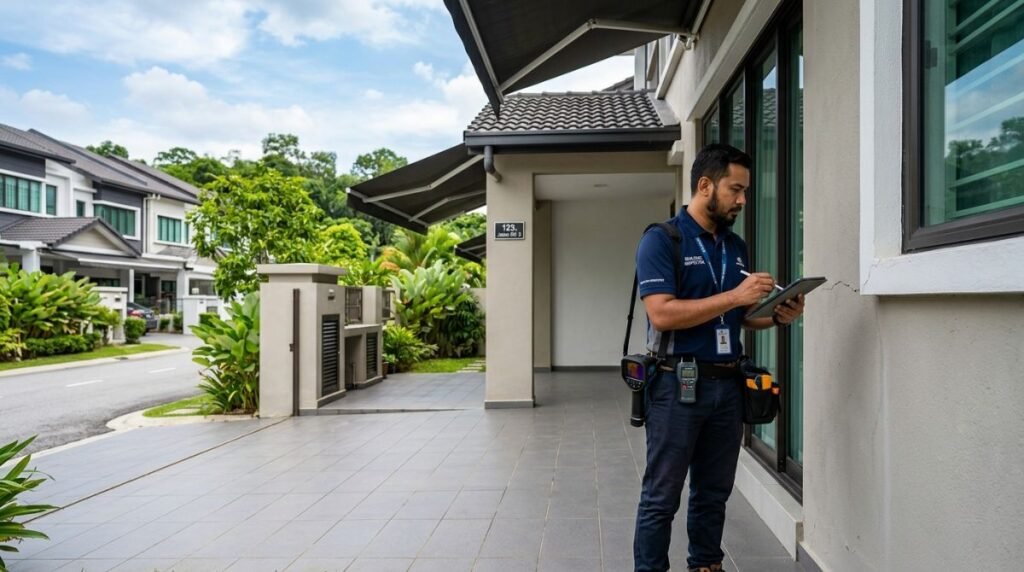
Acquiring real estate in Malaysia—whether an upscale high-rise strata residence in Mont Kiara, a terrace home in Petaling Jaya, or an industrial warehouse in Iskandar Puteri—represents one of the most consequential capital investments an individual or enterprise can undertake. However, the physical handover of keys upon Vacant Possession (VP) or the execution of a secondary market Sales and Purchase Agreement (SPA) does not conclude risk exposure. Beneath modern plastering, skim-coated drywalls, and polished porcelain tiles often lie latent structural defects, hidden moisture ingress routes, and mechanical or electrical hazards.
Need an engineer on site? Pro Inspect Solution provides property defect inspection in Malaysia across KL, Selangor and Malaysia. This article is a general guide.
Engaging an engineering-grade house inspection in Malaysia is no longer an optional formality; it is a critical asset preservation protocol. Unrectified construction anomalies can swiftly cascade into major repair costs running into tens of thousands of ringgit once legal warranty periods lapse. This authoritative technical guide breaks down statutory safeguards under Malaysian law, essential diagnostic standards, and the multidisciplinary engineering methodologies needed to safeguard residential and commercial properties.
Table of Contents
- 1. The Technical Necessity of Property Defect Inspections in Malaysia
- 2. Defect Liability Period (DLP) vs. Subsale Due Diligence
- 3. Core Engineering Systems & Building Zones Evaluated
- 4. Malaysian Statutory Standards: CIS 7 (QLASSIC), UBBL, and Building Acts
- 5. The Certified Professional Engineering Inspection Workflow
- 6. Frequently Asked Questions (FAQ)
1. The Technical Necessity of Property Defect Inspections in Malaysia
Malaysia’s equatorial climate subjects buildings to relentless operational strain. Continuous tropical humidity, high ambient solar radiation, and intense monsoon downpours accelerate concrete carbonation, seal failure, hairline micro-cracking, and exterior façade debonding. In fast-tracked property developments, compressed construction timelines frequently result in substandard workmanship, unprimed waterproofing membranes, and non-compliant MEP (Mechanical, Electrical, and Plumbing) installations.
A certified engineering audit provides definitive empirical leverage. For new homeowners, an authenticated defect assessment legally obligates housing developers to carry out rectifications under statutory housing legislation. In subsale acquisitions, uncovering historic structural settlement, subterranean moisture ingress, or unpermitted structural alterations arms prospective buyers with concrete data to renegotiate transaction pricing or require vendor remediation prior to closing.

2. Defect Liability Period (DLP) vs. Subsale Due Diligence
Property owners in Malaysia must navigate distinct legal rights depending on whether their purchase is a primary developer handover or a subsale asset:
A. New Construction Under the Defect Liability Period (DLP)
Under the Housing Development (Control and Licensing) Act 1966 (Act 118) alongside statutory Schedules G and H overseen by the Ministry of Housing and Local Government (KPKT), buyers are entitled to a mandatory 24-month Defect Liability Period commencing from the date of Vacant Possession. Securing an independent Property Defect Inspection (DLP) ensures that architectural flaws, hollow screeds, and plumbing defects are formally tagged and entered into the developer’s official rectification log before renovation works disrupt your statutory claim.
B. Subsale Property Due Diligence ("As-Is, Where-Is")
Secondary market properties are sold on an "as-is, where-is" basis without developer warranty protections. After ownership transfer, all rectification liabilities fall squarely on the purchaser. A pre-purchase engineering survey identifies historical structural movement, deteriorated electrical wiring, or load-bearing wall modifications. In scenarios involving adjacent commercial construction or infrastructure piling, property owners should also commission a professional Dilapidation Survey to establish baseline structural condition records against prospective settlement damage.
3. Core Engineering Systems & Building Zones Evaluated
A professional building audit moves methodically across five primary engineering categories:
- Civil & Structural Integrity: Non-destructive screening for shear cracks, honeycomb concrete defects, load-bearing slab deflections, and differential foundation settlement. When structural anomalies indicate active distress, our team provides an integrated Structural Repair Consultancy to determine load capacities and design certified remedial retrofits.
- Waterproofing & Concealed Moisture Ingress: In high-rise strata developments governed by Section 142 of the Strata Management Act 2013 (Act 757), inter-floor leakage carries a statutory presumption against upper unit owners. Engineering inspectors deploy calibrated thermal imaging cameras and digital moisture meters to trace hidden pipe ruptures, damp penetration, and failed bathroom membrane seals without destructive hacking.
- Roof Envelopes & Façade Systems: High-level building enclosures, clay roof tile trusses, parapets, and gutters present severe physical access challenges. Utilizing licensed Façade & Roof Inspection (Drone) operations, inspectors capture high-resolution visual and radiometric thermal data to detect displaced tiles, flashing breaks, and exterior cladding delamination safely and comprehensively.
- Mechanical & Electrical Safety: Verification of Residual Current Devices (RCD/RCCB) sensitivity thresholds to prevent electrocution risks in accordance with Energy Commission (Suruhanjaya Tenaga) regulations, polarity checks, earth loop resistance verification, and water supply pressure consistency audits.
- Architectural Finishes: Verification of hollow or debonded floor and wall tiles using precision tapping rods, checking door and window alignment against plumb tolerances, sealant adhesion, and drywall ceiling joint integrity.

4. Malaysian Statutory Standards: CIS 7 (QLASSIC), UBBL, and Building Acts
Certified inspections rely on codified standards and objective tolerance thresholds rather than subjective impressions:
- CIS 7 (QLASSIC): Published by the Construction Industry Development Board (CIDB Malaysia), the Quality Assessment System in Construction (CIS 7) establishes nationwide benchmark criteria for architectural finishes, including floor flatness limits, wall plumbness, door-frame squareness, and visual consistency.
- Uniform Building By-Laws 1984 (UBBL): Specifies legal design baselines for structural stability, adequate natural ventilation, fire safety separation, and drainage configurations administered by local councils such as DBKL, MBPJ, and MBSA.
- Street, Drainage and Building Act 1974 (Act 133): Sets out legal enforcement parameters governing structural safety, habitable conditions, and penalties regarding unauthorized building alterations.
- Malaysian Standards (MS / BS EN): Dictates engineering compliance criteria, including MS IEC 60364 for electrical safety installations and MS 1402 for internal sanitary piping design.
5. The Certified Professional Engineering Inspection Workflow
- Documentation Review: Scrutiny of architectural floor layouts, Certificate of Completion and Compliance (CCC), and mechanical as-built drawings where applicable.
- Instrumented On-Site Assessment: A comprehensive 3 to 5-hour on-site engineering survey utilizing digital moisture meters, thermal infrared cameras, ultrasonic concrete testing tools, laser level cross-liners, and electrical socket analyzers.
- Defect Tagging & Logging: Highlighting defective points on-site using non-damaging numbered stickers matched directly to a digital defect database.
- Formal Technical Report: Compilation of an authenticated defect audit containing photographic proof, location markers, applicable regulatory code references, and engineer-certified remedial instructions.
- Joint Re-Inspection: Conducting a follow-up verification audit alongside developer technical personnel or main contractors to confirm all listed items have been rectified properly.
6. Frequently Asked Questions (FAQ)
Can I perform a defect inspection myself using a simple checklist?
While property owners can easily spot obvious cosmetic blemishes like paint stains or surface chips, untrained inspections cannot detect sub-surface hollow tiles, electrical RCD trip failures, concealed moisture ingress, or active structural shear cracks. An independent technical report prepared by a registered professional engineer carries evidentiary weight before the Tribunal for Homebuyer Claims (Tribunal Tuntutan Pembeli Rumah) or civil court proceedings.
When should I schedule a house inspection during Vacant Possession?
You should commission an inspection immediately upon receiving the keys for Vacant Possession (VP), prior to commencing any renovation, hacking, or built-in cabinetry installation. Initiating renovation works beforehand allows developers to argue that identified defects were caused by your third-party contractors.
How long does a professional defect inspection take on site?
A standard 1,000 to 1,500 sq ft condominium unit typically requires 3 to 4 hours of rigorous testing. Larger multi-storey landed residences, semi-detached properties, or luxury bungalows require 5 to 7 hours of detailed field evaluation by our engineering specialists.
Contact Us / Professional Inspection & Engineering Consultation
Pro Inspect Solution, led by Ir Vimal, Professional Engineer, provides professional building condition assessments, structural integrity audits, handover defect inspections, and professional engineering advisory across Malaysia.
- 📍 Service Coverage: Kuala Lumpur, Selangor, and Nationwide Malaysia
- 📞 Phone / WhatsApp: +60 16-806 4902
- ✉️ Official Inquiries: inspectsolution.pro@gmail.com
- 🌐 Official Website: proinspectsolution.com
- 👷♂️ Lead Engineer: Authored & verified by Ir Vimal, Professional Engineer
Need Professional Property Inspection or Building Audit Services?
Get instant consultation and professional engineering advice from Pro Inspect Solution.
