
By Ir Vimal, Professional Engineer | Published on October 5, 2026
As Malaysia’s urban skyline continues to mature, commercial developers, joint management bodies (JMB), management corporations (MC), and institutional asset owners face an unprecedented wave of statutory compliance. Ensuring structural safety across ageing high-rises and commercial assets is not merely prudent facility management—it is a strict statutory mandate under Act 133 Malaysia (Street, Drainage and Building Act 1974). With local municipal councils (Pihak Berkuasa Tempatan or PBT) actively serving compliance notices on buildings crossing their statutory 10-year milestones, commissioning an accredited Periodic Building Inspection is imperative to protect lives, prevent catastrophic concrete failures, and avoid severe legal and financial liabilities.
Need an engineer on site? Pro Inspect Solution provides periodic building inspection service under Section 85A across KL, Selangor and Malaysia. This article is a general guide.
1. What is a Periodic Building Inspection?
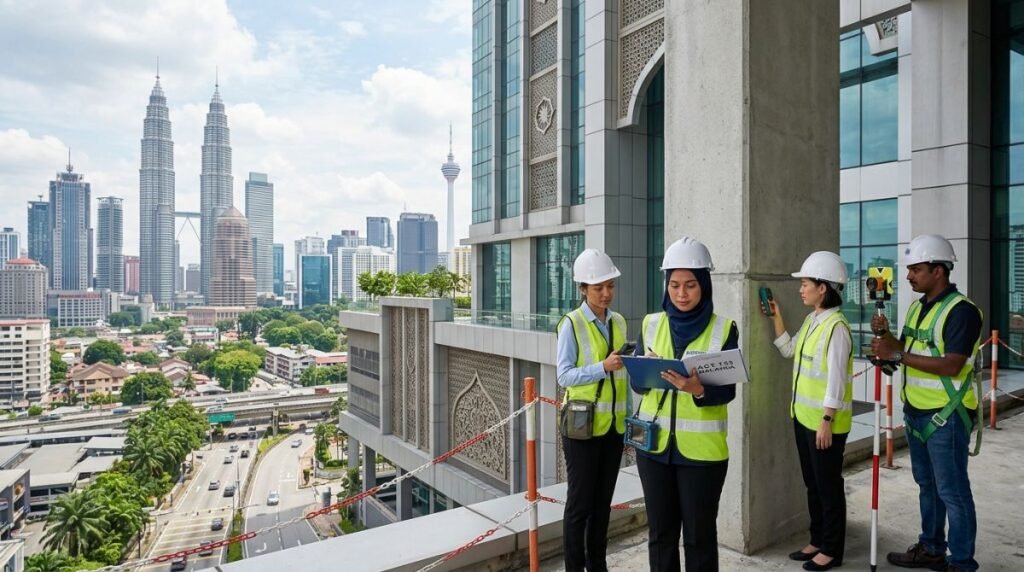
A Periodic Building Inspection is a comprehensive, legally enforced structural audit designed to evaluate an existing building’s structural stability, integrity, and operational safety. Regulated under national engineering frameworks administered by the Board of Engineers Malaysia (BEM), this assessment must be carried out and officially endorsed by a registered Professional Engineer specializing in civil or structural engineering.
Unlike cosmetic snagging lists or routine property handovers, a statutory periodic structural assessment assesses internal and external structural components. This includes reinforced concrete (RC) frames, post-tensioned transfer slabs, structural steel trusses, basement retaining walls, foundation piling systems, and high-level building envelopes. Early structural diagnostics identify severe degradation mechanisms such as concrete carbonation, chloride attack, rebar corrosion, shear displacement, and differential foundation settlement before catastrophic failures occur.

2. Understanding Act 133 Malaysia and Section 85A Requirements
In Peninsular Malaysia, the statutory authority governing building safety is codified under the Street, Drainage and Building Act 1974 (Act 133), supported by the state-level Uniform Building By-Laws (UBBL 1984) and the Strata Management Act 2013 (Act 757). Within Act 133, Section 85A establishes the statutory mandate for periodic structural safety audits:
- Statutory Trigger (The 10-Year Rule): Any building exceeding five storeys in height (or any building specifically gazetted by municipal authorities) must undergo a certified visual and structural inspection once the property reaches 10 years from the date of issuance of the Certificate of Fitness for Occupation (CFO) or Certificate of Completion and Compliance (CCC).
- Mandatory 10-Year Recurrence: Following the baseline 10th-year audit, follow-up inspections must be conducted at regular intervals not exceeding 10 years throughout the entire operational life of the structure.
- BEM Registered Certification: The inspection, non-destructive testing (NDT), and structural condition assessment report must be stamped, signed, and certified by an accredited Professional Engineer registered with the Board of Engineers Malaysia.
- Official Submission of Form B: The certified structural condition report, including structural calculations, risk classifications, and mandatory rectification schedules, must be formally logged with the relevant municipal council (such as DBKL, MBPJ, MBSA, or MBPP).
3. Why 2026 is a Crucial Compliance Year for Malaysian Asset Owners
The year 2026 represents a critical regulatory milestone across Malaysia’s urban landscapes. The unprecedented real estate and high-density development expansion across the Klang Valley, Penang, and Johor during the mid-2010s resulted in thousands of strata residential towers, commercial offices, integrated developments, and logistics hubs that are now simultaneously reaching their statutory 10-year age threshold.
Municipal authorities, in coordination with the Ministry of Housing and Local Government (KPKT), have intensified municipal audit cycles. Failure to produce a verified Form B structural certificate not only triggers hefty municipal fines but also leads to commercial property insurance invalidation, operational closure orders, and complications during mandatory annual fire safety certificate renewals with Jabatan Bomba dan Penyelamat Malaysia (BOMBA).
4. The Professional Engineering Inspection Methodology
At Pro Inspect Solution, our structural engineers execute a rigorous, four-tiered engineering assessment aligned with Malaysian Standards (MS / BS EN codes) and municipal structural safety directives.
Phase 1: Baseline Structural Survey and As-Built Review
Our team initiates the investigation by reviewing original structural drawings, piling records, soil investigation (SI) reports, and previous maintenance documentation. A comprehensive visual condition survey is conducted across all accessible structural zones to catalog settlement cracks, flexural cracking, concrete spalling, honeycombing, and active water seepage. When assessing buildings undergoing internal modifications or tenant fit-outs, we integrate a Property Defect Inspection (DLP) framework to distinguish localized cosmetic defects from underlying structural movement.

Phase 2: Drone-Assisted Façade and Roof Structural Audits
In accordance with updated Department of Occupational Safety and Health (DOSH) guidelines and municipal façade inspection standards, high-risk manual gondola inspections are replaced with aerial diagnostic technologies. Utilizing our advanced Façade & Roof Inspection (Drone) service, our certified drone operators capture high-resolution visual imagery and radiometric thermal scans to identify hollow external plaster, delaminated mosaic tiles, cracked curtain wall brackets, and roofing membrane failures without disrupting tenants or commercial operations.
Phase 3: In-Situ Non-Destructive Testing (NDT)
When physical degradation or structural anomalies are detected, our engineers conduct specialized in-situ non-destructive testing in accordance with BS 1881 and MS 26 standards:
- Rebound Hammer Testing (Schmidt Hammer): Evaluates the surface hardness and relative compressive uniformity of reinforced concrete elements.
- Ultrasonic Pulse Velocity (UPV): Measures the velocity of ultrasonic sound waves through concrete members to locate concealed honeycombing, internal cracks, and density voids.
- Electromagnetic Covermeter Scanning: Maps rebar spacing, detects displaced reinforcement bars, and verifies adequate concrete cover depth against corrosion risks.
- Carbonation and Chemical Depth Profiling: Determines the penetration of atmospheric carbon dioxide into the concrete cover, establishing whether the passive protective alkaline layer surrounding rebar has been compromised.
- Core Extraction and Compression Testing: Where severe load-bearing deficiencies are suspected, localized diamond core samples are extracted for destructive laboratory compression testing.
Phase 4: Structural Remediation and Rectification Consultancy
Upon completing structural diagnostics, our engineers prepare a certified engineering appraisal. If structural retrofitting or localized repairs are necessary, we formulate comprehensive engineering specifications through our Structural Repair Consultancy. This covers high-pressure epoxy and polyurethane (PU) crack injection, carbon fiber-reinforced polymer (CFRP) structural wrapping, steel plate bonding, and foundation underpinning. In environments surrounded by adjacent construction or deep basement excavations, an independent Dilapidation Survey is also recommended to establish baseline condition benchmarks and protect against third-party structural liabilities.
5. Penalties and Liabilities of Non-Compliance
Ignoring statutory inspection mandates under Section 85A of Act 133 introduces significant financial, operational, and criminal liabilities for asset owners, developers, and management committees:
Statutory Notice under Act 133, Section 85A: Any building owner, Joint Management Body (JMB), or Management Corporation (MC) that fails to comply with an inspection order issued by the local authority commits an offence and can be prosecuted in court, facing substantial statutory fines, recurring daily penalties for continuing default, or custodial sentences. Municipal councils retain the statutory power to enter the property, close unsafe premises, and execute emergency structural rectifications at the full expense of the owner.
In addition to municipal enforcement, insurance underwriters increasingly demand certified Form B compliance documentation before endorsing commercial fire, public liability, and property damage insurance renewals. In the event of falling concrete debris, façade detachment, or structural collapse, management corporation committee members and corporate directors can be held personally liable under Malaysian tort law and the Strata Management Act 2013 for gross statutory negligence.
6. Frequently Asked Questions (FAQ)
How often is a Periodic Building Inspection legally required in Malaysia?
Under Section 85A of the Street, Drainage and Building Act 1974 (Act 133), a building exceeding five storeys in height must undergo an initial periodic structural inspection upon reaching 10 years from the issuance of the Certificate of Fitness for Occupation (CFO) or Certificate of Completion and Compliance (CCC). Subsequent inspections are required at least once every 10 years thereafter.
Who is legally qualified to carry out an Act 133 building inspection?
The inspection must be executed and certified by a Professional Engineer registered with the Board of Engineers Malaysia (BEM) under the civil or structural discipline. Only registered Professional Engineers possess the legal standing to sign and submit compliance reports to local authorities (PBT).
What happens if our building fails the structural inspection?
If critical structural defects or safety hazards are identified, the inspecting engineer will issue a full structural appraisal detailing the required repair and strengthening works. The building owner or Joint Management Body (JMB/MC) must engage registered contractors to execute the remedial works within the timeframe specified by the local municipal council.
Are drone inspections accepted by Malaysian local councils for façade audits?
Yes. Commercial drone thermography and high-resolution optical surveys are widely accepted by municipal authorities across Malaysia (such as DBKL, MBPJ, and MBSA) when incorporated into a comprehensive engineering report stamped and certified by a registered Professional Engineer.
Contact Us / Certified Inspection & Engineering Consultation
Pro Inspect Solution, led by Ir Vimal, Professional Engineer, provides certified building condition assessments, structural integrity audits, handover defect inspections, and professional engineering advisory across Malaysia.
- 📍 Service Coverage: Kuala Lumpur, Selangor, and Nationwide Malaysia
- 📞 Phone / WhatsApp: +60 16-806 4902
- ✉️ Official Inquiries: inspectsolution.pro@gmail.com
- 🌐 Official Website: proinspectsolution.com
- 👷♂️ Lead Engineer: Authored & verified by Ir Vimal, Professional Engineer
Need Certified Property Inspection or Building Audit Services?
Get instant consultation and professional engineering advice from Pro Inspect Solution.
