
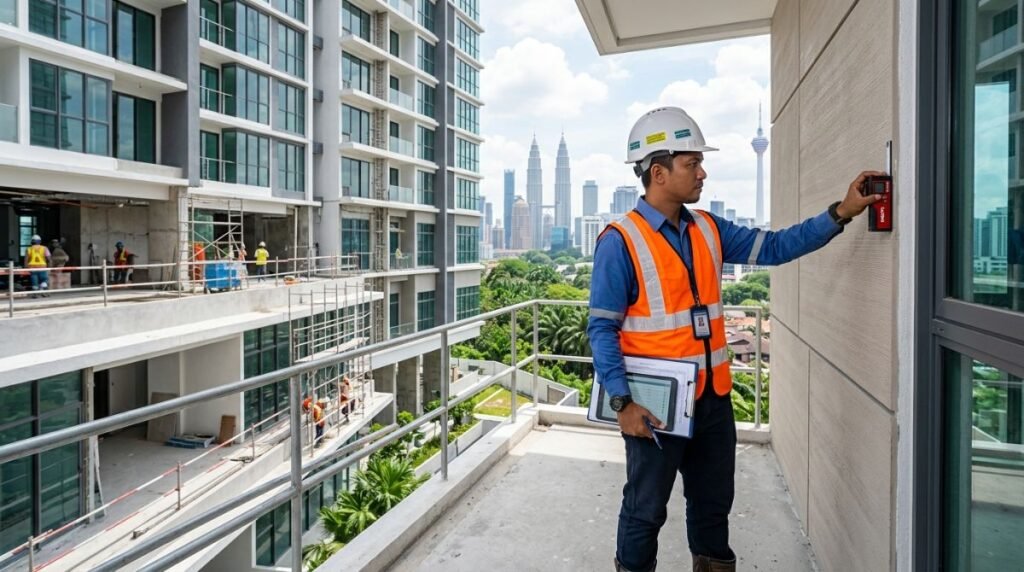
When acquiring, designing, or constructing real estate in Malaysia, building workmanship directly impacts structural longevity, safety, aesthetic appeal, and capital appreciation. To benchmark construction quality through uniform scientific metrics, the Construction Industry Development Board (CIDB Malaysia) established the Quality Assessment System in Construction (QLASSIC), governed strictly under the Construction Industry Standard (CIS 7). Mastering the evaluation methodology, weightage matrices, and field testing protocols of QLASSIC enables commercial developers, main contractors, and property buyers to maintain uncompromised building standards prior to handover.
By Ir Vimal, Professional Engineer | Published on October 5, 2026
Table of Contents
- What is QLASSIC and Construction Industry Standard (CIS 7)?
- Regulatory Framework: UBBL 1984, Act 133, and CIS 7
- Primary Objectives of the QLASSIC Assessment System
- Three Core Assessment Modules Evaluated Under CIS 7
- Scoring Allocation and Component Weightage Distribution
- Detailed Architectural Works Tolerances and Testing Protocols
- Statistical Sampling Guidelines and GFA Ratios
- Step-by-Step On-Site QLASSIC Assessment Workflow
- QLASSIC Benchmark Scores vs. Private DLP Defect Audits
- Frequently Asked Questions (FAQ)
What is QLASSIC and Construction Industry Standard (CIS 7)?
QLASSIC stands for the Quality Assessment System in Construction. It is an independent, quantitative quality evaluation framework developed by CIDB to measure the quality of workmanship in building construction works. The assessment strictly references CIS 7 (Quality Assessment System for Building Construction Work), an established national standard designed to evaluate visual appearance, functional integrity, and dimensional tolerances against established baseline thresholds.
Unlike statutory structural approvals governed by local authorities (PBT) under the Uniform Building By-Laws 1984 (UBBL 1984) and the Street, Drainage and Building Act 1974 (Act 133), QLASSIC operates as a qualitative workmanship audit rather than an engineering load calculation test. Assessments are strictly performed on newly completed projects prior to occupancy, ensuring that construction defects are identified and cataloged before normal wear, tenant renovations, or concealed cosmetic patching alter the original baseline.

Regulatory Framework: UBBL 1984, Act 133, and CIS 7
In the Malaysian built environment, quality assurance operates across two distinct compliance tracks:
- Statutory Structural Safety: Under Act 133, the UBBL 1984, and the Board of Engineers Malaysia (BEM) guidelines, Principal Submitting Persons (PSP) such as Professional Engineers certify structural integrity, fire protection, and civil stability before issuing the Certificate of Completion and Compliance (CCC).
- Workmanship and Craftsmanship Quality: CIS 7 provides the quantitative methodology to grade how well those certified structures are executed finish-wise. It penalizes hollow tiles, out-of-plumb brick walls, misaligned architraves, water ponding, and uneven plastering.
By harmonizing architectural execution with Malaysian Standards (MS) and British/European Standards (BS EN), QLASSIC translates subjective arguments over “acceptable craft” into verifiable, pass-or-fail mechanical inspections.
Primary Objectives of the QLASSIC Assessment System
The implementation of QLASSIC across Peninsular Malaysia, Sabah, and Sarawak has transformed the quality culture of local construction ecosystems. Key operational objectives include:
- Eliminating Subjectivity: Replaces discretionary visual opinions between buyers and main contractors with defined dimensional tolerances under CIS 7.
- Contractor Workmanship Benchmarking: Provides CIDB, government agencies, and institutional developers with centralized empirical metrics to assess contractor execution track records across multiple tenders.
- Right-First-Time Construction Culture: Encourages main contractors and trade sub-contractors to practice rigorous internal Quality Assurance and Quality Control (QA/QC) during construction rather than relying on hurried post-handover touch-ups.
- Protecting Asset Valuation: Ensures that residential and commercial developments retain premium operational standards, reducing long-term lifecycle maintenance expenditures for Joint Management Bodies (JMB) and Management Corporations (MC).
Three Core Assessment Modules Evaluated Under CIS 7
A certified QLASSIC field audit evaluates a building project through three discrete operational components:
- Architectural Works: The dominant module of the framework, comprising internal finishes (flooring, internal walls, ceilings, doors, windows, and component fixtures), external envelope elements (facades, roofs, perimeter aprons, and open drains), and specialized functional tests. For complex high-rise envelopes where scaffolding has been dismantled, engaging a specialized Façade & Roof Inspection (Drone) allows teams to perform high-resolution thermographic and visual audits of high-elevation finishes safely.
- Basic M&E Fittings: Covers the surface neatness, mechanical stability, correct alignment, and basic operational readiness of electrical switch sockets, light switches, sanitary fixtures, and exposed distribution boards.
- External Works: Evaluates civil infrastructures within the development boundary, such as hardcourt pavements, driveways, guardhouses, boundary perimeter fencing, surface water drainage channels, and retaining structures. In brownfield developments or tight urban sites, executing a pre-construction and post-construction Dilapidation Survey prevents baseline structural disputes regarding nearby municipal roads and boundary walls.
Scoring Allocation and Component Weightage Distribution
The QLASSIC scoring structure reflects the tangible impact of each component on end-users. As outlined in the official CIDB CIS 7 distribution, Architectural Works carry the overwhelming majority of points across all project classifications.
| Assessment Module | Category A: Landed Residential | Category B: Stratified Residential | Category C: Non-Residential |
|---|---|---|---|
| Architectural Works | 85% | 83% | 80% |
| Basic M&E Fittings | 2% | 3% | 5% |
| External Works | 13% | 14% | 15% |
| Total Potential Score | 100% | 100% | 100% |
Detailed Architectural Works Tolerances and Testing Protocols
Because Architectural Works constitute 80% to 85% of the total QLASSIC evaluation, CIS 7 enforces exact mechanical field tolerances. Certified assessors evaluate finishes across several distinct categories:
| Architectural Element | Weightage Breakdown (%) | CIS 7 Mechanical Tolerances & Inspection Criteria |
|---|---|---|
| Floor Finishes | 18% | Zero visible cracks, no hollow debonding detected via tapping rods, lippage ≤ 1.0 mm, levelness ≤ 3 mm per 1.2 m straight edge, no water ponding toward floor traps. |
| Internal Walls | 18% | Verticality ≤ 3 mm per 1.2 m spirit level, no plaster hollowness or map cracking, smooth uniform coat without brush marks, alignment ≤ 4 mm deviation. |
| Ceilings | 8% | Surface alignment ≤ 3 mm per 1.2 m, neat jointing, no visible sagging, clean penetration cutouts, no moisture stains or mould presence. |
| Doors & Windows | 16% | Perimeter gap consistency between 2 mm – 4 mm, secure latching, smooth sliding/swinging operation, neat weatherproof sealant application, zero frame denting. |
| Internal Fixtures | 8% | Squareness, joint neatness, flush alignment of built-in cabinetry, secure anchoring of vanity units and sanitary fittings. |
| External Finishes | 26% | External wall paint uniformity, roof tile alignment, zero spalling, apron gradient ≥ 1:100 fall away from building envelope, drain alignment. |
| Field Functional Tests | 6% | 24-hour ponding test for bathroom slabs, window water-tightness test under simulated driving rain, pull-off adhesion tests for external rendering. |
When diagnostic water penetration tests or plaster debonding reveal underlying structural movement, settlement, or cold joint defects, engaging an independent Structural Repair Consultancy ensures engineered remedial intervention rather than superficial cosmetic skim-coating.

Statistical Sampling Guidelines and GFA Ratios
Evaluating every square meter of a 50-storey stratified tower or a 500-unit landed township is logistically unfeasible. QLASSIC adopts a scientifically validated statistical sampling methodology based on Gross Floor Area (GFA) to achieve an accurate representation of overall project quality.
| Assessment Element | CIS 7 Sampling Distribution | Minimum Threshold | Maximum Threshold |
|---|---|---|---|
| Internal Finishes | 1 sample per 70 m² GFA | 30 locations / units | 700 sample points |
| Roof Finishes | Per building block | 1 comprehensive roof check | 50% of total blocks |
| Perimeter Aprons & Drains | Linear meter run | 2 sections per block | Proportionate to site layout |
| Car Park Decks | 10 m linear length per zone | 2 sample points per deck | All parking deck tiers |
| Wet Area Ponding Tests | Statistically selected units | 5 bathrooms / balconies min | Determined by block size |
Step-by-Step On-Site QLASSIC Assessment Workflow
An official QLASSIC assessment adheres to a structured, auditable engineering procedure governed by CIDB guidelines:
- Project Registration & Documentation: The developer or main contractor submits building architectural plans, approved GFA schedules, and the Certificate of Practical Completion (CPC) issued by the project architect.
- Sampling Plan Generation: An accredited QLASSIC assessor formulates an unbiased, randomized sampling matrix determining which units, stairwells, and common corridors will undergo physical inspection.
- Execution of Field Audits: Certified inspectors systematically execute non-destructive testing using standardized calibration tools, such as tapping rods for tile hollowness, digital calipers, spirit levels, wedge gauges, and optical inspection instruments.
- Pass/Fail Computation: Each inspected item receives an absolute pass or fail. The total number of passing points is divided by the total evaluated points and multiplied by component weightages to compute the final score.
- Official Certification: CIDB validates the audit logs and formally issues the official QLASSIC Certificate, recording the project’s quality achievement for marketing and public record.
QLASSIC Benchmark Scores vs. Private DLP Defect Audits
One of the most widespread misconceptions among Malaysian home buyers is assuming that purchasing a property in a high-scoring QLASSIC development negates the necessity of a personal inspection.
A development achieving an impressive QLASSIC score of 85% means that 85% of sampled checkpoints passed CIS 7 criteria. However, because QLASSIC relies on statistical sampling, your individual residential unit might never have been entered or audited by the CIDB team.
QLASSIC serves as an aggregate quality benchmark for marketing and contractor appraisal. In contrast, property owners receiving Vacant Possession (VP) must conduct an independent, parcel-specific Property Defect Inspection (DLP). A private DLP inspection delivers a thorough, photographic audit covering 100% of your unit’s internal finishes, mechanical installations, and plumbing lines. This technical report provides the legally enforceable evidence required to compel developer rectifications under the statutory provisions of the Housing Development (Control and Licensing) Act 1966 (Act 118) and the Strata Management Act 2013 (Act 757).
Frequently Asked Questions (FAQ)
What is considered an excellent QLASSIC score in Malaysia?
In the Malaysian construction market, an overall QLASSIC score of 75% represents acceptable, industry-standard workmanship. Scores between 80% and 85% indicate very good craftsmanship, while ratings exceeding 85% are regarded as exceptional achievements attained by top-tier contractors utilizing advanced precast systems and rigorous QA/QC management.
Is a QLASSIC assessment mandatory for private residential projects?
QLASSIC is mandatory for public government housing and infrastructure contracts under designated financial thresholds set by the Ministry of Works (KKR). While optional for private residential developments, leading Malaysian property developers voluntarily commission QLASSIC certifications as an authoritative quality differentiator for prospective buyers.
Can a homeowner engage CIDB for a QLASSIC inspection after moving in?
No. QLASSIC assessments can only be conducted on brand-new, unoccupied buildings prior to furniture delivery, tenant occupancy, or interior renovation work. Homeowners seeking professional quality verification after receiving their keys should engage an independent professional engineering inspection firm to prepare an official DLP defect report.
What specific tools are used by certified QLASSIC assessors?
Certified assessors utilize standardized, calibrated instruments including telescopic tapping rods (to detect hollow tiles and debonded plaster), digital spirit levels (to measure wall verticality), graduated steel wedge gauges (to measure door and window gaps), 1.2 m aluminum straight edges (for surface flatness), and optical mirrors.
Contact Us / Certified Inspection & Engineering Consultation
Pro Inspect Solution, led by Ir Vimal, Professional Engineer, provides certified building condition assessments, structural integrity audits, handover defect inspections, and professional engineering advisory across Malaysia.
- 📍 Service Coverage: Kuala Lumpur, Selangor, and Nationwide Malaysia
- 📞 Phone / WhatsApp: +60 16-806 4902
- ✉️ Official Inquiries: inspectsolution.pro@gmail.com
- 🌐 Official Website: proinspectsolution.com
- 👷♂️ Lead Engineer: Authored & verified by Ir Vimal, Professional Engineer
Need Certified Property Inspection or Building Audit Services?
Get instant consultation and professional engineering advice from Pro Inspect Solution.
