
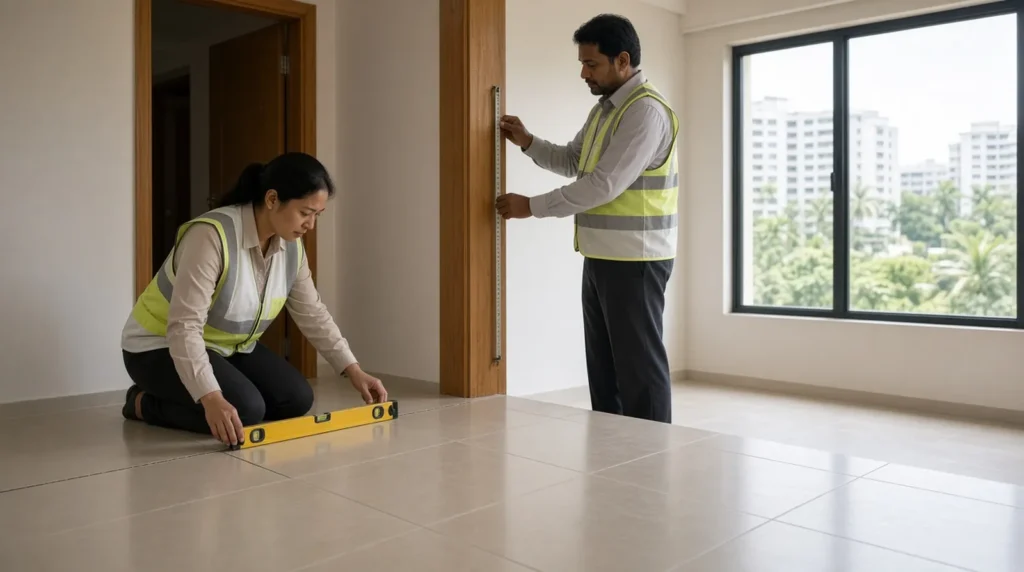
A developer or agent may quote a QLASSIC score as if it were a clean bill of health for a new home. Under CIDB’s Construction Industry Standard CIS 7:2021, the score is a workmanship rating for a building project, expressed as a percentage. It is not, on its own, a structural safety certificate, a by-law clearance, or a substitute for an independent inspection.
Read a QLASSIC score as a first-time workmanship rating of sampled finishes and fittings, weighted by building type. Ask for the CIS edition, the building category, the date, and the component breakdown before you rely on the number.
- QLASSIC is CIDB’s Quality Assessment System for Building Construction Works, now set out in CIS 7:2021.
- The 2021 revision assesses architectural works, basic M&E fittings and external works. It dropped structural works and M&E works.
- The score is built from sampled items that meet the standard on first inspection. Later rectification is not rescored.
- CIS 7:2021 is for workmanship rating. Unless the contract says otherwise, it is not a specification, and a qualified person must not use it to decide whether a building complies with the by-laws.
- A high score is still worth asking about. It does not replace a pre-purchase building inspection.
01What A QLASSIC Score Is
QLASSIC stands for Quality Assessment System in Construction. CIDB introduced CIS 7 in 2006, revised it in 2014, and issued the second revision in 2021. The standard describes QLASSIC as an independent method to assess and evaluate, primarily, the quality of workmanship of building projects. Marks that meet the standard are summed to give a total quality score, as a percentage, for the project. That percentage is the figure quoted in brochures and handover packs.
CIS 7:2021 is solely for building workmanship rating. It is not intended to be used as a specification or a compliance requirement unless the parties to the construction contract agree that it will bind them. Use of the standard is voluntary, and following it does not, by itself, confer immunity from legal obligations.
For the wider system, see our guide to QLASSIC and CIS 7. This article focuses on how to read the number itself.
02How The Score Is Calculated
Assessors inspect sampled items against the quality standards in the annexes. An item that meets the standard is ticked. An item that does not is marked as failed. Items that do not apply are marked not applicable. The score is the number of ticks over the total number of items assessed.
It is a sample, not a 100% survey. CIS 7:2021 says it is impractical to assess every element, so the assessment uses sampling. Building samples are based on gross floor area. External works are sampled in length sections or by location. Samples are meant to be spread evenly, and all locations are to be prepared for assessment.
It is a first-time inspection. Scoring is done on works inspected for the first time. Rectification after the assessment is not rescored, so that contractors do things right the first time. For a buyer, a later repair does not automatically raise the published score.
Architectural and external works are assessed when the project is complete and before handover. If a component or element does not apply, the weightage is prorated.
03What The Weightings Tell You
The total score is the sum of marks awarded to three components, each given a different weight depending on the building category. CIS 7:2021 Table 1 sets those weights as follows.
| Component | Category A, Landed Housing | Category B, Stratified Housing | Category C, Public, Commercial Or Industrial, No Centralised Cooling | Category D, Same Types With Centralised Cooling |
|---|---|---|---|---|
| Architectural Works | 85 | 83 | 82 | 80 |
| Basic M&E Fittings | 2 | 3 | 4 | 5 |
| External Works | 13 | 14 | 14 | 15 |
| Total | 100 | 100 | 100 | 100 |
Category A is landed housing, such as detached, semi-detached, terrace and cluster houses. Category B is stratified housing, such as flats, apartments, condominiums, service apartments, SOHO and town houses. Categories C and D are public, commercial and industrial buildings, split by whether the building has a centralised cooling system.
Architectural works carry most of the score, 80% or more in every category. In the standard, those works deal mainly with finishes, plus two named material and functional tests: a skim-coat or prepacked-plaster check and a wet-area water-tightness test. Basic M&E fittings cover items such as switches and sanitary fittings, not a full mechanical and electrical assessment. External works cover infrastructure and facilities or amenities around the building.
Two projects can share a similar total and still feel very different if one is carried by finishes and the other by external works. Ask for the component breakdown, not only the headline percentage.
04What The Score Does Not Tell You
This is the part most marketing copy leaves out.
It is not a structural assessment under the current standard. The preface to CIS 7:2021 says the second revision kept architectural works, basic M&E fittings and external works, but dropped structural works and M&E works. A 2021 score does not tell you that the frame, the reinforcement, or the main mechanical and electrical systems were assessed under QLASSIC. If an older project was assessed under CIS 7:2014, the scope was different. Ask which edition was used.
It is not a by-law or design check. Clause 1.4 says qualified persons shall not use the system to decide if the building complies with the relevant by-laws. The qualified person remains responsible for conformity with approved standards, practices, specifications and drawings in the contract.
It is not a 100% inspection of your unit. Your kitchen wall, bathroom waterproofing or bedroom floor may not have been in the sample. A good project score is encouraging. It is not a room-by-room warranty.
It does not automatically record later repairs, or catch every latent defect. Failed items are not rescored after rectification, so the figure may not match the condition at vacant possession. The wet-area and plaster tests help with some later problems, but many leaks, cracks and movement issues still appear after occupation.
A Practical Way To Put It. Treat a QLASSIC score as one piece of workmanship evidence for the project, not as proof that your unit is defect-free or structurally verified.
05What To Ask For Before You Buy
People often search for a public “QLASSIC score list.” This article does not publish one. Ask the developer, selling agent or joint management body for the official result that applies to the building you are considering, then check these points.
- Which edition of CIS 7 was used? The 2021 standard has a narrower scope than the 2014 edition, so scores are not fully comparable across editions.
- Which building category was applied? Landed, stratified and the two non-residential categories use different weightages. In a mixed development, ask how the project was categorised.
- When was the assessment done? Architectural and external assessments come after completion and before handover. The date shows how the figure relates to vacant possession.
- What is the breakdown? Ask for the architectural, basic M&E fittings and external-works marks, and whether any part was marked not applicable and prorated.
- What was sampled, and what failed? It is fair to ask whether your block or floor was in the sample. Also ask what failed and was later repaired, because those repairs will not have changed the score.
If the seller can only quote a single percentage, with no edition, date or breakdown, treat that figure as incomplete.
06How It Sits Next To An Independent Inspection
QLASSIC and an independent inspection answer different questions. QLASSIC compares sampled, first-time workmanship against CIS 7. An independent inspection looks at the unit or building you are about to buy, including cracks, leaks, safety issues and workmanship that may never have been in the sample.
A strong score should not talk you out of a pre-purchase building inspection. For a new home, that inspection still matters at vacant possession and during the defect liability period. For a subsale, there may be no QLASSIC score, or only an old project score that says nothing about later wear, alterations or leaks.
07Common Mistakes When Reading The Number
- Treating the score as a safety certificate. CIS 7:2021 does not present it as a structural or by-law clearance.
- Comparing scores from different CIS editions as if they were the same test. The 2021 revision dropped structural and M&E works.
- Assuming your unit was inspected, or that later repairs raised the score. The system is sampled, and failed items are not rescored after rectification.
- Relying on an unofficial list of project scores. Ask for the official result for the building in front of you.
- Skipping an independent inspection because the marketing score looks high. The two checks are complementary, not interchangeable.
Frequently Asked Questions
What Is A Good QLASSIC Score?
CIS 7:2021 defines how the percentage is calculated. It does not set a single official “pass mark.” Read the number with the edition, category, date and component breakdown.
Does A High QLASSIC Score Mean The Building Is Structurally Safe?
No. Under CIS 7:2021, structural works are no longer part of the assessment. The standard also tells qualified persons not to use QLASSIC to decide by-law compliance.
Can I Compare Two Projects By Their Scores Alone?
Only with care. Different categories use different weightages, and the 2014 and 2021 editions do not cover the same components. Compare breakdowns, editions and dates, not headlines.
If Defects Were Fixed After The Assessment, Does The Score Go Up?
Not under the first-time inspection rule in CIS 7:2021. Ask what failed and what was later repaired, rather than assuming the score already reflects those repairs.
Where Can I Find A Public List Of QLASSIC Scores?
This article does not publish a score list. Ask the developer, agent or management body for the official result for the project, including the edition, category, date and breakdown.
Should I Still Get A Pre-Purchase Inspection If The Score Is High?
Yes. A QLASSIC score is a sampled workmanship rating for the project. A pre-purchase inspection looks at the unit or building you are actually buying.
References
- [1] CIDB, Construction Industry Standard CIS 7:2021, Quality Assessment System for Building Construction Works, Preface, clauses 1.1–1.4 and 1.7, and Section 3 (including Table 1).
- [2] CIDB, “Quality Assessment System for Building Construction Works (QLASSIC)”: https://www.cidb.gov.my/eng/qlassic-quality-assessment-system-for-building-construction-works/. Some pages on that site still describe earlier editions; this article follows CIS 7:2021 for current scope.
- [3] CIS 7:2021 document copy hosted by CREAM: https://www.cream.my/data/cms/files/CIS7%202021.pdf.

Leads building inspection, concrete assessment and defect investigation work at Pro Inspect Solution, and writes guidance for owners, JMBs/MCs, developers, contractors and engineers. LinkedIn
Questions About A QLASSIC Score Or A Pre-Purchase Inspection?
Contact Pro Inspect Solution on WhatsApp or call +60 16-806 4902. Email inspectsolution.pro@gmail.com