
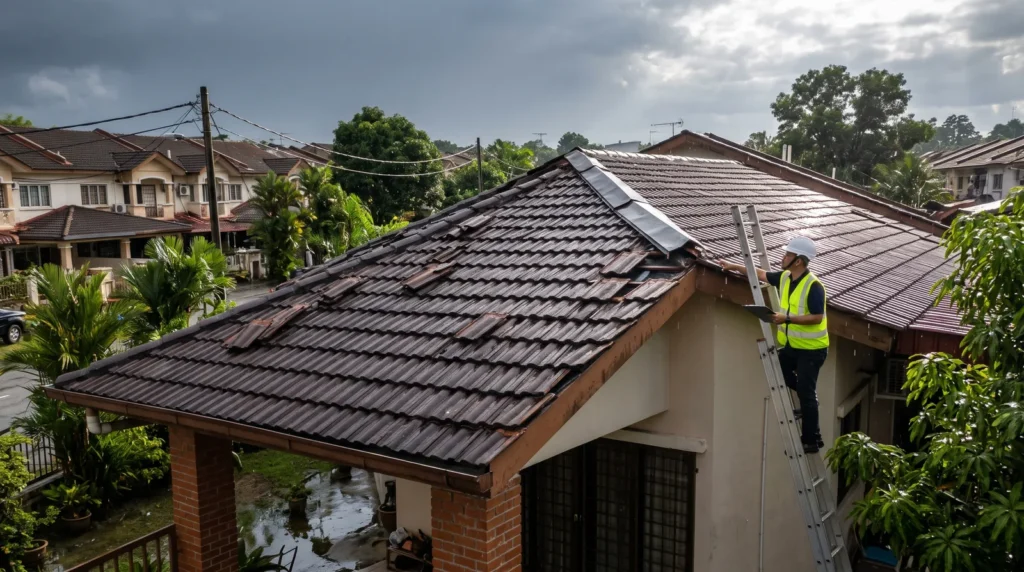
After a thunderstorm or a strong monsoon wind, the first sign of trouble is often a metal sheet lifted at the eaves, a row of tiles missing at the corner, or a ridge capping that has shifted. That is typical roof wind damage Malaysia sees after a storm, and it is usually a story about uplift, not about the roof being pushed sideways. Wind moving over a building creates suction on the covering. If the fixings, battens or trusses cannot hold that suction, the covering starts to come away, and rain then follows.
Malaysia assesses wind actions on buildings using MS 1553:2002, Code of Practice on Wind Loading for Building Structure, as amended in 2013. The code does not only give a basic wind speed for the site. It also shows that pressures are higher at roof edges, corners, hips and ridges than in the middle of the roof. This guide explains those points in plain language and sets out what owners and joint management bodies (JMBs) should check after a storm.
- Typical roof wind damage in Malaysia starts with uplift: suction lifts the covering, often at an edge, corner, hip or ridge, and rain then follows.
- For Peninsular Malaysia, MS 1553:2002, as amended in 2013, gives a basic wind speed Vs, based on a 50-year return period, of 33.5 m/s in Zone I (inland area of the Peninsula) and 32.5 m/s in Zone II (a marked coastal belt). These are starting values, not the final pressure on the roof.
- Figure 3.1 is a simplified map for Peninsular Malaysia only. The standard also tabulates 3-second gust wind speeds for stations across Malaysia, including Sabah and Sarawak. A designer there should use that station data, not assume a Peninsular zone value.
- A local pressure factor of 1.5, and 2.0 closest to the edge or ridge, is applied for suction at roof edges and at hips and ridges of pitched roofs (pitch of 10 degrees or more), compared with 1.0 in the general roof area. These higher local factors are alternative design cases and are not all applied at the same time.
- Do not walk on a damaged roof. Check from a safe place, and call a Professional Engineer if covering is missing or lifted, water is entering, or there is sagging, spreading or new cracks at roof level.
01How Wind Uplift Acts On A Roof
Wind can push on a surface (positive pressure) or pull it away (suction, or uplift). For many tiled and metal roofs, uplift is the more demanding case. The force does not stop at the sheet or the tile. It has to be carried down a clear path:
- the covering itself (tiles, metal sheets or other cladding);
- the fixings that hold the covering down;
- the battens or purlins;
- the rafters or trusses; and
- the connections that hold the trusses down to the walls or frame.
If any one of those links is weak, corroded, decayed or missing, the covering can lift even when the storm is not exceptional by design standards. Damage often begins at a single loose sheet or a short run of tiles and then peels further as the wind gets under the covering.
02Basic Wind Speed Zones Under MS 1553
MS 1553 starts from a basic wind speed, Vs, based on a 50-year return period. For Peninsular Malaysia, the simplified map in Figure 3.1 of the standard, as amended in 2013, gives two zones:
- Zone I, shown over the inland area of the Peninsula, at 33.5 m/s; and
- Zone II, a marked coastal belt on the same map, at 32.5 m/s.
The official map governs which zone applies to a given site. These figures are starting values, not the final pressure on your roof. The designer then adjusts for the terrain around the building, the height of the roof, nearby hills or escarpments, and the importance of the building.
Figure 3.1 is a simplified map for Peninsular Malaysia only. The standard also tabulates 3-second gust wind speeds for meteorological stations across Malaysia, including stations in Sabah and Sarawak, for return periods of 20, 50 and 100 years. A designer working in East Malaysia should use the appropriate station data in the standard, together with engineering judgment for the actual site, rather than assuming that a Peninsular zone value applies automatically.
MS EN 1991-1-4, the Eurocode for wind actions, is also used in Malaysia where a project specifies it. The two approaches should not be mixed casually on the same check. This article follows MS 1553, which remains commonly used for wind loading on buildings.
03Why Roof Wind Damage In Malaysia Often Starts At The Edges
Even on a roof designed for the correct basic wind speed, the pressure is not uniform. Wind separates at eaves, verges, corners, hips and ridges, and the local suction there is higher than over the general roof area.
MS 1553 accounts for this with a local pressure factor applied to cladding and roof coverings. In the general roof area the factor is 1.0. At roof edges, and at hips and ridges of pitched roofs (with a pitch of 10 degrees or more), the factor is higher: 1.5 over a wider edge or ridge zone, and 2.0 over a smaller zone closest to the edge or ridge, for suction. These higher local factors are alternative design cases and are not all applied at the same time, so the covering and its fixings at those locations are assessed for substantially higher local uplift than the middle of the roof.
That is why damage so often starts at a corner, along the eaves, or at a ridge, and why a roof that looks sound in the centre can still lose its edge sheets or ridge cappings. Overhangs, bargeboards and flashings sit in these same high-suction zones and deserve the same attention.
04The Role Of Fixings, Battens And Trusses
A correctly calculated wind speed does not help if the load path is incomplete. On a tiled roof, the tiles must be fixed in accordance with the design, especially in the edge and ridge zones, and the battens must be sound and properly fixed to the rafters or trusses. On a metal roof, the sheets must be fixed at the specified spacing, with the correct fasteners and washers, into purlins or battens that can take the pull-out force. Ridge, hip and barge flashings need their own fixings; they are not held down by gravity.
Common weak points, found after storms and during inspections, include:
- missing, undersized or corroded screws, nails or clips, particularly at edges and corners;
- fasteners that have missed the batten or purlin, or that have pulled through a thin or badly holed sheet;
- battens or purlins that are underspaced, rotten, split or badly corroded;
- truss or rafter connections that have loosened, and missing or inadequate hold-downs to the supporting walls; and
- earlier alterations, such as a new opening, a water tank, a signboard or a poorly detailed penetration — that interrupt the covering or add load without a proper check.
Timber decay and steel corrosion reduce capacity quietly. A roof that was adequate when it was new may not be adequate after years of leaks at a flashing or at the eaves. If the roof will also carry a new load, such as a solar array, that should be checked separately; see our guide on whether your roof can carry a solar panel array.
05What Owners And JMBs Should Check After Roof Wind Damage In Malaysia
Do not walk on a roof that may be damaged or unstable. Start from the ground, from a window that looks onto the roof, or from a neighbouring block, and look for:
- missing, lifted, creased or overlapping metal sheets, or missing or displaced tiles, especially at corners, eaves, verges, hips and ridges;
- ridge or hip cappings, flashings, bargeboards, fascias or gutters that have shifted, loosened or come away;
- debris from the roof in the grounds, on canopies or in gutters;
- new daylight visible through the covering, or wet ceiling boards, stains or drips in the rooms below, including along walls at the top storey;
- a sagging ridge line, a spread at the eaves, or new cracks in gable walls, parapets or at the bearing of trusses; and
- damage to nearby trees, signage or lightweight structures that may also have affected the roof.
Photograph what you can see, note the date of the storm, and keep any loose pieces that have fallen. If the building is occupied, keep people away from areas with a damaged ceiling or a suspected loose covering. Temporary covering, if needed, should be arranged with care so that it does not itself become a hazard in further wind. High or unsafe roofs can also be reviewed by a drone façade and roof inspection where that helps.
06When To Call An Inspector
Call a Professional Engineer when covering is missing or lifted, when water is entering, or when you see sagging, spreading or new cracks at roof level. You should also call if a severe storm has passed and the JMB cannot tell, from a safe viewpoint, whether the fixings, flashings and structure are still sound.
An inspection can record the as-found condition of the covering and, where it is safe to do so, the fixings, battens, purlins and trusses, and can advise whether temporary protection, targeted repair or a wider check is needed. Do not assume that a quick replacement of a few sheets, without looking at the fixings and the supporting members, has restored the roof to a reliable state.
07Keep The Next Storm From Opening The Same Weak Point
Most roofs that lose covering in a Malaysian storm were already vulnerable at an edge, a ridge or a poorly fixed detail. MS 1553 is a reminder that those locations are designed for higher suction than the middle of the roof, and that the whole load path, covering, fixings, battens and trusses, has to be able to take it.
A simple habit helps. After every severe storm, walk the grounds, look at the roof from a safe place, and record what you see. If anything is out of place, get it inspected before the next squall arrives.
Frequently Asked Questions
What Causes Typical Roof Wind Damage In Malaysia?
It is usually uplift, not the roof being pushed sideways. Wind moving over a building creates suction on the covering. If the fixings, battens or trusses cannot hold that suction, the covering starts to come away, often at an edge, corner, hip or ridge, and rain then follows.
What Basic Wind Speeds Does MS 1553 Give For Peninsular Malaysia?
MS 1553:2002, as amended in 2013, starts from a basic wind speed Vs based on a 50-year return period. The simplified map in Figure 3.1 gives Zone I, shown over the inland area of the Peninsula, at 33.5 m/s, and Zone II, a marked coastal belt on the same map, at 32.5 m/s. These are starting values. The designer then adjusts for terrain, roof height, hills or escarpments, and the importance of the building. The official map governs which zone applies. Figure 3.1 is a simplified map for Peninsular Malaysia only. The standard also tabulates 3-second gust wind speeds for stations across Malaysia, including Sabah and Sarawak.
Why Does Roof Wind Damage Often Start At The Edges?
Wind separates at eaves, verges, corners, hips and ridges, so the local suction is higher than over the general roof area. MS 1553 applies a local pressure factor of 1.0 in the general roof area, and 1.5 and 2.0 for suction at roof edges and at hips and ridges of pitched roofs with a pitch of 10 degrees or more, with 2.0 used on the smaller zone closest to the edge or ridge. These higher local factors are alternative design cases and are not all applied at the same time.
What Should Owners And JMBs Check After A Storm?
Do not walk on a roof that may be damaged or unstable. From the ground or another safe viewpoint, look for lifted or missing covering at corners, eaves, verges, hips and ridges, shifted cappings or flashings, debris, water entering below, and any sagging, spreading or new cracks at roof level. Photograph what you can see and note the date of the storm.
When Should We Call A Professional Engineer?
Call when covering is missing or lifted, when water is entering, or when you see sagging, spreading or new cracks at roof level. You should also call if a severe storm has passed and you cannot tell, from a safe viewpoint, whether the fixings, flashings and structure are still sound.
References
- [1] Department of Standards Malaysia, MS 1553:2002, Code of Practice on Wind Loading for Building Structure, as amended by AMD. 1:2013.
- [2] MIDAS support note on MS 1553:2002 (Vs based on a 50-year return period; Zone I 33.5 m/s and Zone II 32.5 m/s per Figure 3.1): MIDAS.
- [3] Research context confirming the two Peninsular zones (Zone I inland Vs = 33.5 m/s; Zone II on-shore outer perimeter Vs = 32.5 m/s): ResearchGate.
- [4] Can Your Roof Carry A Solar Panel Array?.
- [5] Façade and Roof Inspection (Drone).
Get An Independent Look At The Roof
Contact Pro Inspect Solution on WhatsApp or call +60 16-806 4902. Email inspectsolution.pro@gmail.com