
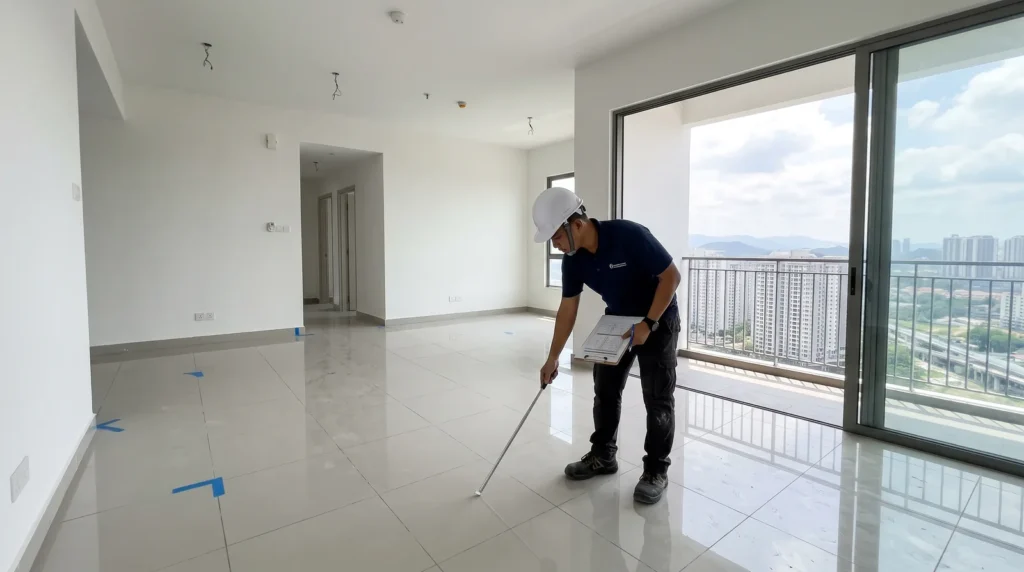
The keys are in your hand. The developer has already walked the unit, a Certificate of Completion and Compliance (CCC) has been issued, and you may have seen a QLASSIC score for the project. It is reasonable to ask whether you still need a private house inspection before you move in.
A private house inspection is an independent condition record of your house or unit, commissioned by you, with a written defect schedule and photographs. It is not the same as the developer’s own quality checks, a QLASSIC workmanship score, or the CCC. It is most useful at key handover, and again in time for defects to be notified before the defect liability period ends.
- A private house inspection is done for you, not for the developer. You should receive a written report, not only a verbal walkthrough.
- The most useful moments are at vacant possession, before you move in or renovate, and before the defect liability period (DLP) runs out.
- For housing sold by licensed developers under the standard sale and purchase agreements of the Housing Development Act, the DLP is 24 months from vacant possession. Commercial or non-HDA contracts follow the period in your agreement.
- A CCC confirms compliance with the approved plans and the by-laws. A QLASSIC score rates workmanship on a project. Neither is a room-by-room defect list for your unit.
- Use the report to notify defects in writing during the DLP. Our property inspection service page and our DLP guide explain the next steps.
01What A Private House Inspection Is
A private house inspection is an independent, mostly visual inspection of a house, apartment or other dwelling, carried out for the buyer or owner. An inspector or engineer walks the accessible rooms in a fixed order, records defects with photographs, notes what could not be seen, and sets out what should be repaired, monitored or checked further.
It is the same family of work as a pre-purchase building inspection, but the timing and the use of the report are often different. Before you sign a sale and purchase agreement, the report helps you decide whether to proceed and what to negotiate. After you receive the keys to a new home, the report is a condition record of the unit as handed over, which you can use to notify the developer during the DLP. The headings of the inspection are similar either way. Our Malaysian house inspection checklist sets out what is typically covered: structure and movement, wet areas and leaks, the roof and external works, finishes, and the services you can reasonably operate on the day.
The inspection is not a 100% survey of concealed work, a design review, or a substitute for the CCC. It records the condition that could be seen and tested within the agreed scope, on a stated date.
02When A Private House Inspection Pays Off
You do not need an inspection on every day of the DLP. You do need one at the moments when the record will still change what you can do next.
- At key handover, before you move in. Vacant possession is the cleanest baseline. Furniture, curtains and stored boxes will soon hide walls, floors and window sills. A report dated close to handover describes the unit as it was received, which is harder to reconstruct later.
- Before you renovate. Hacking, tiling, painting or moving plumbing can cover defects, and it can also lead to an argument about who caused a later leak or a cracked tile. Finish the inspection, and where you can, get the main items attended to, before the renovation starts.
- Before the defect liability period ends. For housing sold by licensed developers under the standard sale and purchase agreements of the Housing Development Act, the DLP is 24 months from vacant possession. Non-HDA contracts, including many commercial units, follow the period written in your agreement. A second look a few months before the expiry date is useful: some leaks, hollow tiles and recurring defects only show after a rainy season or after you have lived in the house. Do not leave it to the last week.
If you are buying a sub-sale home, the developer’s DLP has often already ended. In that case the more useful moment is before you sign, as set out in our pre-purchase inspection guide, rather than after you move in. Check the vacant possession date if the home is still young; a recent sub-sale can still sit inside a DLP.
Do Not Wait Until You Are Unpacking. The inspection is hardest, and the record is weakest, after you have moved in, painted, or started a renovation. Book it when the unit is still empty, and keep time to notify defects in writing.
03How It Differs From The Developer’s Own Checks
Developers do inspect their own work. Those checks have a different client, a different purpose and, often, a different level of detail from a private house inspection.
| Check | Who It Is For | What It Tells You | What It Does Not Replace |
|---|---|---|---|
| Developer’s site quality checks and handover walk | The developer | The developer’s own construction control and a snag list at handover | An independent record for the purchaser |
| QLASSIC score (CIDB CIS 7) | The project | A workmanship score for sampled architectural, basic M&E and external works | A room-by-room defect list for your unit, or a structural assessment |
| Certificate of Completion and Compliance (CCC) | The building, for occupation | That the building was completed in accordance with the approved plans and the by-laws, as stated by the Principal Submitting Person who issued the CCC | A statement that the house is free of defects |
| Private house inspection | You, the buyer or owner | A written condition record of the accessible areas of your house or unit, with photographs and next steps | The CCC, a fire-safety audit, or a full specialist M&E survey unless those are added to the scope |
A QLASSIC score can be useful background on the project, but it is a sampled workmanship rating, not an inspection of every room in your unit. Our guide on how to read a QLASSIC score explains what the number does and does not mean. The CCC is a completion and compliance document, not a defect report. Our article on what UBBL requires for a new building places the CCC in that sequence.
The practical difference is independence and the written record. The private inspector works to your brief, walks your unit, and gives you a defect schedule you can attach to a written notice. The developer’s walk is still worth attending, and you should still keep their forms, but it is not a substitute for your own report.
04What You Should Receive, And How To Use The Report
Ask for a written report, not only a conversation on site. It should state the date, the property, the areas inspected and the areas that were not accessible, include a defect schedule with photographs, distinguish cosmetic items from repairs and from findings that need an engineer, and set out recommended next steps and the limits of the brief.
Use the report promptly. For a new home still inside the DLP, notify defects to the developer in writing, with a copy of the relevant photographs and a clear description of each item and its location. Keep an acknowledgement of receipt. Our defect liability period guide sets out the usual notice steps under the standard housing contracts, including the time the developer has to attend to notified defects. This article does not replace that guide, and it is not legal advice.
If the inspection finds diagonal or stepped cracks, sloping floors, active leaks into a structure, or a safety issue, the right next step is further investigation by an engineer, not a longer cosmetic list. In a stratified building, defects in common property — the main roof, façade, car park or shared risers — are usually taken up through the joint management body or management corporation, not only as a unit claim.
Write Down What You Could Not See. A locked roof hatch, a water or power supply that was not yet on, a sealed ceiling trap, or furniture already in a room are gaps, not passing marks. A later visit may be needed once access is available.
05Common Mistakes
- Moving in first, inspecting later. Belongings and new finishes hide defects and weaken the handover record.
- Starting the renovation before the inspection. It becomes harder to say whether a defect was already there, and some developer obligations on those areas can be disputed.
- Treating the CCC or a QLASSIC score as a private inspection. Those documents answer different questions.
- Relying on a verbal walkthrough with no written report. You will need a dated schedule and photographs if you notify defects.
- Waiting until the last days of the DLP. Some defects only show after rain or after occupation, and you still need time to notify them in writing.
- Ignoring common property in a stratified building. A tidy unit can still sit under a leaking façade or a poorly detailed roof that belongs with the management body.
Frequently Asked Questions
Do I Need A Private House Inspection Before Moving In?
It is the most useful time to have one if you have just received the keys to a new house or unit. The inspection gives you an independent, dated record of the condition at handover, before furniture and renovation hide defects. It complements, and does not replace, the developer’s own checks, the CCC and any QLASSIC score.
How Is A Private House Inspection Different From The Developer’s Inspection?
The developer’s checks and handover walk are for the developer’s own quality control. A private house inspection is commissioned by you, walks your unit to an agreed scope, and produces a written defect schedule with photographs that you can use to notify defects. A QLASSIC score is a project workmanship rating, and a CCC is a completion and compliance document. Neither is an independent report on your unit.
When Should I Book The Inspection?
Book it at vacant possession, while the unit is still empty, and before you start any renovation. For a home that is already occupied, a second inspection a few months before the DLP expires is still useful, so remaining or recurring defects can be notified in time. For a sub-sale purchase, the better moment is often before you sign the sale and purchase agreement.
Does A CCC Or A QLASSIC Score Replace A Private House Inspection?
No. The CCC confirms that the building was completed in accordance with the approved plans and the by-laws. A QLASSIC score rates sampled workmanship on the project. A private house inspection records the condition of your accessible rooms and finishes on a stated date. You may want all three, but they are not interchangeable.
Can I Use The Report During The Defect Liability Period?
Yes. That is one of its main uses on a new home. Attach the relevant findings and photographs to a written notice to the developer within the DLP in your sale and purchase agreement. For HDA housing that period is 24 months from vacant possession. See our defect liability period guide for the usual notice steps.
References

Leads building inspection, concrete assessment and defect investigation work at Pro Inspect Solution, and writes guidance for owners, JMBs/MCs, developers, contractors and engineers. LinkedIn
Book A Private House Inspection In Malaysia?
Contact Pro Inspect Solution on WhatsApp or call +60 16-806 4902. Email inspectsolution.pro@gmail.com