
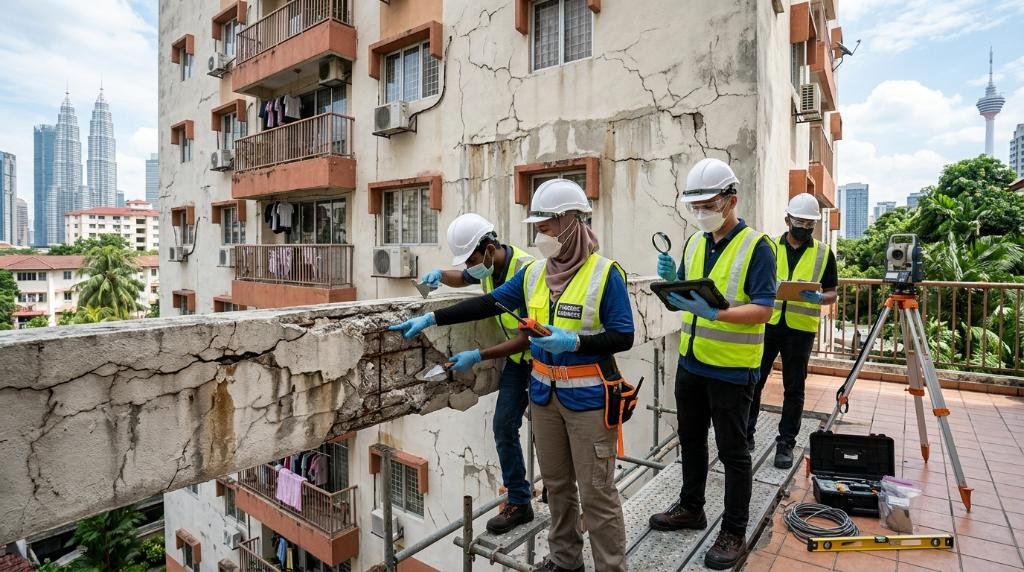
Across Malaysia’s built environment, rapid vertical expansion and fast-tracked construction timelines have created a volatile landscape for developers, main contractors, and joint management bodies (JMBs). When multimillion-ringgit commercial assets exhibit sudden shear cracking, uncontrolled water ingress through subterranean diaphragm walls, or differential slab settlement, standard architectural snagging lists no longer suffice. At this juncture, disputes shift from superficial aesthetics to high-stakes legal confrontations involving claims of catastrophic financial impact.
The surging market demand in Kuala Lumpur for specialized technical delay and engineering dispute advisory to mitigate major real estate project failures was highlighted when CCi launches 7th Asia Pacific office in Kuala Lumpur, Malaysia – Consultancy.asia. This influx of global dispute advisory practices into Malaysia reinforces a critical reality: resolving modern infrastructure and building failures demands rigorous empirical science. Employing forensic engineering dispute resolution has emerged as the definitive mechanism for separating contractor liability, consultant design deficiencies, and latent construction defects in arbitration and courtrooms alike.
1. The Financial Gravity of Latent Defects in Malaysian Developments
In high-density commercial and residential developments across the Klang Valley, Penang, and Johor Bahru, latent structural defects pose an existential financial threat. While patent defects are readily identified during the standard 24-month Defect Liability Period (DLP), latent flaws—such as insidious reinforcement corrosion, alkali-silica reactions (ASR), structural thermal bridge delamination, and progressive geotechnical shifting—frequently remain hidden until substantial occupation has occurred.
When a dispute surfaces, property owners often find themselves pitted against main contractors and design consultants in a contentious blame game. Without verified diagnostic evidence, a commercial defect claim Malaysia can stall indefinitely in protracted negotiations, leaving critical structural remediation unaddressed while holding costs skyrocket. The intersection of statutory compliance under the Strata Management Act 757 and developer liabilities means that property management bodies must substantiate their claims with forensic certainty, not subjective suppositions.

2. Forensic Engineering Dispute Resolution: Deconstructing Root Causes
Forensic engineering is not merely a high-level building audit; it is a reverse-engineering science. When cracks propagate through transfer girders or basements flood beneath the water table, forensic engineering dispute resolution applies empirical testing, physics-based simulations, and metallurgical and petrographic testing to reconstruct the chronological sequence of failure.
The investigative process involves several disciplined phases:
- In-Situ Non-Destructive Testing (NDT): Utilizing Rebound Hammer (Schmidt Hammer) calibrated in accordance with BS EN 12504-2, Ultrasonic Pulse Velocity (UPV) mapping per BS EN 12504-4 to detect internal voids, and ground-penetrating radar (GPR) to verify concrete cover thickness and rebar distribution against the approved Construction Drawings (As-Built).
- Destructive Core Extraction & Chemical Profiling: Extracting cylindrical concrete cores under BS EN 12504-1 to verify true in-situ compressive strength, paired with phenolphthalein spraying for carbonation depth measurement and laboratory chloride titration testing.
- Geotechnical & Hydrogeological Correlation: Analyzing piezometer readings, inclinometer measurements, and bore logs to separate sub-grade settlement from superstructural design deficiencies.
Through this systematic pipeline, dispute resolution teams eliminate conjecture. When parties enter mediation or the courtroom armed with empirical structural evidence backed by an authoritative Expert Witness & Dispute Resolution team, disputes that once seemed destined for years of litigation are frequently settled with technical clarity.
3. Conducting Rigorous Structural Failure Investigations
A comprehensive structural failure investigation demands a clear distinction between structural serviceability failure (excessive deflections, wide cracking, vibrations) and ultimate limit state failure (partial collapse, yield failure, buckling). In tropical climates like Malaysia, structural integrity is constantly challenged by aggressive humidity, intense rainfall, and high thermal differentials between exterior envelope surfaces and air-conditioned internal zones.
Façades, curtain wall bracketings, and reinforced concrete overhangs are particularly susceptible to premature micro-fissuring and catastrophic spalling. When dealing with complex high-rise envelopes, forensic investigations must combine physical inspections with aerial thermal imaging and photogrammetry. Utilizing specialized Façade & Roof Inspection (Drone) methodologies allows engineers to capture high-resolution visual and thermographic baselines across thousands of square meters without erecting costly external scaffolding, quickly isolating defective waterproofing joints, debonded tiles, and corroded sub-frames.
Once structural pathologies are mapped, engineers compare the measured realities against design obligations set forth by the CIDB Standards and Guidelines, Uniform Building By-Laws (UBBL 1984), and Eurocode standards (MS EN 1992 for concrete and MS EN 1993 for steel structures). This technical comparison clearly delineates whether the failure originated from inadequate structural sizing, subcontractor material substitutions, batching plant inconsistencies, or poor site curing regimens.

4. Untangling Building Delay and Defect Disputes in Adjudication
In Malaysian statutory adjudications under the Construction Industry Payment and Adjudication Act 2012 (CIPAA), defect claims rarely exist in isolation. They are almost invariably intertwined with liquidated ascertained damages (LAD) and extension of time (EOT) counterclaims. This dynamic creates a convoluted building delay and defect dispute ecosystem.
Consider a frequent scenario in major mixed-use projects: an employer withholds interim progress payments, alleging defective workmanship in post-tensioned slabs. The contractor counters that the delays were driven by late issuance of structural Variation Orders (VOs) and that the observed slab deflection falls within acceptable Eurocode tolerances. Resolving this requires an integrated technical-contractual review:
- Critical Path Delay Analysis: Determining whether the physical remediation of the structural defect actually drove critical path delays, or whether commercial procurement delays preceded the defect discovery.
- True Cost to Complete & Rectification Audits: Quantifying genuine rectification costs through specialized Structural Repair Consultancy frameworks, ensuring that claims for damages reflect mathematically justified engineering remedies (e.g., carbon fiber reinforced polymer (CFRP) strengthening or micro-cement pressure grouting) rather than inflated over-demolition quotes.
- Contractual Culpability Apportionment: Evaluating whether the defect resulted from an ambiguity in the Employer’s Requirements (Design and Build) or unauthorized deviation during on-site execution.
5. Evidentiary Rigour: The Role of an Independent Forensic Engineer
Tribunals, High Court judges, and Asian International Arbitration Centre (AIAC) arbitrators are legal specialists, not structural engineers. When complex failure mechanisms are argued, the party presenting the most credible, objective, and test-supported engineering narrative holds the advantage. This makes the appointment of an independent forensic engineer essential.
An expert witness must maintain strict objectivity. The primary duty of an independent forensic engineer is not to advocate blindly for the hiring client, but to assist the court or arbitral tribunal in understanding complex technical phenomena. By maintaining rigorous technical neutrality, cross-referencing on-site NDT testing against finite element models (FEM) and Malaysian design codes, a professional engineer delivers an unimpeachable expert witness report that withstands intense cross-examination.
Whether navigating adjudication under CIPAA, handling a multi-party dispute in the High Court of Malaya, or negotiating settlement terms before formal litigation commences, forensic engineering transforms chaotic accusations into mathematically proven realities, protecting project margins and corporate reputations.
Frequently Asked Questions (FAQ)
What is the primary role of forensic engineering in a construction defect dispute?
Forensic engineering investigates why and how a structural element, envelope system, or building component failed to perform as intended. Unlike standard inspection services, forensic engineers use destructive and non-destructive scientific testing, structural modeling, and material science to determine the definitive root cause of failure and legally apportion liability among developers, engineers, and contractors.
How does an expert witness report influence commercial defect claims in Malaysia?
In Malaysian court litigation or AIAC arbitration, an expert witness report prepared by a qualified Professional Engineer serves as key technical evidence. The report provides objective, empirical proof of whether defects breached the contract specifications, local Uniform Building By-Laws (UBBL 1984), or Malaysian Standards, helping the tribunal determine financial damages and necessary remediation costs.
Can forensic investigations assist during CIPAA 2012 adjudication proceedings?
Yes. Under the Construction Industry Payment and Adjudication Act 2012 (CIPAA), employers frequently withhold payments by asserting cross-claims or set-offs for defective construction. An independent forensic engineer quickly conducts focused site investigations to substantiate or defend against these claims, ensuring adjudication submissions are backed by verified technical evidence within strict statutory deadlines.
What non-destructive testing (NDT) methods are commonly used for structural investigations?
Common NDT techniques include Ultrasonic Pulse Velocity (UPV) testing, Schmidt rebound hammer testing, Ground Penetrating Radar (GPR) for rebar and void identification, cover meter surveys, thermographic infrared imaging, and crack width monitoring using digital microscopic gauges. These tests provide accurate assessments without damaging the building’s structural integrity.
Contact Us / Certified Inspection & Engineering Consultation
Pro Inspect Solution, led by Ir Vimal, Professional Engineer, provides certified building condition assessments, structural integrity audits, handover defect inspections, and professional engineering advisory across Malaysia.
- 📍 Service Coverage: Kuala Lumpur, Selangor, and Nationwide Malaysia
- 📞 Phone / WhatsApp: +60 16-806 4902
- ✉️ Official Inquiries: inspectsolution.pro@gmail.com
- 🌐 Official Website: proinspectsolution.com
- 👷♂️ Lead Engineer: Authored & verified by Ir Vimal, Professional Engineer
Need Certified Property Inspection or Building Audit Services?
Get instant consultation and professional engineering advice from Pro Inspect Solution.
