
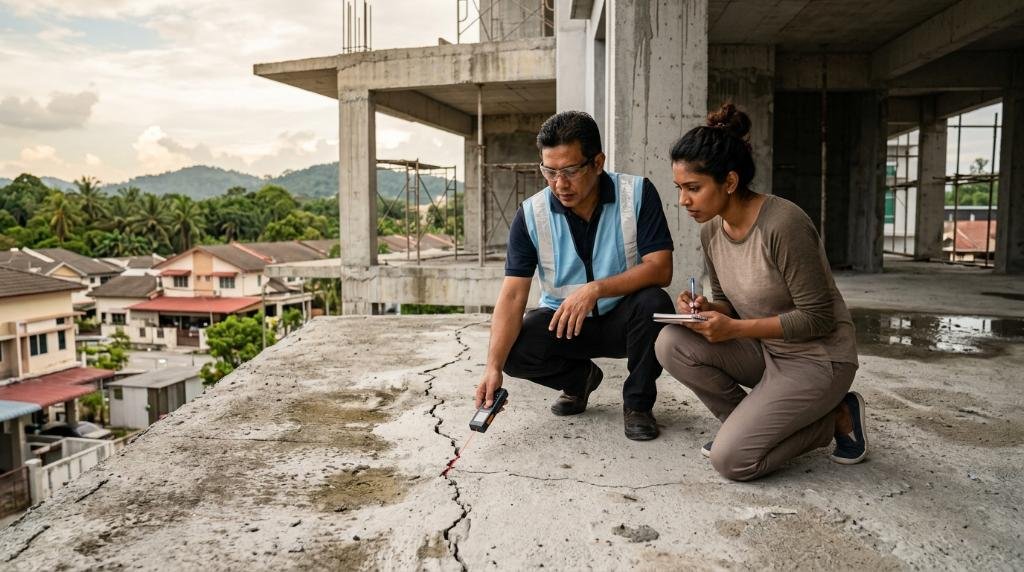
1. Introduction: Why Every Crack in the Slab Demands Immediate Inspection
In structural engineering, concrete is often celebrated for its massive compressive strength and long-term durability. However, it is also inherently weak in tension. When a visible crack in the slab develops—whether across a high-rise residential floor, a commercial podium deck, or an industrial ground slab—it serves as an immediate warning indicator that internal or external stresses have exceeded the material’s structural capacity.
Ignoring early physical warnings can lead to disastrous consequences. A sobering reminder of structural vulnerability occurred in public infrastructure when reports surfaced regarding a severe overhead failure: Mumbai Metro Line 4 Slab Collapse: Was MMRDA Warned About the Pillar Crack? – lokmattimes.com. This tragedy highlights a critical engineering truth: hairline fractures and pillar cracks are rarely cosmetic. When structural warnings are ignored or dismissed as routine wear, load-bearing concrete elements can degrade rapidly, compromising the safety of thousands and resulting in catastrophic structural failure.
In Malaysia, our extreme tropical climate amplifies these risks significantly. High ambient temperatures during placement, intense solar radiation, flash floods, and heavy monsoon rainfall create ideal conditions for rapid concrete drying shrinkage, thermal expansion stress, and water ingress. In regions with marine clay or soft peat soils like the Klang Valley, Penang, and Johor Bahru, differential settlement frequently triggers severe structural concrete cracks. As professional engineers, our objective at Pro Inspect Solution is to ensure that property owners, facility managers, developers, and contractors take decisive, science-backed action before minor slab defects transform into multi-million Ringgit liabilities.
2. Structural vs. Non-Structural Cracks: Identifying the Root Cause
Not every crack in the slab implies impending collapse, but discerning non-structural defects from severe structural failures requires specialized engineering expertise. During a standard slab defect inspection Malaysia, we categorize slab cracking into two primary classifications based on origin, geometry, and risk severity.
A. Non-Structural Slab Cracks
Non-structural cracks primarily affect surface aesthetics and durability rather than immediate load-bearing capacity. However, if left unsealed in humid tropical environments, they allow carbon dioxide and moisture penetration, accelerating steel reinforcement corrosion.
- Plastic Shrinkage Cracking: Occurs while the concrete is still in its plastic state (within hours of pouring). High evaporation rates, wind, and hot sun cause rapid surface moisture loss before the concrete gains adequate tensile strength.
- Drying Shrinkage Cracking: Develops over weeks or months as excess mixing water evaporates, causing the hardened concrete matrix to contract. These cracks are common when expansion or contraction joints are spaced too far apart.
- Thermal Cracking: Driven by temperature differentials during hydration or daily heating/cooling cycles, leading to localized tensile stresses.
B. Structural Concrete Cracks
Structural cracks indicate that the floor slab is suffering under loads it cannot safely sustain or that foundation movement has compromised its support system. These require immediate structural engineering evaluation.
- Flexural Cracks: Usually appear on the tension face (underside of mid-span or top surface over supports) when bending moments exceed the concrete’s tensile capacity.
- Shear Cracks: Diagonal cracks near columns, beam supports, or wall edges indicating severe shear stress, often signalling risk of punching shear collapse in flat slab designs.
- Differential Settlement Cracks: Wide, continuous diagonal or vertical cracks caused by uneven movement of the underlying subgrade soil.

According to MS EN 1992 (Eurocode 2 for Design of Concrete Structures), crack width limits are strictly specified. In reinforced concrete slabs exposed to moisture, cracks wider than 0.3 mm generally exceed acceptable design serviceability thresholds and mandate formal building defect analysis and structural remediation.
3. Professional Inspection Methodologies & Building Defect Analysis
A superficial visual walk-through is never sufficient to evaluate structural floor slabs. Accurately assessing a crack in the slab requires systematic, non-destructive, and semi-destructive testing protocols. At Pro Inspect Solution, our diagnostic framework incorporates advanced engineering tools:
1. Optical Crack Mapping & Displacement Tracking
Using digital crack-measuring microscopes, calibrated crack width gauges, and tell-tale monitors, we record crack widths, direction, and active movement over time. Active cracks (those widening or shifting under dynamic loads) present far higher structural risk than dormant cracks.
2. Non-Destructive Testing (NDT)
- Ultrasonic Pulse Velocity (UPV) Testing: Sends high-frequency sound waves through the concrete slab. By measuring velocity changes, engineers map internal crack depth, honeycomb voids, and hidden concrete honeycombing.
- Ground Penetrating Radar (GPR): Scans the internal matrix of the slab to verify steel rebar spacing, cover depth, post-tension tendon conduits, and sub-slab soil voids.
- Rebound Hammer (Schmidt Hammer) Test: Evaluates surface hardness and estimates compressive strength uniformity across the slab.
3. Structural As-Built Verification
Structural diagnosis requires comparing physical field observations against original design drawings. Where original blueprints are missing or outdated, our team utilizes professional As-Built Survey & Drawing Services to map floor layouts, beam dimensions, structural slab thickness, and column configurations, establishing an accurate baseline for structural recalculations.
4. Malaysian Standards, Statutory Compliance, and Legal Risk
In Malaysia, structural slab failure carries significant legal liability for building owners, joint management committees, and developers. Compliance with statutory framework standards is mandatory under federal law.
A. Street, Drainage and Building Act 1974 (Act 133) & UBBL 1984
Under Section 85A of the Street, Drainage and Building Act 1974 (Act 133), local municipal councils (such as DBKL, MBPJ, MBSP, or MBJB) have the authority to compel building owners to carry out mandatory structural inspections if visual defects or cracks indicate potential structural distress. The Uniform Building By-Laws (UBBL 1984) dictate mandatory dead and live load allowances, concrete cover specifications, and structural fire protection standards.
B. Strata Management Act 2013 (Act 757)
In multi-storey strata properties (condominiums, commercial towers, stratified industrial parks), structural floor slabs separating units are defined as common property. Under the Strata Management Act 2013 (Act 757), Joint Management Bodies (JMBs) and Management Corporations (MCs) bear strict legal responsibility for maintaining common structural elements. Water seepage originating from a structural crack in the slab between floors automatically triggers Section 142 statutory inter-floor leakage presumptions.
C. Construction Industry Development Board (CIDB) Standards
Contractors and developers must strictly adhere to quality standards published under the CIDB Technical Standards and Guidelines (including QLASSIC / CIS 7 standards). Workmanship defects resulting in early-age slab cracking can lead to formal dispute claims at the Building Defects Tribunal or high-court litigation. Safety audits must also comply with workplace structural safety rules set by the Department of Occupational Safety and Health (DOSH).
5. Concrete Slab Repair Malaysia: Proven Remediation Solutions
Executing an effective concrete slab repair Malaysia project requires matching the correct repair methodology to the underlying root cause. Superficial plastering or applying retail sealants over structural cracks is a recipe for catastrophic re-failure. Engineering repair methods include:
1. High-Pressure Epoxy Injection
For dry structural cracks ranging between 0.1 mm and 5.0 mm wide, low-viscosity epoxy resin is injected under high pressure through surface ports. The epoxy penetrates deep into the full depth of the slab, bonding fractured concrete surfaces back together and restoring structural shear and tensile continuity according to BS EN 1504 standards.
2. Polyurethane (PU) Grouting for Active Seepage
When a crack in the slab is leaking water—such as in basement slabs, flat roofs, or water tanks—epoxy will not cure properly. Hydrophobic Polyurethane (PU) resin is injected to react with water, expanding rapidly into a flexible, closed-cell foam that stops active water flow immediately before permanent structural sealing is applied.

3. Structural Reinforcement & Carbon Fiber Wrapping (CFRP)
If building defect analysis reveals that the slab is structurally under-reinforced or suffering from flexural overload, external carbon fiber reinforced polymer (CFRP) laminates or sheets are bonded to the tension face of the slab. CFRP provides immense tensile strength enhancement without adding significant dead weight.
4. Specialist Engineering Consultation
Before appointing a repair contractor, property managers should engage an independent engineer. Our specialized Structural Repair Consultancy team conducts unbiased root-cause diagnostics, structural recalculations, and provides detailed tender specifications. Furthermore, through our Concrete Technology Consultancy, we evaluate concrete mix designs, carbonation rates, and chemical admixtures to ensure long-term repair durability in high-humidity Malaysian environments.
6. Proactive Prevention: Safeguarding Property Value & Structural Integrity
Preventing slab defects begins during the initial design and construction phase, but continuous maintenance is equally vital throughout the structure’s service lifespan. Key preventive practices include:
- Comprehensive Geotechnical Investigation: Conduct thorough soil test boring prior to slab-on-grade construction to design appropriate subgrade compaction or piling systems.
- Proper Curing Control: In hot Malaysian weather, freshly poured concrete must be protected with curing membranes or wet hessian mats to prevent rapid moisture loss and plastic shrinkage cracks.
- Adequate Control Joint Spacing: Saw-cut control joints must be installed within 12 to 24 hours of finishing, spaced at optimal intervals to accommodate thermal movement.
- Routine Structural Audits: Commercial and residential property owners should schedule routine condition surveys every 3 to 5 years to detect micro-cracks before moisture corrodes embedded steel rebar.
7. Frequently Asked Questions (FAQ)
How do I know if a crack in the slab is structural or non-structural?
Non-structural cracks are typically under 0.3mm wide, uniform, and caused by drying shrinkage or temperature shifts. Structural cracks are generally wider than 0.3mm, continuous across structural spans, displaced (uneven surface height), diagonal near columns, or accompanied by floor sagging and spalling concrete. A professional engineering assessment is recommended for definitive diagnosis.
What is the cost of concrete slab repair in Malaysia?
Repair costs vary widely based on the defect extent, accessibility, and repair technology. High-pressure PU grouting for active water leaks typically ranges from RM150 to RM350 per linear meter. Structural epoxy injection or CFRP carbon fiber reinforcement costs higher depending on structural engineer specifications and specialized resin formulations.
Who is legally responsible for repairing slab cracks in a strata building?
Under the Strata Management Act 2013 (Act 757), structural concrete slabs that form load-bearing elements or separate individual parcels are classified as common property. Management Corporations (MC) or Joint Management Bodies (JMB) are legally responsible for maintaining structural integrity and rectifying inter-floor leaks originating from common slabs.
Can epoxy pressure injection permanently fix structural concrete cracks?
Yes. High-pressure epoxy injection restores structural shear and compressive strength by sealing cracks down to 0.1mm width and bonding fractured sections back into a continuous monolithic element. However, underlying causes like ongoing foundation settlement or load capacity issues must be stabilized first.
What non-destructive tests (NDT) are used during slab defect inspection in Malaysia?
Certified engineers utilize Ultrasonic Pulse Velocity (UPV) testing to determine internal crack depth, Rebound Hammer testing for surface compressive strength, and Ground Penetrating Radar (GPR) to scan embedded rebar layout and identify sub-slab void formation.
Need Professional Property Inspection or Building Audit Services?
Get instant consultation and professional engineering advice from Pro Inspect Solution.
