
By Ir Vimal, Professional Engineer | Published: July 23, 2026
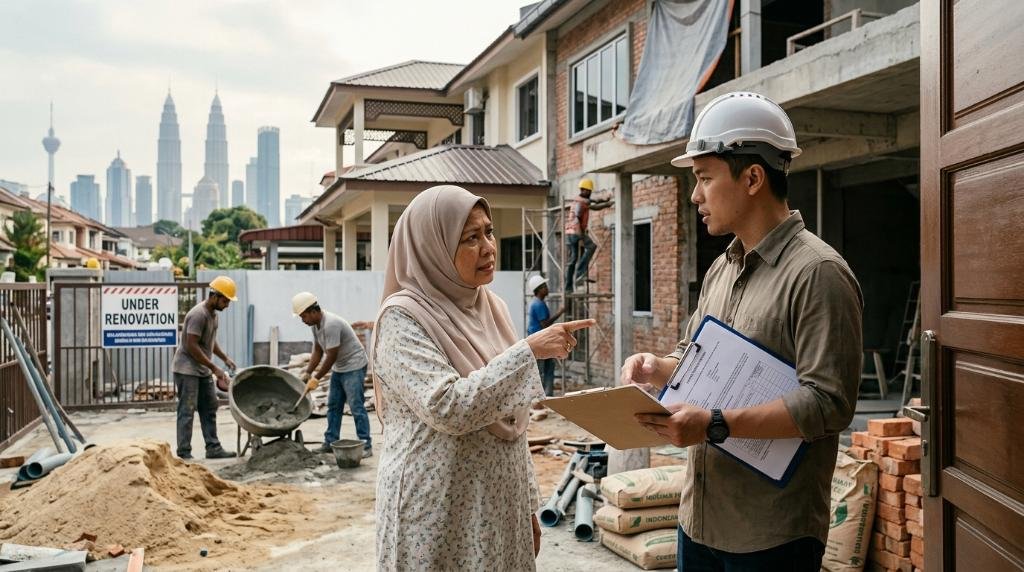
The Malaysian dream of owning and beautifully customizing a home is increasingly turning into a nightmare for many. As property development surges in 2026, so too does the sophistication of renovation scams in Malaysia. Beyond the obvious financial devastation of a contractor taking your deposit and vanishing, there is a much more insidious threat: the “completed” renovation that is fundamentally unsafe, structurally compromised, and legally unapproved.
As a practicing Professional Engineer (Ir), I have witnessed firsthand the devastating aftermath of these fraudulent projects. Scammers no longer just run away with your money; they stay, build with dangerously substandard materials, bypass critical Malaysian structural codes, and leave you with a ticking time bomb. This guide isn’t your standard list of generic tips. We are going deep into the engineering, legal, and statutory realities of the Malaysian construction industry so you can protect your property and your life.

The Reality of Renovation Scams in Malaysia in 2026
In recent years, the Tribunal for Consumer Claims Malaysia (TTPM) and the police have recorded thousands of cases related to fraudulent home renovations. The financial losses easily run into the tens of millions of Ringgit annually. However, the true cost is often hidden behind fresh coats of paint and cheap plaster ceilings.
Modern renovation scams have evolved. The current trend involves syndicates establishing seemingly legitimate companies, producing slick 3D renderings, and offering prices that are “just a little bit lower” than market rates to appear competitive rather than suspiciously cheap. Once the initial deposits are secured and demolition begins, the extortion starts: sudden “material price hikes,” demands for progress payments before milestones are met, and aggressive legal threats if homeowners refuse to pay.
Insider Engineering Perspective: Where Most Homeowners Get Defrauded
From an engineering standpoint, a scam isn’t just a financial crime; it is an assault on building integrity. When investigating failed residential structures, the root cause almost always traces back to a contractor willfully ignoring the Uniform Building By-Laws (UBBL) 1984 and the Street, Drainage and Building Act 1974 (Act 133).
Bypassing Structural Codes
Fraudulent contractors actively avoid consulting Professional Engineers (PE). For instance, when homeowners request a rear kitchen extension, scammers will routinely remove load-bearing walls without installing proper temporary supports or correctly sized steel beams (I-beams). They completely disregard critical design standards like MS EN 1992 (Eurocode 2 for concrete structures).
The Rebar and Concrete Deception
To maximize their profit margins, scammers substitute specified materials with inferior alternatives. You might be paying for High Yield (Y) steel rebars, but they will install undersized Mild Steel (R) bars with excessive spacing. Furthermore, rather than ordering Ready-Mixed Concrete with the correct characteristic strength (e.g., Grade 25 or Grade 30) from reputable batching plants, they manually mix concrete on-site with improper water-to-cement ratios. This results in severe honeycombing, spalling, and eventual structural failure—issues that only become visible long after the contractor has disappeared.
The Danger of Unregistered Contractors and Substandard Materials
One of the largest red flags in the industry is the proliferation of unregistered contractors. Under the Lembaga Pembangunan Industri Pembinaan Malaysia Act 1994 (Act 520), it is an offense to undertake any construction work without a valid Construction Industry Development Board (CIDB) registration.
Unregistered contractors operate in the shadows. If a structural failure occurs or a worker is injured on your property, you, as the property owner, can be held directly liable. These rogue operators also have zero access to CIDB-certified building materials (which carry the mandatory Standard Malaysia (MS) certification). Instead, they flood your home with cheap, non-compliant imported materials that fail under stress, leak during our heavy monsoon downpours, and pose severe fire hazards due to non-compliance with BOMBA regulations.
For more foundational information regarding baseline standards in the Malaysian property landscape, you can always refer back to our homepage for engineering insights.

Why Local Council Approvals and Home Renovation Laws Are Non-Negotiable
A classic tactic of a renovation scammer is convincing the homeowner that local council approvals (PBT – Pihak Berkuasa Tempatan) are unnecessary. They will say, “I know the orang dalam (insider), we don’t need to submit drawings, it’s just a small extension.”
This is a blatant lie and a violation of home renovation laws. Any modification that alters the footprint, layout, or structural integrity of a building requires approved architectural and structural drawings endorsed by registered professionals. If you proceed without approval from councils like DBKL, MBPJ, or MBSJ, you face severe consequences:
- Demolition Orders: The council has the legal right to force you to tear down the illegal extension at your own cost.
- Hefty Fines: Fines can multiply daily until the illegal structure is rectified.
- Insurance Voidance: If a fire or structural collapse occurs in an unapproved extension, your home insurance provider will immediately void your claim.
Always verify the statutory requirements on official government portals like the Ministry of Housing and Local Government (KPKT).
Leveraging CIDB Complaints to Protect Your Investment
If you suspect you are being defrauded, time is of the essence. You must act before the contractor abandons the site. While police reports are necessary for fraud and theft, the construction-specific route is through CIDB.
Filing CIDB complaints is a powerful tool. Because CIDB heavily penalizes and can revoke the licenses of registered contractors who perform shoddy or incomplete work, the threat of a formal complaint often forces legitimate but stubborn contractors to rectify their mistakes. However, if you hired an unregistered contractor, CIDB’s jurisdiction is limited to penalizing them for operating illegally, and you will likely need to escalate the matter to the Civil Courts or the Tribunal for Consumer Claims (for claims under RM50,000).
Before you hand over a single Ringgit, verify the contractor’s credentials on the official CIDB CIMS Portal.
Frequently Asked Questions (FAQ)
How do I verify if a contractor is registered in Malaysia?
You can easily verify a contractor’s legal standing by using the CIDB CIMS (Centralised Information Management System) public portal. Simply input their company name or registration number to see their grading, specialized categories, and license expiration date.
Can I file CIDB complaints against unregistered contractors?
Yes, you can report them to CIDB for operating illegally under Act 520, which can result in heavy fines for the contractor. However, for financial restitution, you must concurrently file a police report for fraud and bring the case to the Tribunal for Consumer Claims Malaysia (TTPM) or the civil courts.
What home renovation laws apply to standard house extensions?
Under the Street, Drainage and Building Act 1974 (Act 133) and the Uniform Building By-Laws (UBBL) 1984, any structural modification, including extending your kitchen or adding a floor, legally requires formal local council approvals (PBT). This mandates submission of drawings endorsed by a Principal Submitting Person (Architect or Professional Engineer).
Don’t Let Your Dream Home Become a Structural Nightmare
If you suspect your ongoing renovation is plagued by substandard materials, code violations, or structural defects, you need an independent, expert evaluation immediately. Don’t take a contractor’s word for it when your safety and life savings are on the line.
Protect your investment today. WhatsApp us at +60 16-806 4902 for a professional consultation.
