
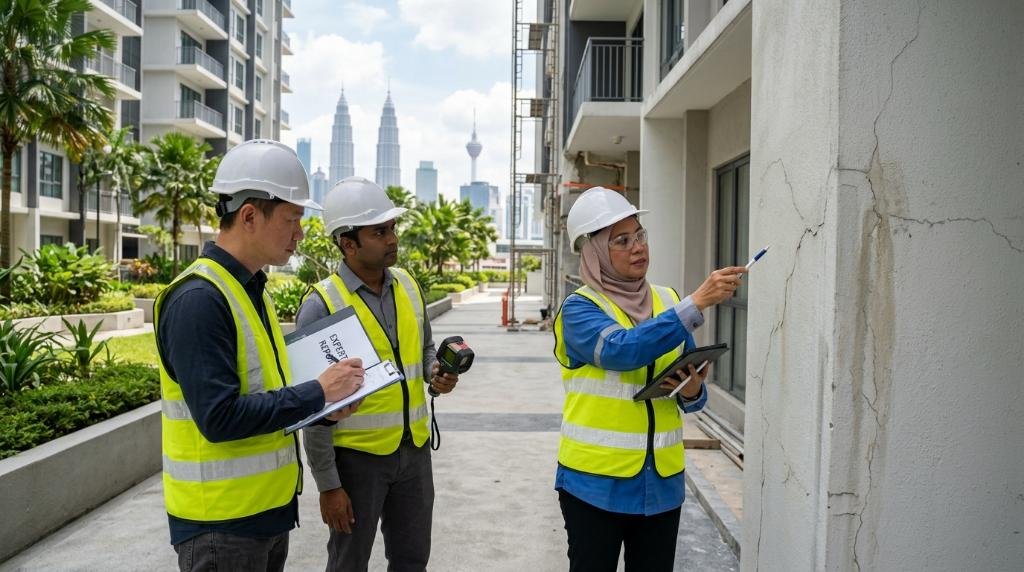
1. Local Industry Shift: Why Expert Determination is Gaining Traction
In recent years, Malaysia’s real estate and infrastructure sectors have experienced unprecedented delivery speeds, yet construction defect claims continue to escalate. High-rise residential towers, commercial complexes, and industrial warehouses frequently face disputes over workmanship, structural micro-cracking, and persistent water ingress. As highlighted in a recent industry report on Expert determination in construction, engineering – dailyexpress.com.my, the local market is shifting rapidly toward expert determination as an efficient, binding mechanism for engineering and building disagreements.
Traditional court litigation or protracted arbitration often takes years to yield a resolution while legal costs snowball. When structural integrity, load path distribution, or inter-floor water leakage is at stake, delaying corrective actions damages the asset and exacerbates financial risks. Property developers, joint management bodies (JMBs), management corporations (MCs), and main contractors increasingly turn to expert determination construction Malaysia procedures to achieve technical clarity and binding decisions without legal delays.
2. Understanding Expert Determination in Construction Malaysia
Expert determination is an alternative dispute resolution (ADR) mechanism where disputing parties contractually agree to submit a specific technical dispute to an independent, qualified subject-matter expert—typically a registered Professional Engineer (Ir.). Unlike an arbitrator, who acts strictly as a judicial officer evaluating legal evidence presented by advocates, the expert acts as an independent investigator utilizing their professional expertise to assess physical conditions, run diagnostic testing, and determine liability.
In a typical construction defect dispute Malaysia, the key advantages of expert determination over standard litigation or adjudication include:
- Technical Expertise: Decisions are grounded in structural dynamics, material mechanics, and local building bylaws rather than purely legal arguments.
- Speed & Efficiency: Inspections and determination reports are generally completed within weeks rather than years.
- Contractual Finality: The determination is contractually binding on both parties, eliminating costly appeal loops unless serious procedural bias is proven.
- Confidentiality: Dispute details remain strictly private between the involved parties, protecting commercial reputations.
When a developer and contractor reach an impasse over concrete strength deficiencies or structural movement, engaging professional engineering services like Expert Witness & Dispute Resolution ensures that dispute findings are legally robust, technically sound, and actionable.
3. Common Structural Failures & Construction Defects in Malaysian Properties
Malaysia’s tropical climate—characterized by high humidity, intense solar radiation, and frequent flash torrential downpours—places severe stress on building envelopes and structural reinforced concrete elements. Over years of conducting forensic structural engineering assessments across Peninsular and East Malaysia, our engineering team has categorized the predominant failure modes triggering expert determinations:
3.1 Reinforced Concrete Honeycombing & Reinforcement Corrosion
Poor compaction during concrete casting combined with inadequate concrete cover leads to structural honeycombing. Over time, moisture ingress causes carbonation or chloride attack, expanding steel rebar up to six times its original volume. This results in severe concrete spalling and compromised structural shear capacity.
3.2 Inter-Floor Water Seepage & Waterproofing Membrane Failure
Under the Strata Management Act 2013 (Act 757), statutory presumptions exist regarding inter-floor leakage in stratified parcels. Determining whether leakage stems from defective localized plumbing, deteriorated polyurethane (PU) grout injections, or improper membrane lap overlaps requires non-destructive testing (NDT), infrared thermography, and moisture mapping during an expert witness inspection.
3.3 Differential Settlement and Foundation Cracking
Unstable residual soils, poorly compacted backfill, or inadequate sub-soil drainage cause differential settlement. This manifests as diagonal step cracking along brick infill walls, structural column distress, or floor slab tilting. Resolving a complex structural failure dispute resolution requires deep soil investigation data (borehole logs), crack monitoring trends, and finite element modeling.

To prevent latent defects from escalating into full structural failures, asset owners must conduct a thorough building condition assessment prior to the expiry of the Defect Liability Period (DLP).
4. Step-by-Step Expert Determination & Inspection Protocol
Executing an expert determination requires strict adherence to engineering standards and transparent protocols to ensure the final determination stands up to scrutiny. At Pro Inspect Solution, our evaluation procedure follows a rigorous four-stage framework:
-
Terms of Reference (TOR) & Scope Agreement:
Both disputing parties agree in writing to appoint the expert, define the exact questions to be answered (e.g., establishing root causes, allocating repair costs), and commit to accepting the decision as final and binding. -
On-Site Technical Inspection & Diagnostic Testing:
The expert conducts detailed field site visits. Advanced non-destructive testing (NDT)—such as Ultrasonic Pulse Velocity (UPV), Covermeter Rebar Scanning, Core Drilling, and Rebound Hammer testing—is performed. For high-rise exterior envelopes, modern techniques such as façade & roof inspection (drone) thermal imaging capture high-resolution imagery without expensive scaffolding. -
Technical Submissions & Submissions Review:
Each party submits architectural/structural drawings, as-built plans, concrete cube test results, pouring logs, and formal written submissions outlining their claims. -
Determination Report Issuance:
The expert synthesizes physical diagnostic findings, statutory requirements, and standard construction codes to issue a formal determination report detailing technical conclusions, financial apportionment, and obligatory scope of remedial works.

5. Malaysian Statutory Framework & Technical Standards Compliance
An expert determination report must be underpinned by established legal and technical codes recognized within Malaysia. Relying on arbitrary opinions invalidates findings during legal enforcement. Key governing frameworks include:
- Uniform Building By-Laws 1984 (UBBL): Governs structural safety, structural loading capacity, structural materials, and fire safety compliance across all local municipal councils (PBTs).
- CIDB Technical Guidelines: Maintained under the Construction Industry Development Board (CIDB Standard & Guidelines), governing workmanship standards including CIS 7 (Quality Assessment System in Construction – QLASSIC).
- Malaysian Standards (MS) & British Standards (BS EN): Including MS 1195 for structural concrete usage and BS EN 1504 for concrete protection and repair systems.
By selecting qualified Professional Engineers who understand both Malaysia’s statutory landscape and hands-on structural diagnostics, parties in a construction conflict ensure that defect issues are settled with complete technical accuracy and minimum disruption.
Frequently Asked Questions (FAQ)
What is expert determination in construction dispute resolution?
Expert determination is an alternative dispute resolution (ADR) mechanism where an independent, technically qualified specialist—such as a registered Professional Engineer—is appointed to evaluate evidence, inspect structural/building defects, and render a final decision on technical disputes.
Is expert determination legally binding in Malaysia?
Yes. When parties include an expert determination clause in their building contract or execute a joint submission agreement, the expert’s written determination is contractually binding, making it enforceable in court under contract law.
How does expert determination differ from CIPAA or formal arbitration?
CIPAA (Construction Industry Payment and Adjudication Act 2012) specifically targets unpaid progress claims. Arbitration operates like a court proceeding focused heavily on legal procedure. Expert determination focuses primarily on technical, engineering, and structural defect investigations where physical evidence and engineering principles drive the outcome.
Can expert determination be used during the Defect Liability Period (DLP)?
Absolutely. It is particularly effective during the DLP or when latent structural defects emerge years post-completion, allowing developers, contractors, and Joint Management Bodies (JMBs) to quickly establish responsibility without halting remediation work.
Need Certified Property Inspection or Building Audit Services?
Get instant consultation and professional engineering advice from Pro Inspect Solution.
