
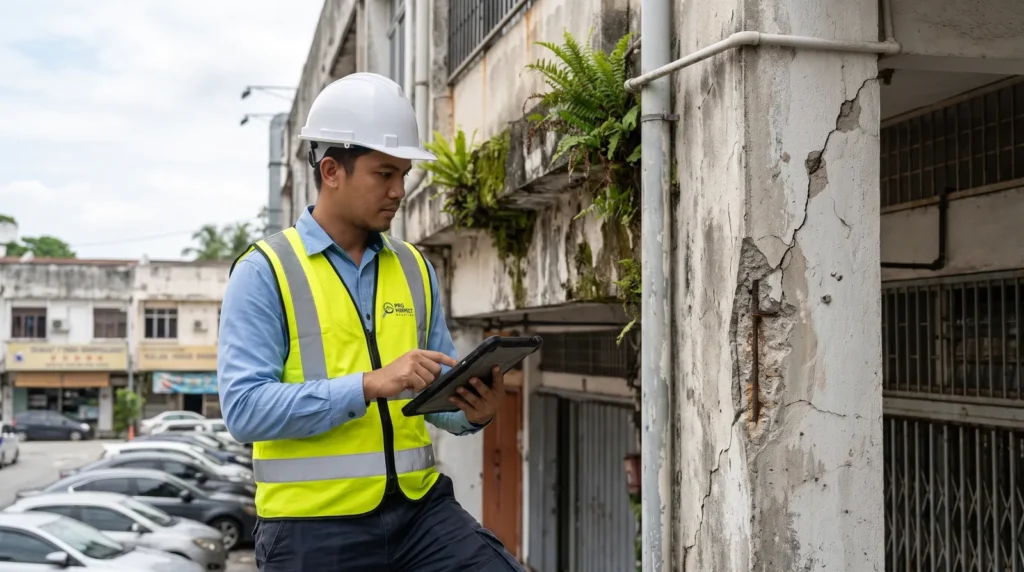
A building condition assessment (BCA) report is an engineer’s structured record of the condition of every accessible building element. Each element is rated for condition and for the maintenance action it needs, and the report then turns those ratings into a prioritised repair and maintenance plan. In Malaysia, a widely used public-sector method is the JKR condition × priority matrix. It produces a score from 1 to 25 for each defect and an overall rating from A to E for the building. This guide explains what goes into a good BCA report and how the ratings are worked out, with a worked example. It also covers how owners, JMBs and facility managers can use the result.
What a building condition assessment report contains in Malaysia, how the JKR 5×5 matrix rates defects, and how ratings become a repair plan.
01What a Building Condition Assessment Report Is (and Is Not)
A BCA is a planned, mostly visual inspection of a building’s structure, envelope, roof, finishes and external works. Testing is added where the findings call for it. The report answers three questions: what condition each element is in, how serious each defect is, and what should be done and when.
BCA vs Section 85A Periodic Inspection
A BCA is not the same as the statutory periodic inspection under Section 85A of the Street, Drainage and Building Act 1974 (Act 133) [1].
| Building condition assessment | Section 85A periodic inspection | |
|---|---|---|
| Trigger | The owner’s choice: maintenance planning, refurbishment, due diligence, insurance | Statutory: buildings of more than five storeys, on notice from the local authority after the building’s 10th year, then at intervals of not more than 10 years |
| Who inspects | Engineer-led; a Professional Engineer endorses it where an opinion on structure is given | A Professional Engineer appointed by the owner |
| Format | The consultant’s report format | The local authority’s own forms and heading order |
| Output | Defect schedule, ratings, repair priorities, budget input | Submission to the local authority |
A BCA can feed into Section 85A work, but it does not replace it. For the statutory side, see our guide to periodic building inspection in Malaysia.
BCA vs Pre-Purchase Inspection and Structural Investigation
A pre-purchase inspection focuses on one unit, before a buyer commits. A structural investigation is a detailed engineering study of a specific concern, often with testing and calculations. A BCA sits between the two: it covers the whole building at a consistent level of detail and flags the items that need a deeper look.
Who Signs the Report
No statute reserves a voluntary, non-statutory condition survey for one profession. Building surveyors also carry out condition surveys under their own codes of practice. Once a report gives an opinion on structural adequacy, or will support an authority submission or a structural repair design, it should be endorsed by a Professional Engineer with a Practising Certificate (PEPC). Our BCA reports are endorsed by a Professional Engineer with a Practising Certificate (PEPC).
02The Malaysian Framework Behind Condition Assessment
Owners’ Duties Under Act 133 and Act 757
- Act 133: Section 85A sets the periodic inspection duty described above. Section 83 lets the local authority require an owner to repair or demolish a dangerous or ruinous building [1].
- Act 757: in strata buildings, the Strata Management Act 2013 requires the joint management body to keep the building and common property in a state of good and serviceable repair (s.21). It also sets up a sinking fund for capital works such as repainting and replacement (s.24), with contributions of not less than 10% of the charges (s.25) [2].
A BCA gives the committee the evidence it needs to plan that spending.
The JKR Condition Assessment Guideline
JKR’s Garis Panduan Pemeriksaan dan Penilaian Keadaan Bangunan Sedia Ada (JKR 21602-0004-13, 2013) is a widely used public-sector method in Malaysia [3]. It rates each defect for condition and maintenance priority on a 5 × 5 matrix, and is the system used in the worked example below.
International References
Two international references sit alongside it:
- ASTM E2018-24: the US guide to property condition assessments for commercial property. It states that its use is strictly limited to its defined scope [4].
- ISO 15686: the international framework for service-life planning. It helps when a report estimates remaining service life [5].
Peer-reviewed Malaysian work on the condition survey protocol (CSP1) matrix uses the same condition × priority idea [6].
03How Condition Is Rated: The JKR 5 × 5 Matrix
Condition Score (1 to 5)
| Score | JKR term | JKR meaning (English gloss) |
|---|---|---|
| 1 | Sangat Baik (very good) | No defects; very good condition; functions well |
| 2 | Baik (good) | Minor defects or damage; functions well |
| 3 | Sederhana (moderate) | Major defects or damage; still functions but must be monitored |
| 4 | Kritikal (critical) | Critical; cannot function to the agreed service level |
| 5 | Sangat Kritikal (very critical) | Does not function; risk of accident or injury |
Priority Score (1 to 5)
JKR’s maintenance priority runs 1 Normal, 2 Rutin (routine), 3 Pembaikan (repair), 4 Pemulihan (rehabilitation) and 5 Penggantian (replacement) [3].
Matrix Score and Building Rating
Each defect’s matrix score is condition × priority, so it runs from 1 to 25. The building score is the total of all matrix scores divided by the number of defects recorded. The building is then rated on the JKR bands [3]:
| Rating | Building score | Typical action |
|---|---|---|
| A – Sangat Baik | 1–5 | Scheduled maintenance |
| B – Baik | 6–10 | Condition-based maintenance |
| C – Sederhana | 11–15 | Repair |
| D – Kritikal | 16–20 | Rehabilitation |
| E – Sangat Kritikal | 21–25 | Replacement |
Do not confuse this with BARIS. Section 85A reports in some local authorities use BARIS, the building surveyors’ Building Assessment Rating System. BARIS multiplies a condition score (1–5) by a priority score (1–4), so its matrix tops out at 20, and its bands are 1–4 Good, 5–12 Fair and 13–20 Dilapidated. A report should state which system it uses and never mix the two.
Worked Example: Ten Defects in a Mid-Rise Strata Block (Mock Data)
Illustrative only. The building and defects are invented to show the method.
| # | Element and defect | Condition | Priority | Matrix score |
|---|---|---|---|---|
| 1 | Façade: hairline cracks in render | 2 | 1 | 2 |
| 2 | Roof: blocked gutter and outlets | 3 | 2 | 6 |
| 3 | Roof: membrane blistering | 3 | 3 | 9 |
| 4 | Car park: soffit spalling with exposed bars | 4 | 4 | 16 |
| 5 | Façade: loose render above a walkway | 5 | 4 | 20 |
| 6 | Staircase: corroded handrail fixings | 3 | 3 | 9 |
| 7 | Lobby: hollow-sounding floor tiles | 3 | 3 | 9 |
| 8 | Water tank: corroded steel supports | 4 | 3 | 12 |
| 9 | Common corridor: flaking paint | 2 | 2 | 4 |
| 10 | Windows: failed perimeter sealant | 3 | 3 | 9 |
| Total | 96 |
Building score = 96 ÷ 10 = 9.6, rating B (Baik).
The lesson in this example: an average can look comfortable while two items need urgent action. Item 5 (loose render over a walkway) and item 4 (spalling with exposed bars) score 20 and 16. A good report lists them first and acts on them regardless of the building rating. The overall rating tells you about the building’s general state, and the individual scores tell you what to do first.
04Elements Inspected and the Defects Engineers Look For
For a typical mid-rise strata building, the inspection covers all safely accessible areas of:
- roof structure, coverings, waterproofing and rainwater goods
- external façade, windows and curtain wall
- columns, beams, slabs and soffits, walls, staircases and ramps
- basement and car park
- common-area finishes and wet areas
- water tanks and their supports
- additions and alterations, such as extensions or added loads
- external works, drains, slopes and retaining walls
Visual-only items: plumbing, electrical rooms and fire and life-safety items such as exit signs, emergency lights, fire doors and escape routes are noted visually. Testing of electrical, fire and lift installations is the job of the registered competent persons under the Energy Commission, Bomba and DOSH.
Reading Cracks
Crack width alone does not decide severity. Pattern, location and whether the crack is still moving matter just as much.
- Reinforced concrete: the Malaysian National Annex to MS EN 1992-1-1 limits design crack width to around 0.3 mm for most exposure classes (0.4 mm for dry interiors) under quasi-permanent load. Cracks wider than about 1 mm, or any crack that is still moving, usually call for investigation.
- Masonry and plaster: BRE Digest 251 groups visible damage into categories 0 to 5 by ease of repair. Category 3 (about 5–15 mm) and above are no longer cosmetic [7].
- Location matters: a diagonal crack near a beam support needs an engineer however narrow it is.
For crack patterns and causes, see cracks in walls.
05Field Methods and Testing Used in a BCA
Visual Survey and Referencing
Every defect is tied to a gridline or element ID, photographed with a scale and logged with its rating. The aim is to let anyone return to the same spot later.
When to Escalate to Testing
Testing is agreed with the owner as an add-on. The engineer recommends it when the visual findings justify it:
| Finding | Typical testing |
|---|---|
| Rust staining, cracks along bars, spalling | Cover survey (BS 1881-204), carbonation depth (BS EN 14630) and half-cell potential (ASTM C876-22b) [8], with a break-out to confirm bar condition |
| Hollow-sounding render, tiles or cover | Tap survey and break-out at representative spots; thermal imaging to screen large façades |
| Doubtful concrete quality or a change of use | Rebound hammer (BS EN 12504-2:2021) and UPV (BS EN 12504-4:2021) for uniformity, then cores (BS EN 12504-1:2019) for strength |
| Cover suspected below specification | Covermeter grid compared with the specified cover for the exposure class |
Rebound hammer and UPV readings are not converted into concrete strength unless they are correlated with cores from the same structure, as BS EN 13791:2019 requires [9]. On their own, they show uniformity and where to core. Our reinforced concrete inspection guide covers these tests, and our concrete technology team runs them.
Drone and Thermal Imaging
- Drone images: a reliable visual record that a visible defect exists and where it is.
- Crack widths from drone images: not treated as measured unless the image scale has been verified.
- Thermal imaging: a screening tool. Anomalies are confirmed by tapping or a moisture meter before they are reported as defects.
- Cause and extent: neither drone nor thermal results prove these on their own.
06Anatomy of a Good BCA Report
A sound BCA report includes:
- Scope and limitations. The report records conditions on the inspection date only. It covers visible and safely accessible areas, and every area not inspected is listed with the reason. Concealed and inaccessible defects may exist and are outside the report. Instrument readings are indicative. The report is not a warranty and not a structural design check.
- Defect schedule. For each defect: location, photo, likely cause where it can be judged visually, condition, priority, matrix score and recommended action.
- Building rating. The method used (JKR or BARIS), the building score and the rating.
- Repair priority plan. See the next section.
- Endorsement. By a Professional Engineer with a Practising Certificate where structural opinions are given.
Red flags in a weak report:
- no stated method or rating system
- photos not tied to locations
- no list of areas not inspected
- generic wording copied from building to building
07Turning Ratings Into a Repair Plan
The ratings become an action plan. Anything unsafe is made safe straight away. Our planned repair timeframe is 6 to 24 months, and the other items are sequenced around it:
| Response | Timeframe | Typical defects (from the example) |
|---|---|---|
| Make safe | Straight away – anything unsafe is made safe first | Loose render over a walkway (item 5): cordon off and remove loose material |
| Repair or investigate first | Ahead of planned works, as the engineer advises | Spalling with exposed bars (item 4); corroded tank supports (item 8) |
| Planned repair | Within 6 to 24 months | Roof membrane (3), handrail fixings (6), hollow tiles (7), sealant (10), gutters (2) |
| Maintenance | Through the normal maintenance programme | Hairline render cracks (1), flaking paint (9) |
The plan then feeds the maintenance budget, the sinking fund forecast and a tender scope. If items in the “repair or investigate first” group point to a structural problem, the next step is a detailed investigation and repair design. That is where our structural repair consultancy comes in.
Frequently Asked Questions
What is included in a building condition assessment report?
Scope and limitations, a defect schedule with photos and locations, condition and priority ratings, a building rating, a repair priority plan and the endorsing engineer’s details.
How is a building condition rating calculated?
Under the JKR method, each defect gets a condition score (1–5) and a priority score (1–5). Multiplying them gives a matrix score of 1–25. The building score is the total divided by the number of defects, and it is rated A to E.
How often should a building condition assessment be done in Malaysia?
There is no single statutory interval for a voluntary BCA. Many owners commission one before major budgeting, refurbishment or a change of use, and at regular intervals as the building ages. Buildings of more than five storeys also fall under the Section 85A periodic inspection cycle.
Is a BCA the same as the Section 85A periodic inspection?
No. Section 85A is a statutory inspection by a Professional Engineer appointed by the owner, in the local authority’s format. A BCA is a voluntary assessment for planning and maintenance, although it can support Section 85A work.
Does a BCA include material testing?
Not by default. The engineer recommends testing, such as cover, carbonation, rebound hammer, UPV or cores, where visual findings justify it, and it is agreed as an add-on.
How long does a BCA take for a mid-rise condominium?
It depends on size, access and whether testing is included. Site work is usually measured in days, and the report follows after. Ask for a programme with your quotation.
Who can sign a building condition assessment report in Malaysia?
A voluntary condition survey is not reserved for one profession. Where the report gives a structural opinion or supports an authority submission or repair design, it should be endorsed by a Professional Engineer with a Practising Certificate.
08Talk to Us About Your Building
If you manage a building and need a clear, rated picture of its condition, our engineers can scope a building condition assessment for you. We also cover building condition assessment in KL and Selangor. WhatsApp us at wa.me/60168064902, call +60 16-806 4902 or email inspectsolution.pro@gmail.com.
References
- [1] Street, Drainage and Building Act 1974 (Act 133), Laws of Malaysia, reprint. [Online]. Available: https://www.ppj.gov.my/storage/7476/133—STREET,-DRAINAGE-AND-BUILDING-ACT-1974.pdf
- [2] Strata Management Act 2013 (Act 757), Laws of Malaysia. [Online]. Available: https://www.ppj.gov.my/storage/7465/Act-757–Strata-Management-Act-2013.pdf
- [3] Jabatan Kerja Raya Malaysia, Garis Panduan Pemeriksaan dan Penilaian Keadaan Bangunan Sedia Ada, JKR 21602-0004-13. Kuala Lumpur, Malaysia: JKR, 2013. [Online]. Available: http://epsmg.jkr.gov.my/images/5/52/GARIS_PANDUAN_PEMERIKSAAN_PENILAIAN_KEADAAN_BANGUNAN_SEDIA.pdf
- [4] Standard Guide for Property Condition Assessments: Baseline Property Condition Assessment Process, ASTM E2018-24, ASTM International, West Conshohocken, PA, USA, 2024. [Online]. Available: https://store.astm.org/e2018-24.html
- [5] Buildings and Constructed Assets – Service Life Planning, ISO 15686-1:2011, -2:2012 and -7:2017, International Organization for Standardization, Geneva, Switzerland. [Online]. Available: https://www.iso.org/obp
- [6] A. I. Che-Ani, A. S. Mohd Tazilan and K. A. Kosman, “The development of a condition survey protocol matrix,” Structural Survey, vol. 29, no. 1, pp. 35–45, 2011, doi: 10.1108/02630801111118395.
- [7] R. Driscoll, Assessment of Damage in Low-Rise Buildings, with Particular Reference to Progressive Foundation Movement, BRE Digest 251, rev. ed. Watford, U.K.: BRE, 1995. [Online]. Available: https://bregroup.com/store/bookshop/assessment-of-damage-in-low-rise-buildings-progressive-foundation-movement-revised-1995-dg-251
- [8] Standard Test Method for Corrosion Potentials of Uncoated Reinforcing Steel in Concrete, ASTM C876-22b, ASTM International, West Conshohocken, PA, USA, 2022. [Online]. Available: https://store.astm.org/standards/c876
- [9] BSI, BS EN 12504-1:2019, BS EN 12504-2:2021, BS EN 12504-4:2021, BS 1881-204:1988, BS EN 14630:2006 and BS EN 13791:2019. London, U.K.: BSI. [Online]. Available: https://knowledge.bsigroup.com

Leads building inspection, concrete assessment and defect investigation work at Pro Inspect Solution, turning site findings into clear, practical guidance for owners, JMBs/MCs, developers and contractors. LinkedIn
Need a building condition assessment?
Talk to our engineers on WhatsApp or call +60 16-806 4902. Email inspectsolution.pro@gmail.com