Malaysia’s industrial sector is experiencing unprecedented growth. As highlighted in recent market analysis by The Star, Demand for industrial real estate holds steady despite rising supply, millions of square feet of modern warehousing and logistics hubs are flooding prime corridors across Shah Alam, Klang, Sepang, and the wider Klang Valley. However, with accelerated construction schedules to meet tenant handover deadlines, industrial asset owners and developers are increasingly facing a costly operational hazard: slab cracking and floor degradation.
In a high-throughput distribution centre or heavy manufacturing facility, a concrete floor slab is not merely a non-structural ground finish—it is the foundational working platform of the entire facility. When high-reach forklifts, Very Narrow Aisle (VNA) trucks, and multi-tonne pallet racks operate over cracked slabs, minor surface flaws rapidly turn into severe spalling, wheel damage, operational downtime, and legal disputes during the Defect Liability Period (DLP).
To navigate these disputes and establish liability, professional engineers rely on international benchmarks adapted for Malaysian conditions—specifically, Concrete Society TR22 and Concrete Society TR34. Understanding industrial floor crack limits TR22 TR34 is essential for property owners, logistics operators, and main contractors aiming to protect structural integrity and asset value.
1. Industrial Real Estate Expansion & Floor Slab Vulnerabilities in Malaysia
The influx of automated logistics systems, automated guided vehicles (AGVs), and high-density racking systems in Malaysia has elevated industrial floor slabs from passive concrete beds to precision-engineered structural elements. In logistics corridors like Bukit Jelutong, Westport, and Northport, floor slabs endure continuous dynamic wheel loads ranging from 5 to 12 tonnes per axle.
Malaysian climatic conditions introduce significant thermal and shrinkage challenges. High ambient temperatures combined with high relative humidity accelerate early-age moisture loss in freshly placed concrete. When improper curing practices occur alongside soft subgrade conditions—such as the marine clay deposits prevalent in Klang and Telok Gong—slabs experience differential movement, restraint stresses, and shrinkage cracking.
During a comprehensive property defect inspection (DLP), building owners and tenants frequently debate whether visible floor cracks constitute structural failures or acceptable concrete behavior. Disentangling cosmetic surface imperfections from active structural risks requires applying the dual engineering frameworks of Concrete Society TR22 and Concrete Society TR34.
2. Concrete Society TR22: Non-Structural Crack Classification & Limits
Concrete Society TR22 (Non-structural Cracks in Concrete) serves as the primary engineering reference for diagnosing cracks that occur independently of applied structural loading. In Malaysian factory floor inspection projects, TR22 provides the framework to categorise cracks arising from material properties, thermal response, and moisture loss during early hydration and long-term drying.
Primary Crack Types Under TR22
- Plastic Shrinkage Cracking: Occurs within 1 to 6 hours of placement when surface evaporation rates exceed bleed water rise, commonly driven by Malaysia’s intense heat and high airflow in open portal frame structures.
- Plastic Settlement Cracking: Formed over top reinforcement bars, ductings, or aggregate boundaries due to concrete consolidation while still in a plastic state.
- Early Thermal Contraction Cracking: Caused by thermal gradients as mass concrete cools following peak heat of hydration, particularly in thick uninsulated slab castings exceeding 250 mm.
- Drying Shrinkage Cracking: Long-term volume reduction caused by loss of moisture over months, typically appearing at un-cut stress points or distant joint intersections.
TR22 Crack Width Acceptance Limits
TR22 establishes baseline crack width thresholds based on durability, aesthetic acceptance, and environmental exposure:
- Hairline Cracks (< 0.1 mm): Generally considered structurally non-consequential and acceptable without remedial sealing in dry interior environments.
- Minor Non-Structural Cracks (0.1 mm to 0.3 mm): Acceptable in general building envelopes, provided environmental aggressive agents (e.g., chemical spills or moisture) are absent. However, in industrial applications, these require monitoring to prevent edge deterioration.
- Significant Non-Structural Cracks (> 0.3 mm): Exceed standard durability limits for reinforced concrete under Eurocode / Malaysian practice, requiring professional sealing to prevent ingress of moisture, oils, and aggressive salts that corrode underlying mesh or dowels.
3. Concrete Society TR34: Load Dynamics, Slab Tolerances & Industrial Floor Performance
While TR22 focuses on material origin cracking, Concrete Society TR34 (Concrete Industrial Ground Floors: A guide to design and construction) governs industrial ground floor slabs subject to direct operational, dynamic wheel, and static rack loading. TR34 is the global gold standard for assessing slab structural capacity, joint performance, and surface flatness (Free Movement FM1–FM3 and Defined Movement DM1–DM3).
Why TR34 Enforces Stricter Practical Limits
Under TR34, crack width limits are evaluated not only by durability but by operational dynamic fatigue. In a heavy-duty warehouse, hard-wheeled MHE (Material Handling Equipment) crossing a 0.3 mm crack produces localized high-impact edge stresses. Over time, these dynamic wheel impacts cause edge spalling, turning a micro-crack into a wide floor defect that causes forklift wheel damage and safety hazards.

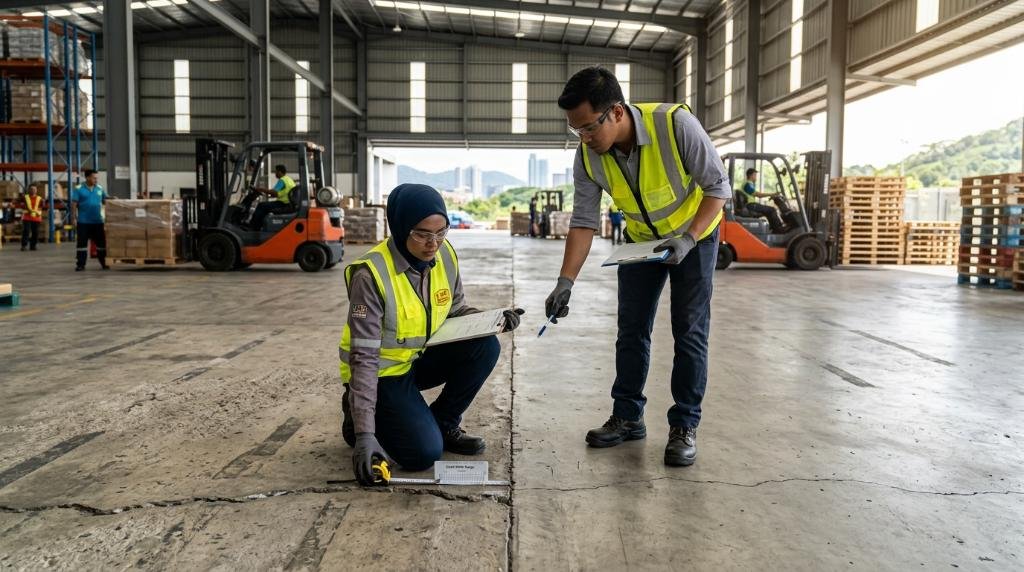
Figure 1: On-site evaluation of industrial floor slab crack width and floor flatness using optical gauges in accordance with TR34 guidelines.
Key operational thresholds under TR34 include:
- Unreinforced & Steel Fibre Reinforced Slabs (SFRC): Cracks exceeding 0.3 mm in active traffic aisles represent joint failure or overload, leading to slab rocking and load transfer loss across dowels.
- Joint Arris Stability: Any crack running parallel within 150 mm of a saw-cut control joint indicates joint locking, leading to secondary stress relief cracking across traffic routes.
- Dynamic Impact Tolerances: Micro-cracks as narrow as 0.2 mm located in VNA defined-movement tracks are considered actionable defects due to high wheel contact pressures exerted by narrow-aisle turret trucks.
4. TR22 vs TR34: Comparative Analysis & Tolerance Engineering Matrix
To assist Malaysian factory managers, developers, and project engineers during DLP audits, the primary engineering differences between Concrete Society TR22 and Concrete Society TR34 are summarized below:
| Evaluation Criteria | Concrete Society TR22 | Concrete Society TR34 |
|---|---|---|
| Primary Engineering Focus | Material diagnosis & non-structural crack classification. | Industrial floor design, dynamic loading, and operational serviceability. |
| Root Cause Analysis | Plastic shrinkage, plastic settlement, hydration heat, drying shrinkage. | Structural overload, subgrade settlement, joint locking, MHE wheel impact. |
| Standard Crack Limit (Interior) | Up to 0.3 mm (Durability threshold for rebar corrosion). | 0.2 mm to 0.3 mm maximum in traffic routes before structural remediation. |
| Traffic & Dynamic Loading Consideration | Not evaluated; assumes static environmental exposure. | Critical; accounts for hard-wheel MHE contact pressures & edge spalling risk. |
| Remedial Urgency Indicator | Based on environmental aggressiveness & moisture exposure. | Based on MHE speed, aisle classification (FM/DM), and spalling velocity. |
Determining whether a floor slab defect falls under TR22 or TR34 requires precise spatial and structural verification. Engaging professional as-built survey & drawing services allows engineers to overlay observed crack patterns against saw-cut joint layouts, pile positions, and subgrade beam grids to pinpoint the true mechanism of failure.
5. Malaysian Standards, CIDB Guidelines & Statutory Frameworks
In Malaysia, industrial facility compliance operates under overlapping legal and technical frameworks. While TR22 and TR34 supply technical guidance, local legal and technical governance relies on key statutory guidelines:
- Street, Drainage and Building Act 1974 (Act 133): Outlines developer and legal structural obligations for overall building stability and public safety under the jurisdiction of local councils (e.g., MBSA, MPK, MBPJ). Statutory details are governed under Street, Drainage and Building Act 1974 (Act 133).
- CIDB Standard Guidelines: The Construction Industry Development Board sets quality benchmarks through CIS publications and quality assessment systems (QLASSIC), enforcing crack limits on finished concrete structures as detailed on the CIDB Technical Guidelines portal.
- Occupational Safety and Health: Under Department of Occupational Safety and Health regulatory oversight, severe floor spalling or unlevel slabs that present forklift tipping risks violate industrial workplace safety requirements under DOSH Malaysia Standards.
- MS EN 1992-1-1 (Eurocode 2): The Malaysian Standard code of practice for concrete structures, which caps quasi-permanent combination crack widths at $w_{max} = 0.3\text{ mm}$ for standard exposure classes.
6. Engineering Diagnostics & Structural Repair Solutions
When an industrial floor inspection in KL or Selangor identifies cracks exceeding allowable limits, immediate structural intervention is required to prevent progressive floor disintegration. A generic surface coating or cementitious patch will rapidly fail under dynamic forklift traffic.

Figure 2: Professional repair execution showing low-viscosity resin pressure injection and semi-rigid polyurea joint filler installation.
Approved Engineering Repair Methodologies
- Low-Viscosity Epoxy Pressure Injection: Recommended for dormant structural cracks (> 0.2 mm) to restore full monolithic compressive and tensile strength across the slab depth.
- Semi-Rigid Polyurea / Epoxy Joint Fillers: Applied to active drying shrinkage cracks or breakdown arris joints in heavy traffic aisles. The material provides edge support under hard wheels while accommodating minimal thermal expansion.
- Carbon Fibre Reinforced Polymer (CFRP) Stitching: Utilised where floor slabs suffer structural load capacity loss over soft subgrades. CFRP rods or laminates are embedded across the crack plane to restore flexural capacity.
- Subgrade Pressure Grouting & Slab Jacking: Where differential settlement occurs on soft coastal alluvium, polyurethane or cementitious resin is injected beneath the slab to fill voids and re-establish uniform subgrade support.
Executing these works without expert assessment can cause locked movement joints and secondary cracking. Property owners should consult experienced structural repair consultancy specialists to engineer fit-for-purpose repair specifications prior to undertaking remedial works.
7. Frequently Asked Questions (FAQ)
What is the acceptable concrete floor crack width for industrial warehouses in Malaysia?
Under general durability standards (MS EN 1992 / BS 8110), non-structural cracks up to 0.3 mm are permissible for general concrete. However, under Concrete Society TR34 for industrial ground slabs with dynamic forklift traffic, cracks exceeding 0.2 mm to 0.3 mm in traffic aisles require immediate sealing to prevent joint arris spalling and floor breakdown.
What is the main difference between Concrete Society TR22 and TR34?
TR22 focuses on classifying and diagnosing non-structural cracks caused by intrinsic material behavior (plastic shrinkage, thermal contraction, drying shrinkage). TR34 focuses on structural design, operational floor load capacity, surface regularity, and long-term dynamic wheel performance of concrete industrial ground floors.
Can industrial developers reject factory handovers due to slab floor cracking during DLP?
Yes. If cracks exceed the allowable width limits specified in TR34/TR22, impair floor flatness (FM1–FM3 tolerances), or indicate subgrade settlement under CIDB / Act 133 provisions, the asset owner or tenant can issue a formal defect notice during the Defect Liability Period (DLP) requiring certified engineering rectification.
How are dynamic wheel loads evaluated when assessing slab crack severity?
Engineers evaluate MHE wheel type (polyurethane, rubber, or steel), wheel contact pressure, axle load, and daily traffic frequency. Under TR34, even small cracks subjected to continuous hard polyurethane wheel impacts undergo severe high-frequency fatigue, accelerating edge breakdown faster than static floors.
Need Certified Property Inspection or Building Audit Services?
Get instant consultation and professional engineering advice from Pro Inspect Solution.