
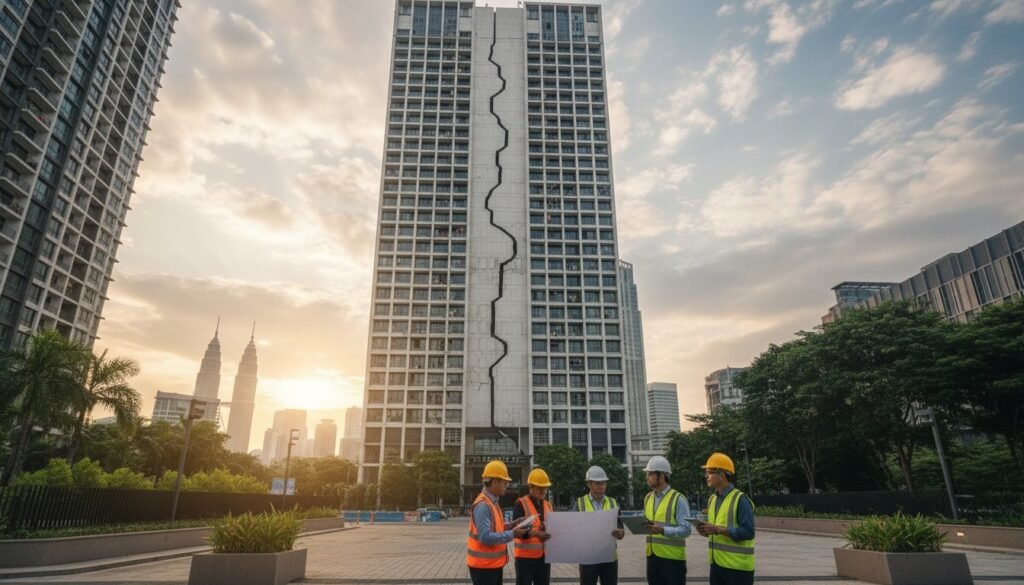
KUALA LUMPUR, April 28, 2026 — By Ir Vimal, Professional Engineer
Expert insights from Pro Inspect Solution on building safety, property defects, and structural integrity in Malaysia.
The skyline of Kuala Lumpur is a testament to Malaysia’s rapid urban development. However, beneath the gleaming facades of newly handed-over high-rises, property owners and Joint Management Bodies (JMBs) are increasingly grappling with a persistent issue: mysterious wall cracks. When a hairline fissure appears in your brand-new unit, the immediate question is a matter of safety and financial liability. Understanding the critical differences between a surface crack vs structural crack is the first step every property owner must take to protect their investment and ensure structural safety.
At Pro Inspect Solution, we have assessed hundreds of commercial and residential buildings across the Klang Valley. Whether you are dealing with minor plastering flaws or severe foundational shifts, knowing how to categorize these anomalies can save you from catastrophic structural failure and costly legal disputes.
The Rising Concern of KL Condo Defects
In recent years, the acceleration of construction timelines has inadvertently led to a spike in KL condo defects. With property owners becoming more educated on their rights during the Defect Liability Period (DLP), social media is frequently flooded with complaints regarding shoddy workmanship, water leakages, and alarming wall cracks.
The Malaysian Construction Industry Development Board (CIDB) has actively promoted the Quality Assessment System in Construction (QLASSIC) to benchmark workmanship quality. Despite these efforts, post-construction defects remain a highly debated topic. High-rise developments are particularly susceptible to wind loads, temperature fluctuations, and slight soil settlements, all of which contribute to the appearance of structural distress.

Understanding the Baseline: Surface Crack vs Structural Crack
Not all cracks are created equal. Broadly speaking, engineers classify them into two main categories: non-structural (surface) and structural. Distinguishing between a surface crack vs structural crack is fundamental during any comprehensive Building Condition Assessment.
While surface cracks are predominantly aesthetic and simple to rectify, structural cracks are indicators of deep-seated issues that compromise the load-bearing capacity of a building’s framework, potentially leading to catastrophic consequences if ignored.
Identifying Surface Level Cracks
Surface cracks, also known as non-structural cracks or hairline cracks, are typically confined to the building’s aesthetic finishes, such as the plaster or paint layer. They do not penetrate the underlying brickwork or concrete frame.
Common Causes of Surface Cracks
- Shrinkage: As plaster or concrete cures, the evaporation of water causes the material to shrink slightly, resulting in fine, map-like cracking.
- Thermal Movement: In Malaysia’s tropical climate, the rapid expansion and contraction of building materials due to intense sun exposure and sudden rainfalls cause minor surface fractures.
- Poor Workmanship: Inadequate curing times or incorrect water-to-cement ratios during plastering are common culprits.
If you discover these anomalies during your handover, it is highly recommended to engage in a professional Property Defect Inspection (DLP) to compel the developer to patch and repaint these areas before your warranty expires.
Warning Signs of Structural Cracks
Structural cracks are vastly more dangerous. They occur in the load-bearing elements of a building, such as beams, columns, load-bearing walls, and foundation slabs. A true structural crack is an early warning sign of impending structural failure.

Key Indicators of a Structural Crack
- Width and Depth: Cracks wider than 2mm to 3mm that appear to grow over time, or cracks where you can insert a coin, require immediate engineering attention.
- Diagonal or Stair-Step Patterns: Cracks that run diagonally across a brick wall or follow a jagged stair-step pattern along mortar joints often indicate foundation settlement.
- Cracks in Beams and Columns: Any horizontal or vertical splitting in concrete support columns or load-bearing beams points to serious stress overloading.
- Associated Deficiencies: Doors and windows that suddenly stick or refuse to close properly, alongside sloping floors, are classic symptoms of structural shifting.
If these signs are present in your property, immediate intervention through specialized Structural Repair Consultancy is mandated to stabilize the building and prevent further degradation.
DBKL Stop Work Orders and Structural Failure Risks
The local authorities are taking a much stricter stance on construction safety. Recently, there has been an uptick in the issuance of the dreaded DBKL stop work order for developments that show signs of severe structural distress or pose threats to adjacent properties.
According to the Street, Drainage and Building Act 1974 (Act 133), local councils have the authority to halt construction and mandate immediate structural integrity audits if a site is deemed unsafe. For developers and adjacent property owners, conducting a proactive Dilapidation Survey before nearby construction begins is a crucial legal safeguard against unwarranted damage claims.
When structural disputes escalate between JMBs, developers, and contractors, engaging an independent engineer for Expert Witness & Dispute Resolution services becomes necessary to provide objective, court-admissible evidence regarding the exact nature and cause of the defects.
Why Building Inspection in Malaysia is Non-Negotiable
Whether you are dealing with a new high-rise or an aging commercial complex, regular maintenance and compliance are mandatory. For older buildings, local authorities enforce the Pemeriksaan Bangunan Berkala (Periodic Inspection) under Section 85A of the Street, Drainage and Building Act to ensure ongoing structural viability.
Modern diagnostic tools have also revolutionized how we detect high-rise defects. For towering condominiums where exterior cracks are inaccessible, a Façade & Roof Inspection (Drone) allows engineers to safely and accurately map out exterior concrete spalling and structural distress.
In cases where original architectural plans are missing or outdated, an As-Built Survey & Drawing Service paired with Concrete Technology Consultancy provides an accurate baseline for retrofitting and structural strengthening works.
Frequently Asked Questions (FAQ)
What is the difference between a surface crack vs structural crack?
Surface cracks are minor, shallow fissures usually caused by plaster shrinkage or thermal movement and do not affect building stability. Structural cracks are deeper, often wider than 2mm, and indicate underlying foundation movement or structural failure that compromises safety.
What should I do if I find KL condo defects during my DLP?
You should immediately hire a certified professional for a Property Defect Inspection to officially document the issues. This documentation must be submitted to the developer for rectification before your Defect Liability Period (DLP) expires.
Can a DBKL stop work order be issued for severe structural cracks?
Yes. If severe structural failure risks are identified during a building inspection in Malaysia, local councils like DBKL (Dewan Bandaraya Kuala Lumpur) can issue a stop work order to halt operations until a full safety audit and necessary remediations are completed.
Are diagonal wall cracks dangerous?
Diagonal or stair-step cracks, especially those extending from the corners of doors or windows, are typically signs of differential foundation settlement and are classified as structural cracks. They should be evaluated by a structural engineer immediately.
Don’t Wait for a Crack to Become a Collapse
Deciphering a surface crack vs structural crack is not a guessing game. Misdiagnosing a critical structural failure as a mere cosmetic flaw can lead to devastating financial losses, voided insurance claims, and severe safety hazards. If you have concerns about KL condo defects, an impending DBKL stop work order, or require a comprehensive building inspection in Malaysia, trust the certified experts at Pro Inspect Solution.
Ready to secure your property’s structural integrity?
