
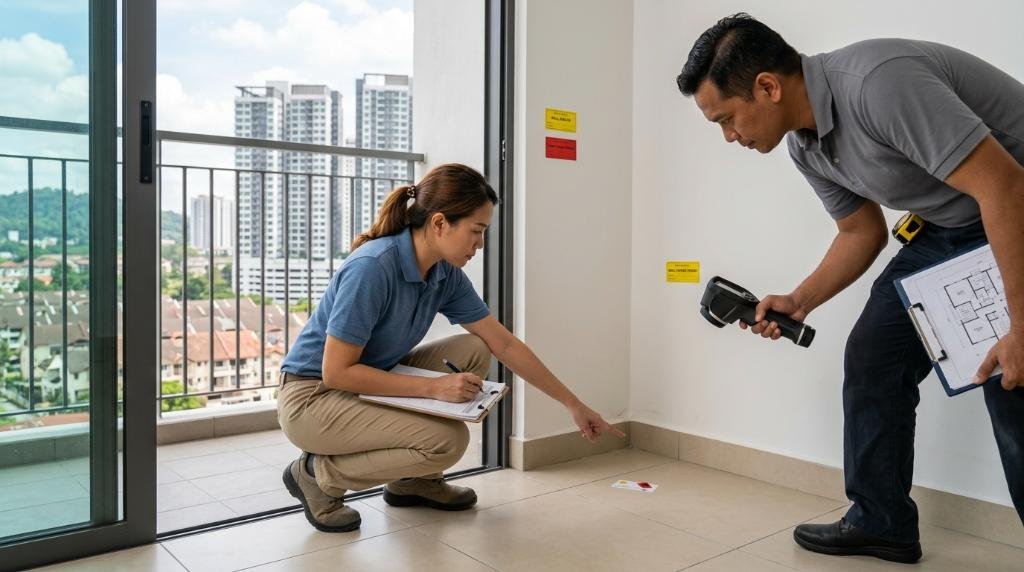
Receiving the keys to a newly completed property in Malaysia—whether a high-rise condominium in Mont Kiara or a landed township in Cyberjaya—is a major life milestone. However, the immediate transition from key collection to handover inspection often exposes new homeowners, real estate investors, and property managers to severe financial and structural risks. Learning how to inspect new house Malaysia developments correctly requires moving beyond surface-level aesthetic checks and adopting rigorous, engineering-grade diagnostic methodologies.
A recent, widely referenced industry analysis published by EdgeProp titled “What NOT to do when checking for defects” brought crucial national attention to the rampant pitfalls surrounding the Defect Liability Period (DLP). Industry data reveals that nearly 1 in every 5 newly completed properties in Malaysia harbors significant underlying failures—ranging from concealed water ingress and hollow floor tiling to severe M&E (Mechanical & Electrical) wiring discrepancies. Despite this, thousands of buyers continue to make critical DLP defect checking errors that void warranties, prolong disputes, or leave structural defects unresolved until long after the developer’s legal obligation expires.
As professional engineers registered with the Board of Engineers Malaysia (BEM), our team at Pro Inspect Solution frequently encounters homes where amateur DIY checks failed to identify systemic structural and architectural defects. In this definitive guide, we break down the top property defect inspection mistakes Malaysia buyers make, provide authentic engineering perspectives on local construction standards (such as CIDB CIS 7:2021 and UBBL 1984), and share actionable pro inspect solution advice to protect your real estate investment.
Table of Contents
- 1. The EdgeProp Context: Why DIY Defect Checks Fail in Malaysia
- 2. Mistake #1: Prioritising Cosmetic Paint Over Structural & Water Ingress Vulnerabilities
- 3. Mistake #2: Confusing CIDB QLASSIC Assessment with Individual DLP Rectification Audits
- 4. Mistake #3: Conducting Flawed DIY Testing Methods (Ponding, Tapping & Polarity)
- 5. Mistake #4: Mismanaging the HDA Schedule G/H Timeline and Developer Escrow Funds
- 6. Mistake #5: Failing to Use Calibrated Non-Destructive Testing (NDT) Equipment
- 7. Engineering-Grade Inspection vs DIY: What Malaysian Buyers Need
- 8. Frequently Asked Questions (FAQ)
1. The EdgeProp Context: Why DIY Defect Checks Fail in Malaysia
The top-referred EdgeProp expose highlighted a stark reality: most Malaysian homebuyers approach vacant possession inspections ill-equipped, relying on social media checklists and masking tape rather than technical knowledge. Many buyers step into their new homes focusing on furniture layout or kitchen design, treating the inspection as a casual walk-through rather than a technical compliance audit.
Under the statutory provisions governed by the Ministry of Housing and Local Government (KPKT) via the Housing Development (Control and Licensing) Act 1966 (HDA), residential buyers are granted a 24-month Defect Liability Period (DLP). However, as noted in the The Star property reports, developers and main contractors work under strict time and cost constraints, often leaving sub-contractor defects hidden beneath fresh coats of skim coat and emulsion paint.
When homeowners commit widespread DIY home inspection mistakes, they inadvertently sign off on latent engineering failures. To conduct a valid assessment, you must understand how local building codes, contractor practices, and tropical environmental stress intersect in Malaysian real estate.

2. Mistake #1: Prioritising Cosmetic Paint Over Structural & Water Ingress Vulnerabilities
One of the primary DLP defect checking errors made by buyers is plastering hundreds of colorful stickers over minor paint smudges, minor scuffs, or barely visible drywall inconsistencies while completely missing critical structural and moisture defects.
Differentiating Hairline Plaster Shrinkage from Structural Shear Cracks
In Malaysia’s hot and humid tropical climate, cement sand rendering undergoes initial drying shrinkage, causing non-structural hairline surface cracks (<0.3mm wide). While visually unappealing, these do not compromise the integrity of the building. Conversely, structural cracks exceeding 2.0mm in width, diagonal cracks extending from door or window lintels, or structural displacement along reinforced concrete (RC) shear walls require immediate structural evaluation.
If a building exhibits active structural cracking or structural settlement, simple developer touch-ups will fail within months. In such cases, property owners must engage certified engineers to conduct a comprehensive Building Condition Assessment rather than accepting cosmetic plaster filling.
Latent Waterproofing Failures in Wet Areas
Waterproofing leakage remains the single most destructive defect in Malaysian high-rise properties. According to empirical structural defect reports, over 60% of inter-floor leaks stem from improperly applied polyurethane (PU) liquid membranes or damaged torch-on felt membranes in wet areas (toilets, yards, and balconies). When buyers ignore floor screed slopes and membrane upturns during inspection, trapped moisture slowly migrates through slab porosity, leading to efflorescence, concrete spalling, and costly legal disputes under the Strata Management Act 2013.
3. Mistake #2: Confusing CIDB QLASSIC Assessment with Individual DLP Rectification Audits
A widespread point of confusion among Malaysian property owners—and even some contractors—is the relationship between CIDB’s QLASSIC system and individual property defect checks.
The Construction Industry Development Board (CIDB) developed the Quality Assessment System in Construction under CIS 7:2021. However, key distinctions exist between a QLASSIC evaluation and a private unit inspection:
| Feature / Parameter | CIDB QLASSIC (CIS 7:2021) | Professional DLP Defect Audit |
|---|---|---|
| Primary Objective | Statistical quality score for overall project benchmarking. | Exhaustive, 100% itemised defect list for developer rectification. |
| Sampling Method | Random statistical sampling based on Gross Floor Area (GFA). | Comprehensive room-by-room, component-by-component physical audit. |
| Legal / SPA Context | Voluntary industry quality benchmark; not part of Schedule G/H SPA. | Directly enforceable under Clause 30 of Housing Development Act (HDA). |
| Actionability | Generates a project score percentage (e.g., 80% QLASSIC score). | Generates actionable, photo-documented defect sheets for repair crews. |
Assuming that a high QLASSIC score on a developer’s marketing billboard guarantees zero defects in your specific unit is a major misstep. Every individual housing unit requires a dedicated inspection under a tailored Property Defect Inspection (DLP) workflow.

4. Mistake #3: Conducting Flawed DIY Testing Methods (Ponding, Tapping & Polarity)
When untrained buyers attempt DIY checks, their testing techniques often yield false negatives or cause accidental property damage. Here are the most frequent tactical errors encountered in the field:
1. Tap Testing for Hollow Tiles (Debonding)
Malaysian contractors frequently use the spot-bedding (“dab and daub”) technique for ceramic, porcelain, and homogenous tiles to cut material costs rather than applying full thin-set troweling with back-buttering as per MS ISO standards. Homeowners typically tap tiles with coins or keys, which produces inconsistent acoustic pitch. Professional inspectors use calibrated acoustic tapping rods to detect hollow voids beneath the tile substrate. Hollow spaces exceeding 30% of the tile surface area will crack under thermal stress and live loading, leading to tile popping (debonding).
2. Improper Water Ponding Tests
To check bathroom floor waterproofing, buyers often splash water across the floor for five minutes and assume all is well. A standard engineering flood test requires plugging floor traps and maintaining a minimum 25mm to 50mm static water head for 24 to 48 hours. This allows time for capillary migration to reveal waterproofing failure on soffit ceilings below or along adjacent drywall borders.
3. Electrical Socket & Safety RCD Verification
Plugging a phone charger into an electrical outlet only confirms power presence; it does not verify correct live-neutral-earth polarity, Earth Loop Impedance, or Residual Current Device (RCD) trip sensitivity. Missing earth wiring or reversed polarity poses severe electrocution and fire hazards under Suruhanjaya Tenaga (Energy Commission) guidelines.
5. Mistake #4: Mismanaging the HDA Schedule G/H Timeline and Developer Escrow Funds
Legal missteps during the 24-month Defect Liability Period can undermine a buyer’s leverage against recalcitrant developers.
Understanding Clause 30 under Schedule G & Schedule H
Under statutory Sale and Purchase Agreements (SPA)—Schedule G for landed property and Schedule H for strata property—Clause 30 sets clear legal mechanics for defect rectification:
- Written Notice: The purchaser must serve a written defect list detailing all non-compliances to the developer.
- 30-Day Rectification Window: The developer is legally obligated to rectify the reported items within 30 days of receiving the notice.
- Notice of Intention (Self-Rectification): If the developer fails to respond or complete repairs within 30 days, the purchaser can issue a formal 30-day notice stating their intention to engage an independent contractor.
- Escrow Deductions: The purchaser’s law firm can recover the repair costs from the 5% stakeholder retention fund held by lawyers under the HDA schedule.
A common error reported by Pro Inspect Solution clients is letting developers stall repairs past key milestones. Allowing developers to delay initial repairs beyond the 6th or 8th month after Vacant Possession (VP) exposes buyers to risk, as the first tranche of retention funds (2.5%) is released back to the developer at month 8.
6. Mistake #5: Failing to Use Calibrated Non-Destructive Testing (NDT) Equipment
Visual checks miss hidden building defects. Modern inspection protocols require professional non-destructive testing (NDT) instruments to uncover concealed issues:
- Infrared Thermal Imaging Cameras: Detect sub-surface moisture accumulation, insulation gaps, and electrical overheating inside distribution boards (DB boxes) without breaking plaster or drywall.
- Pinless & Pin Moisture Meters: Measure internal dampness percentages in concrete slabs, timber flooring, and drywall, distinguishing surface condensation from active structural leaks.
- Digital Laser Distance Meters & Cross-Line Lasers: Measure ceiling heights, wall squareness, and floor level variations against architectural specifications in Schedule 4 of the SPA.
- Digital RCD / Polarity Socket Testers: Test circuit breaker trip speeds in milliseconds under ground-fault conditions, ensuring compliance with Malaysian electrical safety codes.
7. Engineering-Grade Inspection vs DIY: What Malaysian Buyers Need
Understanding how to inspect new house Malaysia developments involves knowing when DIY checks are insufficient. While checking cabinet door alignment or minor paint marks is straightforward, assessing structural movement, inter-floor seepage, and electrical distribution requires engineering expertise.
By engaging certified professionals from Pro Inspect Solution, property owners receive comprehensive engineering reports. Our team provides clear technical documentation referencing Malaysian Standards (MS) and the Uniform Building By-Laws (UBBL), giving developers actionable repair instructions and protecting your legal remedies.
Whether you require a residential Property Defect Inspection (DLP) for a new handover or a detailed Building Condition Assessment for commercial or aging assets, seeking qualified engineering guidance is essential to safeguarding your property.
8. Frequently Asked Questions (FAQ)
Q1: What are the most common DIY home inspection mistakes in Malaysia?
The most common mistakes include focusing exclusively on cosmetic paint scuffs while ignoring hidden waterproofing leaks, failing to perform 24-to-48-hour bathroom ponding tests, using coins instead of calibrated tapping rods to check for hollow tiles, and confusing project-level QLASSIC quality scores with unit-specific defect lists.
Q2: Is a CIDB QLASSIC inspection the same as a DLP defect audit?
No. QLASSIC (CIS 7:2021) is a statistical sampling framework designed to rate a contractor’s overall project workmanship. A DLP defect audit is a 100% itemised physical and functional inspection of your individual property, generating actionable repair schedules under Clause 30 of the Housing Development Act (HDA).
Q3: How long does the Defect Liability Period (DLP) last in Malaysia?
Under Schedule G and H of the Housing Development Act 1966, the statutory DLP lasts for 24 months from the date you receive Vacant Possession (VP) and keys to your residential unit.
Q4: Can I engage a third-party contractor to fix defects if the developer delays?
Yes. If the developer fails to rectify written defects within 30 days, you can issue a formal 30-day notice of your intention to repair them independently. After completing the repairs, your lawyer can claim reimbursement from the 5% stakeholder retention fund held under HDA regulations.
Q5: Why should I hire a professional engineer for property defect inspection in Malaysia?
Professional engineers utilize specialized tools—including thermal cameras, acoustic tapping rods, and electrical polarity analyzers—to identify latent defects like sub-surface water migration, tile debonding, and structural cracks before your warranty expires.
Need Certified Property Inspection or Building Audit Services?
Get instant consultation and professional engineering advice from Pro Inspect Solution.
