
Kuala Lumpur, Malaysia — April 9, 2026 | By Ir Vimal
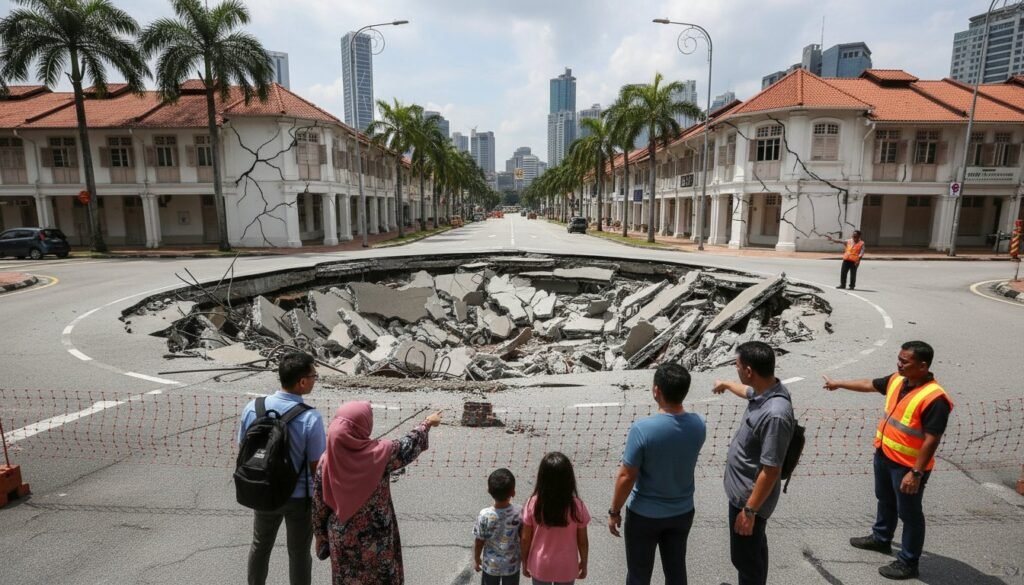
In recent months, a surge in KL sinkhole news has dominated headlines and sparked widespread anxiety across the Klang Valley. With changing climate patterns, heavy tropical monsoons, and Kuala Lumpur’s underlying karst limestone geology, sudden soil settlements and road collapses have become a highly publicized reality. For everyday citizens, this is a safety concern. But for developers, contractors, and neighboring property owners, it has triggered a volatile wave of property damage claims in Malaysia.
When a sinkhole or sudden soil depression occurs near a residential or commercial area, panic ensues. Property owners naturally begin scrutinizing their buildings for hairline cracks, tilted floors, or water leaks. The immediate instinct? Blame the closest construction site. This phenomenon has led to an unprecedented rise in construction defect disputes in KL, where developers are often unfairly accused of causing dilapidation that may have existed for years or was caused by natural geological shifts.
To navigate this legal and financial minefield, developers and property owners are increasingly relying on one critical, non-negotiable step: a comprehensive Dilapidation Survey Malaysia.
Table of Contents
- The Ripple Effect of KL Sinkhole News
- How Sinkholes Trigger Unfair Neighboring Construction Damage Claims
- The Solution: Dilapidation Survey Malaysia Explained
- Why Developers Need a Pre-Construction Condition Survey
- When Disputes Escalate: Expert Witness & Defect Assessment
- Frequently Asked Questions (FAQs)
- Protect Your Project Today
The Ripple Effect of KL Sinkhole News
Kuala Lumpur’s unique topography—built extensively over subterranean limestone caves and old mining pools—makes it geographically susceptible to sinkholes. As reported recently by major publications like The Star, urban decay, burst underground utility pipes, and deep excavation projects all contribute to changes in groundwater levels, which can trigger sudden soil collapse.
However, the intense media coverage of these incidents has created a hyper-vigilant public. Homeowners living adjacent to new high-rise developments or MRT infrastructure projects are hyper-aware of ground vibrations. Every time a piling machine operates, neighboring residents fear that a sinkhole is imminent, leading to rapid complaints to local municipal councils like DBKL (Dewan Bandaraya Kuala Lumpur).

How Sinkholes Trigger Unfair Neighboring Construction Damage Claims
The correlation between geological anxiety and legal action is undeniable. When a sinkhole appears in the vicinity of a project, contractors often face an avalanche of neighboring construction damage complaints. Residents will point out structural cracks, spalling concrete, or misaligned doors, claiming they are a direct result of adjacent foundation works or water table disruption.
The reality is often quite different. In many cases, these defects are the result of natural building aging, poor initial workmanship, or thermal expansion. Without a professional Building Condition Assessment, it is incredibly difficult to differentiate between long-standing wear-and-tear and actual damage caused by construction vibrations or soil settlement.
The Solution: Dilapidation Survey Malaysia Explained
To prevent these unfair accusations, the construction industry relies on a preventative legal and engineering tool known as a Dilapidation Survey. Also referred to as a pre-construction condition survey, this is an exact, highly detailed photographic and written record of the existing condition of all properties surrounding a planned construction site before any heavy machinery is mobilized.
Conducted by certified independent engineers, this survey documents every existing crack, water stain, structural flaw, and aesthetic defect. If a homeowner later attempts to file property damage claims Malaysia alleging that your construction project caused a massive crack in their retaining wall, the dilapidation report serves as undeniable baseline evidence. If the crack was documented in the pre-construction survey, the claim is instantly invalidated.
At Pro Inspect Solution, we utilize advanced technologies, including high-resolution imaging and Façade & Roof Drone Inspections, to capture areas of neighboring properties that are otherwise inaccessible, ensuring a 100% comprehensive baseline record.
Why Developers Need a Pre-Construction Condition Survey
For developers and main contractors in Malaysia, skipping a dilapidation survey to save on upfront costs is a catastrophic financial risk. The benefits of conducting this survey include:
- Compliance with Local Authorities: Councils like DBKL and MBPJ, aligned with CIDB (Construction Industry Development Board) guidelines, increasingly mandate these surveys for Development Order (DO) approvals.
- Risk Mitigation: It acts as an insurance policy against opportunistic or paranoid neighbors who might use the recent KL sinkhole news as leverage for a payout or to issue a stop-work order.
- Baseline for Structural Repairs: If actual damage does occur due to your construction, the survey provides a clear limit to your liability. You only fix what you broke, often consulting a Structural Repair Consultancy to restore the property to its exact pre-construction state.

When Disputes Escalate: Expert Witness & Defect Assessment
Despite best efforts, construction defect disputes KL still end up in arbitration or court. When a neighboring building suffers severe settlement that they blame on your dewatering or piling activities, standard documentation might not be enough.
In these high-stakes scenarios, you require an Expert Witness. A qualified professional engineer can interpret soil investigation reports, vibration monitoring data, and the initial dilapidation survey to provide unbiased testimony. Whether it requires pulling historical As-Built Surveys & Drawings or conducting rigorous concrete testing via a Concrete Technology Consultancy, having a specialized engineering firm on your side is the ultimate defense against baseless litigation.
Furthermore, for newly handed-over properties experiencing issues, developers and buyers should look into conducting a proper Property Defect Inspection (DLP) to ensure defects are rectified legally and efficiently under the defect liability period.
Frequently Asked Questions (FAQs)
Is a dilapidation survey mandatory in Malaysia?
Yes, local municipal councils such as DBKL, MBPJ, and MBSJ frequently mandate a pre-construction condition survey before granting development approvals, particularly for projects involving deep basement excavation, demolition, or piling works near existing structures.
How does a dilapidation survey prevent unfair property damage claims?
It documents the exact condition of a neighboring property prior to nearby construction. If a homeowner claims that new cracks were caused by construction vibrations or recent sinkhole events, the dilapidation report provides timestamped photographic evidence to prove whether the defect is a new occurrence or a pre-existing condition.
Can dilapidation reports be used in Malaysian courts?
Absolutely. A professionally prepared Dilapidation Survey by certified, independent engineers serves as a crucial, legally binding document in construction defect disputes and is heavily relied upon by expert witnesses during litigation or arbitration in Malaysia.
When should I conduct a periodic building inspection?
Under the Street, Drainage and Building Act 1974 (Act 133), high-rise buildings in Malaysia should undergo a Periodic Building Inspection every 10 years to ensure structural integrity and safety, especially important in geologically sensitive areas.
Protect Your Project from Unfair Claims Today
The recent KL sinkhole events have taught the Malaysian construction industry a harsh lesson: public perception can quickly turn into legal liability. Do not let geological paranoia or opportunistic neighbors derail your project timelines and budget.
Securing a professional Dilapidation Survey Malaysia is the most cost-effective insurance a developer or contractor can buy. It protects your reputation, safeguards your bottom line, and ensures that you are only held responsible for your actual impact, not natural soil phenomena.
